Bring the last thing you have to hand over: the completed project account, the slide deck and its speaker notes, the poster, the manuscript, the brief for the executive who funded it. Each comes back inside 24 to 48 hours at doctoral register, matched to the top descriptors in your own scoring guide, with a rehearsal question set attached. This course prints as NURS-FPX9040, Doctor of Nursing Practice 5, worth 2 program points, the last of the five courses grouped as the Doctoral Capstone, taken in FlexPath inside a DNP of at least 26 program points and a minimum of 1,000 supervised practicum hours.
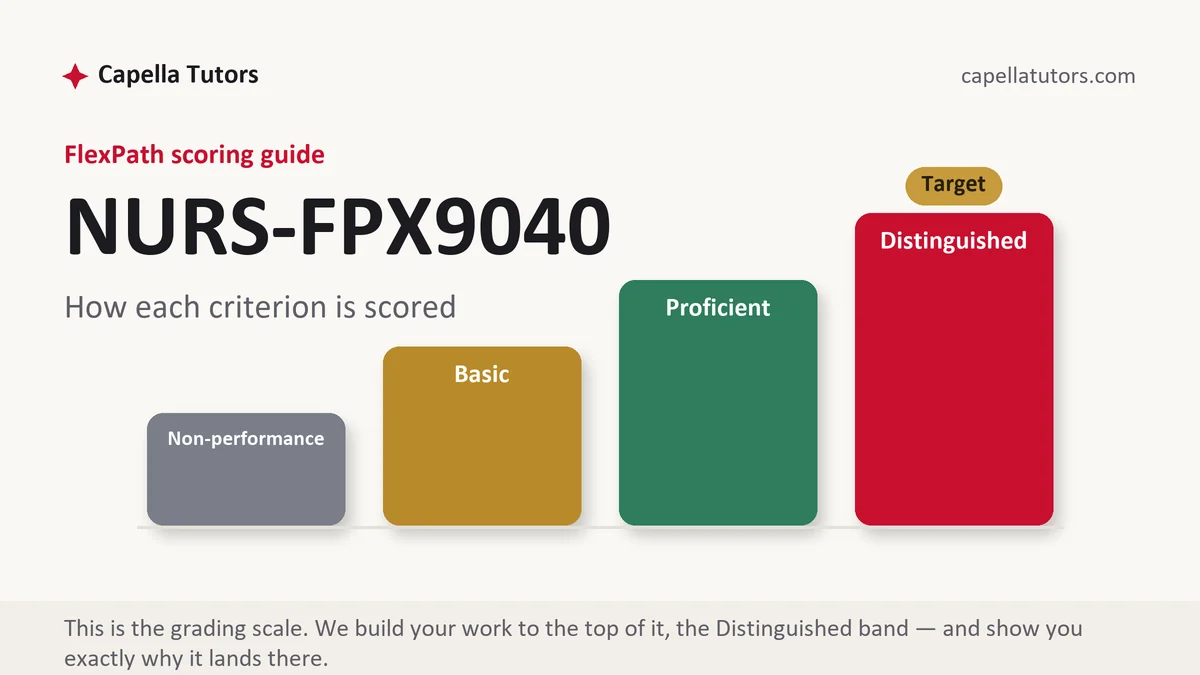
What NURS-FPX9040 actually grades
Five grades the account, not the result. A project whose measure barely moved can finish in the top column, and one with an impressive number and an unexplained method cannot, because what is evaluated at the end is whether a reader who was not there can follow the whole arc and believe it. The assessments in this course usually ask for two different objects: the complete written record, assembled so it stands alone rather than as a stack of earlier chapters stapled together, and something built to be delivered to people outside the courseroom. Programs differ on whether that second object is presented live, recorded, or submitted in writing, so read your project handbook and confirm the form with your chair rather than copying a classmate. Your scoring guide decides which it wants and how it is weighted.
The habit that costs the most points here is writing dissemination as a shortened chapter. Chapters were addressed to evaluators, who are paid to read carefully. Dissemination is addressed to people who can keep your change alive or quietly drop it, and there are three of them: the unit that has to run the thing next month, the executive who decides whether it stays funded, and the wider profession that might repeat it. Same data, three products, three openings. The formats carry hard budgets that first drafts ignore. A poster is roughly 800 words with body type no smaller than 24 point. A twenty-minute talk is twelve to fifteen slides carrying one claim each. An executive brief states the ask inside the first three lines, because the reader will not reach line ten.
The last strand is whether the work survives questions it did not choose. Whatever form your program uses, the criteria here reward an author who has already answered the awkward ones inside the document: the denominator, what else changed in the same window, what would probably have happened without the project, who owns the change now that you are leaving, and what another six months would buy. Sustainability is where nurses lose easy marks. A named successor, the standing report that keeps producing the measure, the review interval, and the threshold that triggers someone to intervene again are four sentences that turn an assignment into something a director can adopt.
How we help in this course
Our 9040 work is built for delivery rather than for filing. The deck arrives with speaker notes at spoken pace, so the timing is real rather than hopeful, and with the method slides placed where the questions land. Posters arrive inside the word budget, one figure given the space it needs and a title that states the finding. Manuscripts are set against the author guidelines of a journal you name. Every draft ships with a rehearsal set: the ten questions your limitations section invites, each with a one-sentence answer you can say without notes.
The commercial terms match the rest of the site: 24 to 48 hours per deliverable, the target set at the Distinguished descriptors, two independent quality passes inside an eight-person team, and unlimited revisions at no charge until the criterion is signed off. Evaluator feedback re-enters the cycle free, and at the end of a doctorate that note is usually a request to state a limitation you hoped to leave implicit.
How to actually write NURS-FPX9040: where to begin
Start from the guide, then reconcile backward through your earlier chapters. Every criterion becomes a heading, the top-level wording is pasted underneath, and then you check that the aim, the population, and the operational definition of the measure are worded here exactly as they were in the proposal. Mismatch between the first course and the last is the most common finding at this stage and the most avoidable. The clusters usually run along these lines: the assembled account, the results evaluated against the aim you set at the start, the dissemination product with its audience identified, and sustainability with implications for practice.
Then write the results paragraph the way a journal would accept it. Suppose the aim was to cut thirty-day readmission among heart failure discharges using a telephone contact within 48 hours. Baseline was 24 readmissions in 112 discharges over six months, 21.4 percent. During the four months the calls ran, 13 of 76 discharges came back, 17.1 percent. That is 4.3 percentage points absolute, a relative reduction of about a fifth, and a chi-square on those counts returns a p value near 0.46, nowhere close to conventional significance. With 76 discharges the evaluation could never have detected a four-point difference, so the honest sentence is that the finding is consistent with a real benefit and equally consistent with none. Now argue the other significance. At about 230 discharges a year, 4.3 points is roughly ten readmissions avoided annually, and around 23 patients called for each one prevented if the effect is real. Cost those ten against the staff time and the case is fundable or it is not.
Close by handing the work over rather than concluding it. Name what the project cannot claim before anyone asks, because a limitation you volunteer is judgment and the same limitation extracted from you is a gap. Then answer the Monday question: on the first Monday after you graduate, who runs this, which existing report produces the number, how often does someone look, and what happens when it drifts. Finish with what a different unit would have to change to repeat it, since that is the difference between a project that ends and a change that travels.
| Section | What goes in it | What Distinguished looks like |
|---|---|---|
| The assembled account | Problem, aim, evidence base, method, delivery and results in one continuous document. | Reads as a single argument, with the aim and the measure worded identically to the proposal. |
| Results against the aim | Baseline and post figures with denominators, the window, the test used and what it returned. | A point estimate with its uncertainty, and a conclusion sized to the design rather than to the hope. |
| Interpretation | What the numbers mean clinically and operationally, and where your result sits against the literature. | Statistical and practical significance separated, with the cost or workload consequence priced. |
| Limitations | Design, sample, window, concurrent events, and anything measured by proxy. | Volunteered in your own words, each with the study design that would have resolved it. |
| Dissemination product | The audience named, the format, the message that audience needs first, the call to action. | Built for its room, inside its word or slide budget, with a title that states the finding. |
| Sustainability and handoff | The owner, the report producing the measure, the review interval, the re-intervention trigger, APA both ways. | A handover a director could act on without you, and implications a second site could use. |
Developing the synthesis
The final synthesis is not another literature review. It is a conversation between one local result and the published work you started from, and it has three moves. Say where your figure agrees with the effects reported in the trials and reviews you cited. Say where it disagrees, and attribute the difference to something concrete about your setting rather than to chance: a different baseline risk, a shorter follow-up, a workforce that turned over mid-project. Then say what your project holds that the published studies did not, which is almost always operational detail, the real staffing, the real electronic record, the real caseload. Effects shrink as interventions move from trial conditions into ordinary units, so state which direction your setting should push the published estimate. One obligation governs the section: a single-site before-and-after design cannot separate your intervention from everything else in those months, so list the concurrent changes you know about, including the flattering ones.
Citations that survive faculty review
At the end of a project the sources do procedural work. A reporting guideline for improvement studies, of which SQUIRE 2.0 is the usual choice in nursing, tells you which sections a reviewer expects and in what order, and reading it before you assemble beats rebuilding afterward. If a manuscript is your dissemination product, the target journal's author guidelines outrank general advice about structure. Competency documents from the AACN and the leadership statements from AONL anchor claims about doctoral-level practice. Evidence hierarchy still applies, systematic reviews and guidelines above single studies, but a trial conducted in your population can be more useful than a review of a different one, and saying which you rely on marks an author in control of the argument. When you summarize a source, give its design and sample before its finding, because a reader cannot weigh a result reported without them. Report estimates with their intervals rather than a bare p value.
The mistakes that land Basic instead of Distinguished
- Declaring effectiveness from a raw drop or a p value alone. Direction is not evidence of cause, and a threshold is not a size.
- A dissemination product with no audience named. A compressed chapter aimed at nobody cannot satisfy a criterion about communicating to stakeholders.
- Limitations the reader finds first. Anything a panel spots before you concede it costs more than the limitation would.
- No successor. A change with no owner after you leave is a pilot, and the sustainability criterion has nothing to grade.
- An aim that drifted. If the outcome you report is not the outcome named in the proposal, the whole evaluation reads as retrofitted.
NURS-FPX9040 questions students actually ask
My outcome did not improve. Can the project still earn Distinguished?
Yes, and the top column rarely mentions the direction of the result. What it asks for is an evaluation a reader can trust: an aim stated in advance, a measure defined the same way at the end as at the start, an analysis that fits the design, and conclusions no larger than the evidence supports. A flat result explained through delivery data, the observation window, and the concurrent events at your site is a doctoral finding. An improvement announced without any of that is not. What loses points is retrofitting: quietly changing the aim to something the data happened to satisfy, or narrowing the population until the result appears. Faculty read the earlier chapters. Say what did not move, what you now believe about why, and what a unit deciding whether to keep the change should conclude.
What goes on the poster and what goes in the talk?
The poster carries the shape of the project and the talk carries the argument. On the board, budget around 800 words total, set body text no smaller than 24 point so it reads from six feet, and give the largest visual space to one figure, usually the measure over time with the start of the intervention marked. Aim, method, one figure, one table, what happens next. Nobody reads a poster standing up for six minutes, so the title should state the finding rather than the topic. In the talk, plan 12 to 15 slides for 20 minutes, one claim per slide, and spend the middle third on method because that is where the questions come from. Put limitations on a slide of their own rather than in the last bullet, since raising them yourself takes the sting out of the first question.
How do I answer a question I cannot answer?
Name the limit, say what would have answered it, and stop. A doctoral panel is testing whether you know the boundary of your own evidence, so the worst answer available is a confident guess and the second worst is a detour into what you did measure. Asked whether the change caused the improvement in a single-site pre-post project, the correct reply is that the design cannot separate your intervention from anything else in the same months, followed by the concurrent changes you know about and the comparison that would have settled it. Prepare five of these from your limitations section, one sentence each, and rehearse them out loud. The uncomfortable questions are predictable: the denominator, the concurrent changes, the counterfactual, the owner after you leave, and what you would do differently.
Final account or presentation due?
Send the criteria, your results, and the audience. Deck, poster and rehearsal questions come back together. First premium sample free.