Forward the prompt together with its criteria and an original premium sample reaches you within 24 to 48 hours, argued at population scale against the Distinguished descriptors, every rate carrying its denominator and every comparison standardized before a second doctoral reader signs off. The catalog lists this course as NURS-FPX8024, Advanced Global Population Health, worth 2 program points in the doctoral core of the Capella FlexPath Doctor of Nursing Practice, which the catalog puts at no fewer than 26 program points and no fewer than 1,000 supervised practicum hours.
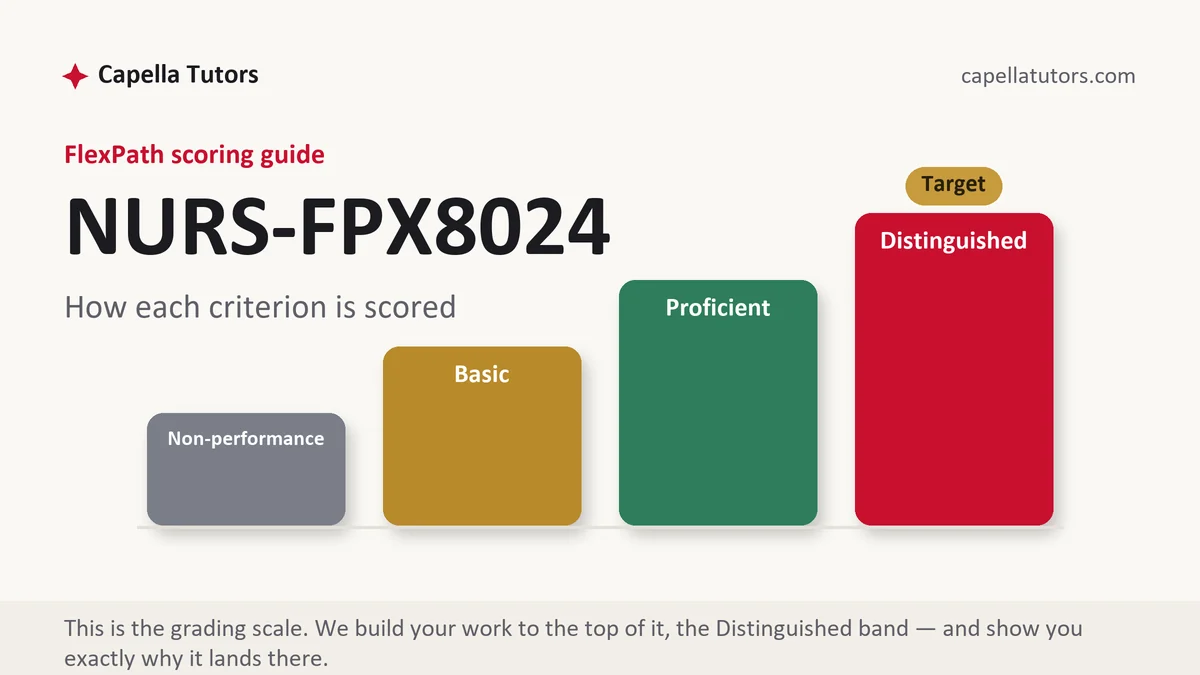
What NURS-FPX8024 actually grades
The unit of analysis in this course is a population of hundreds of thousands, and the criteria punish drafts that shrink it back to a clinic. What gets graded is whether you can characterize disease burden in a defined population using the measures the field uses, explain why that burden is distributed as it is, and propose something a ministry, a health authority or a large payer could finance and govern. Epidemiologic transition is the frame most students need and few use: as populations age and incomes rise, burden shifts from communicable, maternal and nutritional causes toward noncommunicable disease and injury, and the same country often carries both at once, which is the double burden the interesting arguments live inside.
Measurement carries a disproportionate share of the grade because the errors are easy to catch. A rate needs a numerator, a denominator, a multiplier and a time window before it means anything, and drafts routinely present a count as a rate or compare rates built on different windows. Incidence and prevalence answer different questions, and using prevalence to argue about a change in risk is a mistake an evaluator will circle. Cross-country comparison requires age standardization, because a crude mortality rate largely reflects the age structure producing it. Uncertainty is part of the number rather than a caveat about it, so the interval belongs in the table, particularly where civil registration is incomplete and the figure is modeled.
The third strand is systems, financing and governance, where a doctoral answer separates from an undergraduate one. Health system capacity determines whether an intervention that worked in a trial works at scale, and the constraints are concrete: workforce density, supply and cold chain, information systems, and how care is paid for. Financing shapes outcomes directly, since out-of-pocket payment at the point of service drives households into catastrophic expenditure and suppresses use of the services you propose. Governance decides whether anything happens: a national action plan, a treaty obligation, donor conditions on a financing window, or a regulation nobody enforces.
How we help in this course
Work for 8024 starts with the data table, not the introduction. The desk pins down the population and its size, the measure, the reference year, the source and its uncertainty, then writes the argument on top of a structure that already holds, which is why these drafts survive the criterion asking whether the analysis is supported. Tell us the population or country, the condition, and whether your program expects a comparative element, and the sample gets built around a burden picture you can defend line by line.
The offer is the one running across the studio: one original premium sample per deliverable in 24 to 48 hours, written at the Distinguished descriptors, through an eight-person pipeline ending in two separate quality reviews, the first checking each criterion and the second checking figures, sources and APA. Revisions cost nothing until the score lands, and evaluator feedback returns through the same route free. In a data-heavy course that earns its keep, since one mismatched denominator between text and table can pull down three criteria together.
How to actually write NURS-FPX8024: where to begin
Take the scoring guide apart before choosing a topic, because the topic that fits the criteria is rarely the most interesting one. Each criterion becomes a heading, the Distinguished wording sits beneath it, and every table or paragraph gets docked to one of them. Criterion clusters in an advanced population health course usually run: define the population and quantify its burden from named sources, analyze determinants across levels rather than listing them, appraise an intervention against evidence, address financing, governance and equity, and evaluate with population measures. The assessments in this course usually ask for some arrangement of those, and your scoring guide decides it, so work from the document in your courseroom.
Then cost the proposal per head, which is the arithmetic that turns an essay into a plan. Say your district holds 480,000 people and the intervention runs at $1.85 per capita per year, so $888,000 annually. If the public health budget there is $38 per capita, you are asking for 4.9 percent of everything it spends, and stating that share persuades far better than stating the total, because it tells a finance ministry what has to give way. Push further with a burden denominator: if the condition accounts for an estimated 6,200 disability-adjusted life years locally each year and the intervention plausibly averts twelve percent, that is 744 averted for $888,000, near $1,190 each. Attach no universal threshold to that figure, since cost-effectiveness cutoffs are contested and country-specific; present it against alternatives instead.
Close on the pathway from analysis to policy, because criteria at this level want implementation and not aspiration. Name the instrument: national strategy, clinical guideline, financing rule, procurement change, taxation or regulation. Name the body that owns it, who gains and loses, and the sequence with a horizon. Then name the failure mode honestly, since strong trial evidence routinely stalls on workforce shortage, stockouts, competing donor priorities or a data system that cannot report your indicator. Ending with the implementation risk and a monitoring indicator already in routine reporting reads as Distinguished; ending with a call for greater awareness reads as Basic every time.
| Section | What goes in it | What Distinguished looks like |
|---|---|---|
| Population and burden | The population defined and sized, the measures chosen, the reference year, and the sources. | Standardized rates with intervals, and a stated reason for choosing each measure. |
| Determinants | Structural, environmental, behavioral and health system drivers, mapped rather than listed. | Pathways traced from a structural cause to a measurable outcome, without ecological overreach. |
| Comparison | A second population or system, matched on the measure and standardized to one reference. | A comparison that explains a difference through financing or governance, not through culture. |
| Intervention and evidence | What is proposed, the trial or program evidence behind it, and its transferability. | Effect sizes reported with design, and the scale-up gap named before a reviewer names it. |
| Financing and governance | Cost per capita, the share of an existing budget, the owning body, the policy instrument. | A cost expressed against a real budget, with the trade-off it forces stated plainly. |
| Evaluation and references | Indicators, their data source, cadence, equity stratification, current APA both ways. | Indicators drawn from routine reporting, disaggregated, on a cycle that already runs. |
Developing the synthesis
Global health evidence is contested in ways a doctoral reader expects you to handle rather than smooth over. Mass drug administration, insecticide-treated nets and conditional cash transfers each have strong trial results and uneven records at national scale, and that gap is the interesting question. Task shifting to community health workers shows real gains for defined conditions while the effect depends almost entirely on supervision and supply, which trials provide and programs often do not. Coverage reforms improve financial protection more reliably than health outcomes over short horizons. Settle one dispute in the open: concede that efficacy in a trial does not predict effectiveness at scale, then argue from the specific system constraint in your setting. Give the design and the sample before you give findings, hold statistical significance apart from public health significance, and cite frameworks from their originating publications rather than a textbook redrawing, since redrawings quietly change what the model claims.
Citations that survive faculty review
Four source families do the work here. Peer-reviewed epidemiology, global health and health policy research published in the last five years or so, pulled via the Capella library, PubMed and Global Health, carries claims about effect and mechanism. Multilateral statistical and normative sources establish burden and obligation, principally WHO documents including the Global Health Observatory, the Institute for Health Metrics and Evaluation burden estimates, World Bank indicators, and United Nations reporting against the Sustainable Development Goals. National surveillance carries local claims, so ministry reports, Demographic and Health Surveys, censuses and vital registration where it exists. Policy instruments themselves, meaning treaty texts, national strategies and financing rules, carry every claim about what is required rather than recommended. Cite the dataset and its year, not a news article about it, and say when a figure is modeled rather than observed.
The mistakes that land Basic instead of Distinguished
- A rate with no denominator or window. Without both it cannot be compared to anything, including itself a year later.
- Crude rates compared across countries. The difference reported is mostly a difference in age structure.
- Determinants listed instead of traced. A list names causes; a doctoral analysis follows one to a measurable outcome.
- Trial efficacy presented as program effectiveness. Supervision, supply and financing decide the gap, which is the argument.
- A recommendation with no instrument or owner. Raising awareness is not a policy and no ministry can be held to it.
NURS-FPX8024 questions students actually ask
Does global mean I have to write about another country?
Your scoring guide decides, and the word is doing more work than students assume. Global here describes a scale of analysis and a set of shared determinants rather than a passport requirement, so a refugee resettlement population in the American Midwest, a border health district, or a diaspora community with imported disease risk all qualify. What the criteria usually test is whether you can reason across systems, comparing how two differently financed and governed systems produce different results for the same condition. If you choose a domestic population, make the cross-system comparison explicit rather than implied, and if you choose a low-income or middle-income setting, be honest about the quality of the data you rely on.
Why age-standardize if I already have the raw rates?
Because a crude rate mostly reports how old a population is. Cancer mortality per 100,000 looks worse in a country with a median age of 43 than in one with a median age of 19 even when the risk at every age is identical, so comparing their crude rates is not comparing health at all. Age standardization applies both populations' age-specific rates to one reference structure, which removes that artifact and leaves something interpretable. Two rules follow. Say which reference population you used, since the WHO standard and a national standard give different numbers for the same data. And never mix crude and standardized figures inside one table, which is a common and quickly punished error.
How do I use DALYs without overclaiming?
Report the composition, not just the total. A disability-adjusted life year sums years of life lost to early death and years lived with disability, and two conditions with identical totals can be entirely different problems: one killing young people, one disabling older people for decades. State which component dominates yours, because the intervention follows from that. Then say where the estimate came from and that modeled estimates carry uncertainty intervals that widen sharply where vital registration is incomplete, so print the interval rather than the point estimate alone. The disability weights are contested and were derived from survey methods worth one sentence of acknowledgement. A doctoral reader is not looking for certainty here, only for a writer who knows what the number is made of.
Population health deliverable due?
Send the prompt, the criteria, and your population or country. We build the burden table first and argue from it. First sample costs nothing.