Send whatever this course has open and it returns inside 24 to 48 hours as a premium original sample, written to the top-column wording in your own scoring guide, with every data element traced back to the field it came from and revisions running free until the criterion clears. On the transcript it reads NURS-FPX8022, Nursing Technology and Advanced Healthcare Information Systems, worth 2 program points, one of the 8000-level core requirements in Capella's FlexPath Doctor of Nursing Practice, a doctorate whose thirteen courses add up to no fewer than 26 program points.
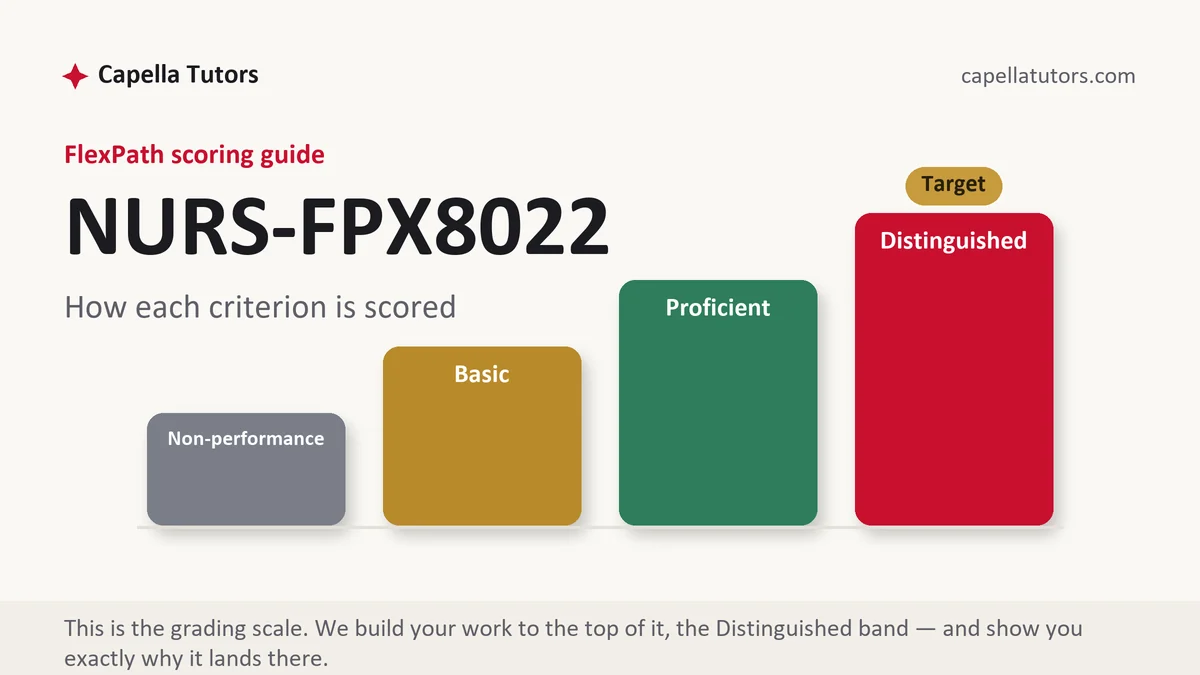
What NURS-FPX8022 actually grades
The doctoral version of an information systems course is not graded on whether you can use a system or pick one. It is graded on whether you can specify the information a practice change will be judged by, and say where that information physically comes from. Criteria at this level want a named data element, a named source system, a defined population, and a window, because a project that cannot define its own numerator has no evaluation to report later. Your scoring guide decides the form, and the deliverables in this course usually hand you an information problem or ask you to bring one out of your own setting, then grade whether the technology you propose changes what clinicians decide rather than what they type.
Provenance is the first strand and the one most drafts skip. Every figure in a health system arrives with a reliability attached: a discrete flowsheet row a nurse completes at the bedside, a coded problem-list entry a physician maintains, a laboratory result posted through an interface, a diagnosis code a coder assigns after discharge for billing. They are not interchangeable, and a measure resting on a field clinicians fill in when they remember is measuring documentation habit rather than care. Take a quarter of 412 adult inpatient encounters where the discharge education row is populated on 231 of them, 56 percent; a teaching measure built on that row reports charting compliance, not what patients were told.
Exchange is the second strand, and it carries vocabulary you are expected to handle correctly at the 8000 level: HL7 version 2 messaging, FHIR resources and the certified interfaces that expose them, LOINC for laboratory observations, SNOMED CT for problems and findings, RxNorm for medications, ICD-10-CM for diagnoses. Promising that the systems will be integrated is not a plan; saying that the pharmacy system will publish an RxNorm-coded medication list to an existing FHIR endpoint, refreshed at discharge, is a plan an analyst could cost.
Third comes stewardship of the data and the obligations riding along with it. A doctoral paper treats decision support as a designed intervention with a written specification, and treats access as a governed privilege: role-based permissions under the minimum necessary standard, a documented security risk analysis, audit logging somebody reviews on a cycle, a retention period drawn from policy, and patient access handled in line with the information blocking rules. The program requires no fewer than 1,000 supervised practicum hours, and the practice site where you log them is where your data live, so the criteria assume you are writing about systems you can actually see.
How we help in this course
We draft 8022 work as a specification rather than an essay. Every measure gets a numerator, a denominator, exclusion rules, a source system for each element, and a collection window before any narrative is written around it. Governance gets owners with job titles. Tell us the setting, the systems it actually runs, and which reports you can realistically get pulled, and the draft argues from your site's data reality instead of from a product brochure.
Delivery does not change for a doctoral course. One premium original sample inside 24 to 48 hours, pitched at the Distinguished descriptors of the guide you upload, routed through the eight-person pipeline where one QA pass exists only to confirm that every number still matches the field it was drawn from, and free revisions until the guide is met. Anything faculty send back is handled inside that same cycle without a fee, and the question they ask most in this course is simple: which field is that number in?
How to actually write NURS-FPX8022: where to begin
Open the scoring guide first, copy each criterion out as a heading, and keep the Distinguished wording visible so you are aiming at a standard rather than a subject. At this level the criteria usually cluster into four demands: describe an information problem in a practice setting with data behind it, propose a technology response a real organization could resource, account for governance and the ethical obligations that arrive with the data, and evaluate the outcome against a measure you defined in advance.
Then write the data dictionary before the narrative, because in this course the dictionary is the argument. Take a sepsis screening measure. The denominator is adult inpatient encounters with a positive screen recorded in the screening flowsheet during the quarter, 412 of them. The numerator is those with a lactate specimen collected inside 60 minutes of that screen, 268, which is 65.0 percent. Now change one word. Count from the moment the lactate was ordered rather than collected and the numerator becomes 334, so the same measure on the same patients reports 81.1 percent. Sixteen points of apparent performance live inside the choice of a timestamp, which is why a doctoral evaluator reads the specification before the conclusion. Write the exclusions too, comfort care and transfers arriving with the lactate already drawn, and say where each element sits: a flowsheet row, the laboratory system, a coded order.
Then specify the intervention instead of describing it. A decision support rule is five decisions committed to paper: what fires it, what logic it evaluates, where in the workflow it appears, who it appears to, and what action it offers, with an override reason list so the rule can be audited a year later. Estimate its volume before you propose it. A rule firing on the same population as the measure above touches roughly 412 encounters a quarter, about 4.5 a day, a load a charge nurse can absorb; loosen the trigger to any abnormal vital sign and the same rule fires dozens of times a shift and is dismissed by the second week.
Close on sustainment, because the criteria reach past go-live and most drafts stop at it. Say who owns each data element once the project team disbands, which existing report will carry the measure forward, on what cycle it gets reviewed, and what value would make you switch the technology off. Then state the exposure you have not solved, whether that is the single analyst who knows how the extract is built or the vendor upgrade that will break your logic next spring.
| Section | What goes in it | What Distinguished looks like |
|---|---|---|
| The gap and its evidence | The clinical or operational failure stated with a count, and what the current systems record about it today. | A gap sized from the site's own data, with the field it was counted from named. |
| Measure specification | Numerator, denominator, exclusions, the source system behind each element, and the collection window. | Every element traceable to one field, with the timestamp defined and its ambiguity resolved out loud. |
| Systems, standards, exchange | The sending and receiving systems, the transport, and the vocabularies carrying clinical meaning. | A standard named for each data class, with interface work priced as funded project work. |
| Technology or decision support design | The trigger, the logic, the point in workflow, the recipient, the action offered, the override record. | A specification another analyst could build, with expected firing volume estimated beforehand. |
| Governance, privacy, security | Element ownership, role-based access under minimum necessary, audit logging, retention, risk analysis. | Each element has an accountable owner, a review date, and one agreed definition behind it. |
| Evaluation and sustainment | The baseline value, the measure after go-live, the review points, the owner afterwards, current APA both ways. | A threshold stated in advance for keeping, changing, or retiring the technology. |
Developing the synthesis
Informatics evidence has to be synthesized at this level rather than listed, and the field supplies real disagreement to work with. Clinical decision support reliably improves process measures such as ordering the right test at the right time, while its effect on patient outcomes is far less consistent and often evaporates when the prompt is easy to dismiss. Remote monitoring and portal programs report engagement gains concentrated in the patients least likely to deteriorate, which is an equity finding rather than a technology finding. The doctoral move is to hold two credible findings against each other and name the implementation condition that explains the distance between them, because that condition becomes a stated requirement in your own design. If a benefit only appears when the prompt interrupts an order rather than waiting in an inbox, your build has to interrupt the order and your evaluation has to verify that it did.
Citations that survive faculty review
Sources fall into three layers here, each with a different job. Peer-reviewed informatics and implementation research published within about the last five years, drawn through the Capella library, CINAHL, and PubMed, backs every claim about error rates, adoption behavior, or outcomes. Standards documentation carries the exchange claims and belongs cited to the body that publishes it: HL7 for FHIR resources, the certification criteria and the United States Core Data for Interoperability list for what a certified system must send, and the information blocking provisions for what patients are entitled to receive. Professional literature sets the accountability you write toward, which at doctoral level means the nursing competencies for informatics and healthcare technologies alongside AMIA and HIMSS practice material. Then reconcile text against reference list in current APA, and reread once for nothing but whether each number still agrees with its field.
The mistakes that land Basic instead of Distinguished
- A measure with no denominator. Compliance improved is not a finding until a reader knows how many encounters were eligible and across what window.
- Free text as a data source. If the answer only exists inside a nursing note, nobody will count it every month, and the measure will not outlive your project.
- A timestamp nobody defined. Two analysts pulling the same measure from different clock fields will report different performance, and you are graded on which one you specified.
- Integration written as a wish. Systems do not talk on their own; an interface is built, funded, and tested, and the paper should say which one and by whom.
- A model reduced to one accuracy figure. With no threshold, no denominator, and no account of the alert burden it creates, an accuracy percentage tells a reader nothing at all.
NURS-FPX8022 questions students actually ask
What if my organization will not give me a data extract?
Ask for a report that already exists before you ask for an extract, because the first request goes to a person and the second goes to a queue. Most sites already run a monthly quality summary or an infection surveillance report, and an aggregate count with a stated window is enough to establish a baseline. Where nothing exists, a hand audit of a defined sample is a legitimate doctoral method: take 40 consecutive encounters inside a stated period, apply written inclusion rules, and report the count with its denominator and the fact that you collected it yourself. A small honest denominator can be graded. A precise-looking figure with no traceable origin cannot.
Do I really need to name interoperability standards?
Yes, because naming them is the cheapest available evidence that you know what the integration will cost. Say which system sends, which receives, what carries the message, and which vocabulary carries the meaning: laboratory values as LOINC-coded observations, problems as SNOMED CT, medications as RxNorm, diagnoses as ICD-10-CM, moving either through the HL7 version 2 interfaces most hospitals still run or through FHIR resources exposed by a certified interface. The depth expected stops at the interface boundary: name the standard and the vocabulary, and leave the mapping document to the analyst who would build it. Faculty read that sentence as a test of whether the rest of the plan is affordable.
How do I write about a predictive model without overclaiming?
Report it the way you would report a diagnostic test, at the threshold you propose to deploy. A deterioration model that flags 340 encounters in a month, 34 of which turn out to be the event, has a positive predictive value of about 10 percent, and if 55 events occurred that month it caught 62 percent of them. Neither figure is impressive alone, which is the point: the useful sentence says 306 alerts a month reached a nurse who found nothing, then says what you intend to do about that burden. Add whether performance was checked separately in the subgroups your unit serves, since a model calibrated on one population degrades quietly in another. A doctoral reader forgives a modest model, not an accuracy percentage with no threshold, no denominator, and no consequence attached.
An 8022 deliverable open right now?
Send the prompt, the scoring guide, and the name of the system your site actually runs. First premium sample free, and the data dictionary comes with it.