Give us the prompt, the criteria, and your practice question, and a premium original sample lands in 24 to 48 hours with a documented search, an evidence table you can defend line by line, appraisal written at doctoral depth, and free revisions until the guide is met. On your plan of study this is NURS-FPX8006, Nursing Research and Evidence-Based Practice, 2 program points toward the minimum of 26 the catalog sets for the FlexPath Doctor of Nursing Practice across thirteen two-point courses. FlexPath bills in flat 12-week sessions and lets you carry two courses at once, and because appraisal work front-loads reading rather than writing, this is a sensible course to pair with a lighter one and submit on grade.
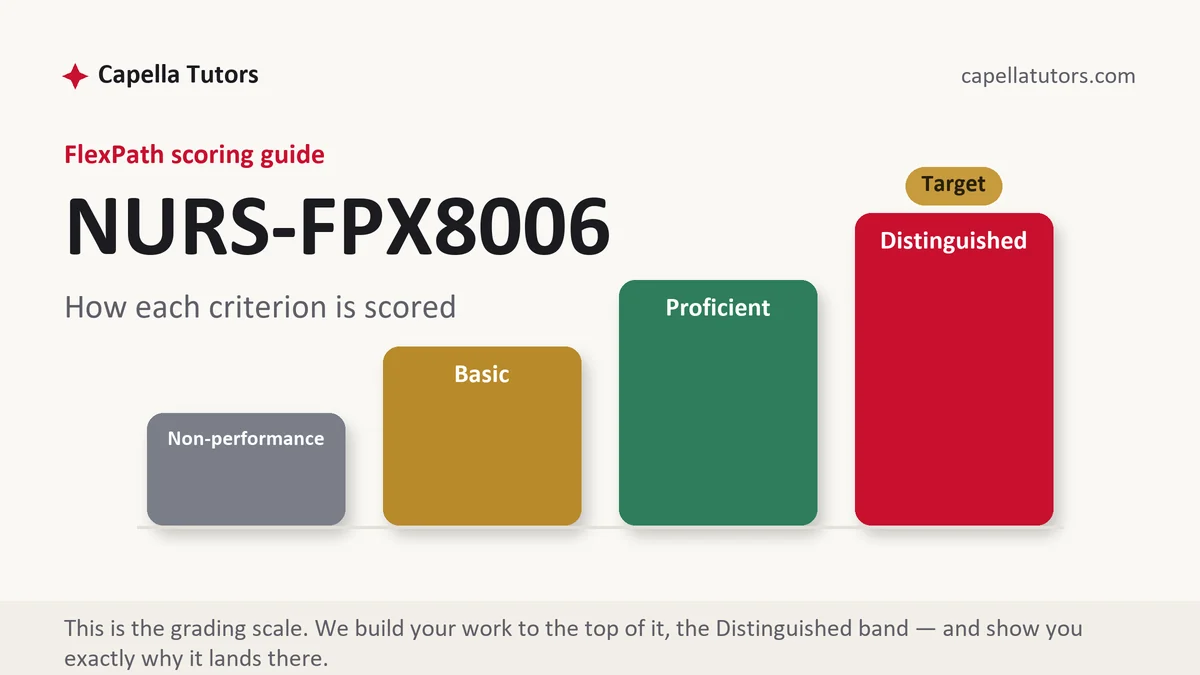
What NURS-FPX8006 actually grades
The first thing under evaluation is a classification, and getting it wrong is expensive. Research produces knowledge intended to generalize beyond the place it was collected. Evidence-based practice takes knowledge that already exists and changes what a unit does with it. Quality improvement moves a local process toward a standard nobody is disputing. Those three activities need different review pathways, make different promises, and license different conclusions, and the criteria in this course expect you to name which one you are doing and defend the label. Most drafts that lose points on the first criterion have written a quality improvement plan and called it research, or proposed a study and called it practice change.
The second thing graded is design literacy, which means reading a paper in the order it was built rather than the order it is printed. Doctoral appraisal starts with methods: who was enrolled, who was excluded, how many were lost by the end, whether anything was compared, whether the people measuring the outcome knew which group they were looking at. Only then do findings mean anything. A criterion asking you to appraise evidence does not want results summarized with the word rigorous attached. It wants the specific reason this study can or cannot support your claim, and that reason sits in the methods.
The third strand is translation, where doctoral work separates from master's work. An appraisal ending with a conclusion about the literature has stopped halfway. The criteria want appraised evidence converted into something your setting could do, measured by something your setting already collects, with a baseline, a target, and a window. The assessments in this course usually ask for a practice question, a reproducible search, an appraisal of what you found, and a recommendation that follows from it, though your scoring guide decides the form each takes.
How we help in this course
Papers for 8006 ship with their working shown. Alongside the sample you get the search log: databases queried, the controlled vocabulary and keyword strings, the date limits, the inclusion and exclusion rules, and the record count at each screening stage. You also get the evidence table as a separate file, one row per study with design, setting, sample, measure, effect and limitation, so when faculty ask where a number came from you point at the row.
Delivery is the studio standard, unchanged for research work. One premium original sample per deliverable inside 24 to 48 hours, written to the Distinguished descriptors in the guide you send, built by the eight-person pipeline with two quality passes, revised at no cost until the criteria are met. Here one of those passes is a verification pass: every effect size, interval and sample figure in the document is checked back against the full text of the source it came from, because a misquoted statistic is the one error in this course that a faculty evaluator can confirm in thirty seconds.
How to actually write NURS-FPX8006: where to begin
Start with the scoring guide and notice that its criteria are verbs. Formulate, search, appraise, synthesize, translate, evaluate. Each verb is a section you will have to produce evidence of having performed, which is why an appraisal paper cannot be written in one pass from reading to prose. Take the criteria in order and produce the artifact each one demands before drafting anything. The first artifact is the question itself, framed so that every element can be searched: the population with its boundaries, the intervention as it would actually be delivered, the comparison you are measuring against, the outcome with the instrument that captures it, and the timeframe over which you expect a change. A question that names none of those things cannot be searched, and everything downstream inherits the vagueness.
Then run a search you could hand to a librarian and have reproduced. Name the databases, and for nursing that usually means CINAHL, MEDLINE through PubMed, and the Cochrane Library, plus a guideline source. Search controlled vocabulary and free text separately, then combine, because subject headings catch papers your keywords miss and keywords catch papers not yet indexed. Record the strings, the date limits, and the design filters. Then keep the count trail: 412 records identified, 38 read in full, 11 included, with a sentence saying why the rest went. That trail separates an appraisal from a reading list, and it takes ten minutes recorded as you go and two hours reconstructed afterwards.
Appraisal comes next, and it runs on arithmetic more than adjectives. An interval tells you what a study rules out, so a relative risk of 0.75 with a confidence interval from 0.58 to 0.97 supports a claim of benefit while the same point estimate with an interval from 0.48 to 1.18 does not, whatever the abstract says. Then convert relative effects into something a unit can weigh: an outcome occurring in 12 percent of controls and 9 percent of an intervention group is an absolute reduction of 3 percentage points, a relative reduction of a quarter, and about 34 patients treated for one to benefit. Rates need the same discipline. A catheter-associated infection figure means nothing per admission and everything per 1,000 catheter days, and a readmission rate needs its window and population attached before it can be compared to anything.
| Section | What goes in it | What Distinguished looks like |
|---|---|---|
| Practice question | Population, intervention, comparison, outcome with its instrument, and the timeframe. | A question narrow enough that a librarian could search it without asking you what you meant. |
| Search strategy | Databases, subject headings and keyword strings, limits, inclusion and exclusion rules, screening counts. | A strategy reproducible from the page, with exclusions justified rather than merely tallied. |
| Evidence table | One row per study: design, setting, sample, measure, effect with its interval, limitation. | Every claim later in the paper traceable to a row, with conflicting rows visible side by side. |
| Appraisal and synthesis | Quality of each study, then strength of the body of evidence, with the disagreements addressed. | Study quality and body strength kept as separate judgments, and the conflict adjudicated on design. |
| Translation to practice | The recommendation, the setting, the stakeholders, the change model governing implementation. | A model cited to its originating publication and applied to your setting rather than described. |
| Evaluation and references | The outcome measure, its denominator, its baseline, the review window, current APA both ways. | A measure the organization already reports, with a baseline in hand before implementation begins. |
Developing the synthesis
Doctoral synthesis holds two judgments apart that undergraduate work runs together: how good an individual study is, and how strong the body of evidence is. They come apart constantly. A systematic review inherits the weaknesses of the trials inside it, so a careful review of six small unblinded studies is a careful review of weak evidence and should be reported that way. A single large well-conducted trial can outweigh an older pooled analysis of poor ones. Consistency across settings raises confidence, and effects that shrink as study quality rises are the classic signature of bias rather than of a real benefit that keeps getting smaller.
Qualitative evidence needs its own treatment rather than a discount. Interview and focus group work answers questions no trial can touch, including why nurses abandon a protocol by week three, and appraising it means asking about sampling, saturation, reflexivity and the audit trail rather than complaining about a missing control group. Say plainly where your evidence runs out. If the strongest study ran in an academic medical center with a dedicated project nurse and your site is a 40-bed community hospital, that gap belongs in your own sentence, followed by what you would monitor to catch the difference early.
Citations that survive faculty review
Four source types carry an appraisal paper. Primary studies and systematic reviews, retrieved through the Capella library from CINAHL, MEDLINE and the Cochrane Library, are the evidence itself, and the working window is roughly five years with landmark work exempted and named as landmark. Guidelines and their own evidence grades, from national guideline bodies and preventive services panels, tell you what has already been recommended, so distinguish the recommendation from the studies underneath it rather than citing a guideline as data. Appraisal and reporting instruments belong to their publishers, so a critical appraisal checklist, a risk of bias tool and a reporting statement are each cited to the group that issued it. Implementation models are cited to their originating publication, never to the textbook chapter that summarized them. One rule outranks the rest: never cite a study you have only met inside somebody else's review.
The mistakes that land Basic instead of Distinguished
- Findings reported before design and sample. A result with no method attached cannot be appraised, only repeated.
- A p value used as an effect size. Significance answers a different question than magnitude, and large samples make it cheap.
- A search with no documented strategy. Unreproducible searching reads as convenience sampling of the literature.
- A rate with no denominator or window. Numbers like this cannot be compared to a benchmark or to your own baseline.
- The wrong activity label. Calling practice change research, or the reverse, sends you down a review pathway that does not fit the work.
NURS-FPX8006 questions students actually ask
Is my project research, evidence-based practice, or quality improvement?
Answer it by asking what you intend to produce. If the aim is knowledge that should generalize beyond your site, it is research, and it belongs in a human-subjects review pathway. If the aim is to apply evidence that already exists to the care your unit delivers, it is evidence-based practice. If the aim is to make a local process perform closer to a standard everyone already accepts, it is quality improvement. The distinction is not cosmetic, because it decides your review route, your consent obligations, and what your final section is allowed to claim. Get a determination from the office that issues them at your organization early and in writing, since a wrong classification discovered late can force a redesign rather than an edit.
The result was statistically significant but the effect looks tiny. What do I write?
Report both facts and let the size drive the recommendation. A p value tells you how surprising the result would be if nothing were happening, and in a large sample a trivial difference clears that bar easily. So convert to something a clinician can weigh. If an outcome occurs in 12 percent of a control group and 9 percent of an intervention group, the absolute risk reduction is 3 percentage points, the relative reduction is 25 percent, and roughly 34 patients need the intervention for one to benefit. Then say whether 34 is worth the cost and the burden on your unit. Faculty are watching for exactly that move, because the alternative is a paper that recommends a change on the strength of an inequality sign.
How many articles does the assessment need?
Your scoring guide decides, and it is the only authority worth following on the number. What is consistent across doctoral appraisal work is that the criteria reward the fit of the evidence rather than the size of the pile. Six studies that answer your question, appraised on design and sample and reported with their limitations, outscore fifteen collected because they mentioned your keyword. Two habits protect you regardless of the count. Read every source in full rather than from its abstract, and document the search that produced them, so a reader can see what you found, what you excluded, and why. A paper that names its own exclusions looks deliberate. A long reference list with no strategy behind it looks like a keyword harvest.
Appraisal due and the evidence will not behave?
Send the question and the criteria. You get the search log, the evidence table, and a paper whose every statistic was checked against its source. First premium sample free.