This manual is for NURS-FPX6624 Assessment 3, start to submission. Hand this one over and a premium original sample lands inside 24 to 48 hours, written to your guide and revised free until it gets there. Assessment 3 in this course usually asks you to take what you have analyzed to other people: an education or training deliverable, a briefing, or a set of materials that changes how a coordination team handles a legally loaded decision. Your scoring guide decides the format, the audience, and whether speaker notes or a facilitator guide are required. Below is how our tutors build a teaching deliverable that still reads as graduate work, the section map the criteria imply, and an annotated excerpt. Your courseroom may print this as NURS FPX 6624 Assessment 3 or NURS6624 Assessment 3; it is the same deliverable, and NURS-FPX6624 Assessment 3 is what this manual walks through.
One honesty note before the manual: Capella revises courses and scoring guides over time, so always write to the exact scoring guide attached to your assessment in the courseroom. The course identity above is verified on capella.edu; the method and structure below are our tutors' approach to it, not Capella's official rubric text.
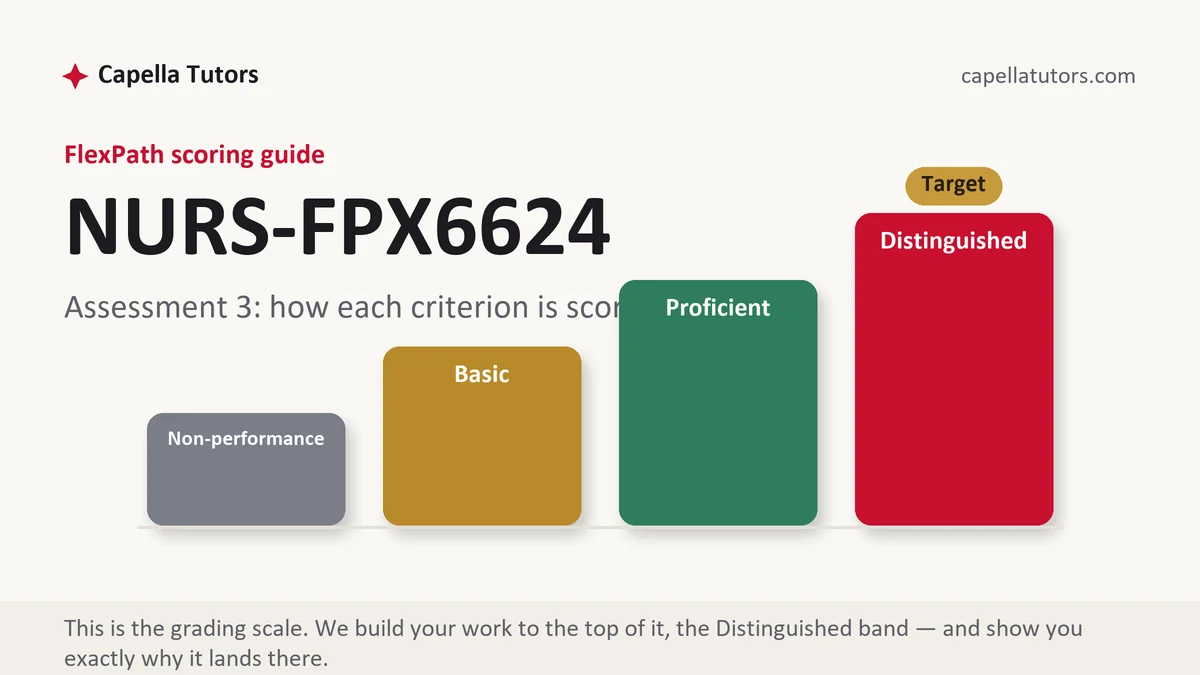
How NURS-FPX6624 Assessment 3 is scored
The four levels apply to each criterion separately, and on an education deliverable they translate like this:
| Level | What it means on a staff education deliverable |
|---|---|
| Distinguished | Outcomes are written as behaviors the team can be observed doing, the legal floor is taught before the ethical reasoning, the materials include a decision aid usable at the point of contact, and learning is evaluated rather than assumed. |
| Proficient | Accurate content, correctly cited, aimed at the right audience, with objectives written as knowledge rather than as behavior and no evidence of learning collected. |
| Basic | A lecture about ethical principles and privacy in general, true throughout and unusable on any actual visit. |
| Non-performance | A required component is absent, commonly the learning outcomes, the evaluation of learning, or the references the criterion asks for. |
Education criteria at master's level are graded on instructional design as well as content. Say what the learners will be able to do, choose methods that fit adults with clinical experience, and attribute the learning principles you rely on to the theorists who published them rather than to a training website.
The NURS-FPX6624 Assessment 3 method, step by step
-
Write outcomes as behaviors someone could observe
Convert every objective into an action with a condition attached: given a family member requesting information at the door, the home visit nurse identifies the authorized decision maker and states what may be shared. Objectives written as understanding or awareness cannot be evaluated, and the criterion that asks for evaluation of learning will have nothing to attach to.
-
Teach the two decisions the team actually gets wrong
A module that covers everything teaches nothing. In a home-based program for adults with advanced dementia, the recurring errors are narrow: information given to whichever relative answered the door, and a surrogate's instruction followed without checking whether the patient has expressed a contrary preference while still able to. Two decisions, taught to the point of competence, beat a survey of ethics in coordination.
-
Establish the legal floor first, and cite it
Teach what the law requires before teaching how to reason: how authorized personal representatives are recognized, what the privacy rule permits when a person involved in the patient's care asks a question, and where your state's surrogate decision-making statute sets the hierarchy and its conditions. Cite the regulation and the statute, note that surrogate law varies by state, and give the learners the actual sequence to follow.
-
Build a decision aid they can use at the door
One page, laminated in real life: how to confirm identity and authority, what may be disclosed without authorization, what needs the surrogate, when to stop and call the coordinator, and where to document. The aid is the deliverable's payload, and criteria that ask for application rather than recall are usually satisfied by the aid plus the case that teaches it.
-
Choose methods that fit experienced adult learners, and attribute them
Case discussion, a short role-play at the doorway, and a decision aid rehearsed twice will outperform a lecture with these learners. Ground that choice in adult learning scholarship, citing Knowles for the assumptions about experienced learners and current peer-reviewed education research for the method, and say in one sentence why the method matches the outcome.
-
Plan the evaluation of learning, then self-score the module
Decide in advance what evidence of learning you will collect: a scored case walkthrough at the end of the session, an observed doorway exchange during the next supervisory visit, and the rate of coordinator escalation calls over the following quarter. Naming immediate, behavioral, and outcome evidence separately shows you know the levels of evaluation are not interchangeable. Then read each criterion, mark your own level, and rewrite what falls short.
A structure that maps to the criteria
Planning targets our tutors use for a master's education deliverable, not Capella requirements; the criteria in your guide decide the real weighting.
| Section | What it must do | Guide |
|---|---|---|
| Audience and need | Who is being taught, what they currently do, and the specific errors the training exists to prevent. | ~200 words |
| Learning outcomes | Three or four observable behaviors, each tied to a decision the team makes in the field. | ~150 words |
| Legal content | The regulations and state statute that set the boundary, taught as a sequence the learner can follow. | ~350 words |
| Ethical reasoning content | The code provisions and the reasoning pattern applied to the two decisions being taught, using a case. | ~350 words |
| Method and materials | The instructional approach with its rationale, plus the decision aid the learners keep. | ~250 words |
| Evaluation and references | The evidence of learning at each level, the collection plan, and APA 7 sources including primary law. | ~200 words |
Annotated sample excerpt
An original excerpt from our team, showing how a teaching deliverable stays scholarly while remaining usable at the bedside. Adapt the pattern to your own audience.
By the end of the session, the home visit nurse will identify who holds decision-making authority for a patient with advanced dementia and state aloud what may be disclosed to a relative who is not that person.1 The teaching case is deliberately ordinary: a daughter meets the nurse at the door, asks what the neurologist said last week, and mentions that her brother holds the health care power of attorney but lives out of state.2 Learners work the case in pairs against the one-page aid, and the session ends with each nurse walking through a second case while a peer scores the four steps, which gives the module observable evidence of learning rather than a satisfaction rating.3
- 1The outcome names the learner, the condition, and the observable behavior. Written this way, the outcome and the evaluation method are decided in the same sentence.
- 2The case is chosen for its ordinariness rather than its drama, which is the correct instinct for staff education. The competing pulls sit inside a two-minute exchange the team has every week.
- 3Evidence of learning is behavioral and collected during the session, and the note says what it replaces. Distinguishing a scored walkthrough from a satisfaction survey is the kind of precision the evaluation criterion rewards.
The full premium sample for your exact assessment, written fresh to your scoring guide and issue, is free to request. Study it, revise it into your own voice, and submit work you understand.
The five mistakes that cost Distinguished
- Objectives nobody can observe. Learners will understand or appreciate, which leaves the evaluation criterion with nothing measurable.
- The survey module. Every principle and every privacy rule covered at low resolution, with no decision taught to the point of competence.
- Law by paraphrase. Disclosure rules and surrogate hierarchy taught from memory or a summary rather than from the regulation and the state statute.
- Methods with no rationale. A lecture chosen by default, with no adult learning basis given and no attribution to the scholarship behind it.
- Satisfaction as evidence. A feedback form treated as proof of learning, with nothing observed and nothing followed up.
Pre-submission checklist
- Each criterion answered in its own labeled section of the deliverable
- Outcomes written as observable behaviors tied to real field decisions
- Privacy rule and state surrogate statute cited primarily, with variation by state acknowledged
- Code of ethics provisions applied to the specific decisions being taught
- A one-page decision aid included, usable without the training materials
- Evaluation of learning specified at more than one level, APA 7 verified, draft self-scored
Teaching deliverable due, clinical week already full?
Send the scoring guide, the audience, and the format it wants. A premium original module comes back inside 24 to 48 hours with outcomes, a teaching case, a decision aid, and an evaluation plan, then revised free until it satisfies your guide.