This manual is for NURS-FPX6624 Assessment 2, start to submission. We can build this one for you and then walk you through defending it, first premium sample free and back inside 24 to 48 hours. Assessment 2 in this course usually asks you to move from analysis to something an organization could adopt: a policy, a protocol, or a set of criteria that decides who receives a limited coordination resource and how that decision gets reviewed. Your scoring guide decides the format and the audience. What follows is how our tutors write an allocation policy that survives an ethics committee, the section map the criteria imply, and an annotated excerpt. Your courseroom may print this as NURS FPX 6624 Assessment 2 or NURS6624 Assessment 2; it is the same deliverable, and NURS-FPX6624 Assessment 2 is what this manual walks through.
One honesty note before the manual: Capella revises courses and scoring guides over time, so always write to the exact scoring guide attached to your assessment in the courseroom. The course identity above is verified on capella.edu; the method and structure below are our tutors' approach to it, not Capella's official rubric text.
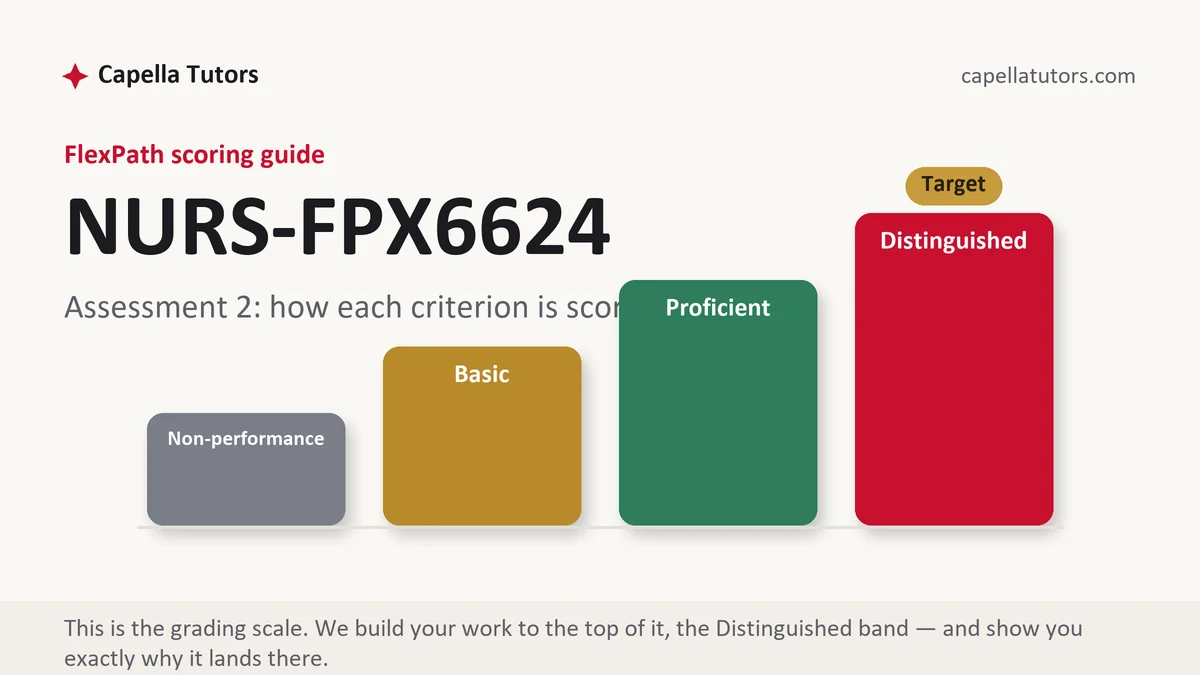
How NURS-FPX6624 Assessment 2 is scored
Levels are assigned per criterion rather than to the paper as a whole, and on a policy deliverable they read like this:
| Level | What it means on an allocation policy |
|---|---|
| Distinguished | A decision rule is stated plainly, the ethical principle behind it is named and defended, the excluded group is identified, and review, exception, and appeal are all written into the policy. |
| Proficient | A workable policy with criteria and a rationale, though the principle is implied rather than argued and the people the rule excludes are never named. |
| Basic | A statement that access should be equitable and need-based, which decides nothing and leaves the coordinator with the same problem she started with. |
| Non-performance | A required element is missing outright, usually the criteria themselves, the ethical justification, or any procedure for review. |
Allocation criteria are written to catch evasion. If your policy could be adopted tomorrow and would still leave two eligible patients and one open slot unresolved, the rule is not finished, and the criterion that pays for a decision rule will say so.
The NURS-FPX6624 Assessment 2 method, step by step
-
Write the eligibility question the policy has to settle
State the scarcity in numbers first: a community paramedicine team with capacity for roughly forty active patients, a referral stream running at three times that rate, and no rule for choosing. Scarcity described precisely is what makes the rest of the document a policy rather than a philosophy paper.
-
State the rule, then name the principle it serves
Write the criteria in the order they are applied, with thresholds. Then say which ethical commitment the order expresses: greatest predicted benefit is consequentialist, greatest unmet need is egalitarian, first come first served is procedural and usually indefensible for a clinical resource. Argue for your choice with reference to the code of ethics by provision and to peer-reviewed work on allocation, and admit what your principle sacrifices.
-
Interrogate the tool that does the sorting
If a risk score drives eligibility, examine what it was trained on. Models built on prior utilization identify patients who already used services, which is not the same population as those with the greatest unmet need, and the resulting inequity has been documented in the health services literature. State how your policy corrects for it, whether by adding a social need component, by reserving a share of capacity for clinician referral, or by auditing accepted patients against the eligible population.
-
Build the procedural safeguards into the policy text
Substantive fairness is half the criterion. Write who reviews the rule and how often, who may grant an exception and on what grounds, how a patient or clinician appeals a decision, and how exceptions are logged so that the pattern of exceptions becomes visible. Publish the criteria to referring clinicians, because a rule applied invisibly is procedurally unfair regardless of its content.
-
Ground the policy in law as well as ethics
Allocation touches statute quickly. Nondiscrimination obligations constrain criteria that correlate with disability or diagnosis, emergency care duties limit what a program may decline, and state scope of practice rules decide what a paramedic may do in the home at all. Cite these to the statute or regulation and, where a rule varies by state, say so rather than describing one state as the national position.
-
Test the rule on three hard cases, then self-score
Run the policy against three patients it should struggle with: a high-utilizing patient who declines most contact, a low-scoring patient whose clinician is certain about the risk, and a patient whose need is housing rather than health care. Fix the rule or add the exception, then read each criterion, mark your own level, and rewrite anything short of the top.
A structure that maps to the criteria
Proportions our tutors plan around for a master's policy deliverable, not Capella rules; your scoring guide decides which section grows.
| Section | What it must do | Guide |
|---|---|---|
| Purpose and scarcity | The resource, its capacity, the demand against it, and the harm the current absence of a rule causes. | ~200 words |
| Eligibility criteria | The rule itself, in applied order, with thresholds a reviewer could apply without interpretation. | ~300 words |
| Ethical justification | The principle the order expresses, argued with code provisions and scholarship, plus what it sacrifices. | ~350 words |
| Equity safeguards | How the sorting tool is checked, what corrects for its bias, and who is excluded by the rule as written. | ~300 words |
| Governance and appeal | Review cycle, exception authority, appeal route, logging, and how criteria are communicated to referrers. | ~250 words |
| Legal basis and references | The statutes and scope of practice rules that constrain the policy, cited primarily, in APA 7. | as needed |
Annotated sample excerpt
An original excerpt from our team, showing an allocation rule written to be applied rather than admired. Reuse the structure with your own resource.
Capacity is forty active patients, and referrals are accepted in the following order until capacity is reached: patients discharged in the last thirty days with two or more admissions in the prior six months; patients with an uncontrolled condition and no completed primary care visit in twelve months; patients referred by a clinician who documents a specific coordination task the program can perform.1 The order privileges preventable acute use over general need, which is a consequentialist choice, and it excludes patients whose primary problem is housing or food insecurity unless a partner agency is already engaged, an exclusion this policy states rather than obscures.2 Eight of the forty places are held for clinician referral outside the score, and the program manager audits accepted patients against the eligible population each quarter to detect drift toward the patients easiest to reach.3
- 1The rule is ordered, thresholded, and applied to a stated capacity. A reviewer could run it without asking what was meant, which is precisely what the decision-rule criterion is looking for.
- 2The ethical commitment is named and the excluded group is identified in the same breath. Papers that state who loses under their own rule almost always outscore papers that imply everyone can be served.
- 3Two procedural safeguards appear inside the rule rather than in a separate paragraph of intentions: reserved capacity and a scheduled equity audit. Substantive plus procedural fairness is the pairing the top column describes.
The full premium sample for your exact assessment, written fresh to your scoring guide and issue, is free to request. Study it, revise it into your own voice, and submit work you understand.
The five mistakes that cost Distinguished
- Equity as a slogan. A policy that commits to fair and equitable access without stating any criterion that could ever exclude anyone.
- An unexamined score. A risk model adopted as the eligibility rule with no attention to what it was trained on or whom it misses.
- Substance without procedure. Criteria with no review cycle, no exception authority, and no appeal, which leaves the rule unaccountable.
- Ethics with no statute. An allocation scheme argued entirely on principle, ignoring nondiscrimination law and scope of practice limits.
- Untested thresholds. Cutoffs chosen for tidiness and never run against a case that should break them.
Pre-submission checklist
- Capacity and demand stated in numbers before any criterion is written
- The rule written in applied order, with thresholds a reviewer could use unaided
- The governing ethical principle named, defended by provision, and its sacrifice admitted
- The excluded group identified explicitly in the policy text
- Review cycle, exception authority, appeal route, and equity audit all specified
- Legal constraints cited to statute, APA 7 verified, draft self-scored at the top level
Policy deliverable with a hard rule to write?
Send the scoring guide and the resource you are rationing. We return a premium original sample inside 24 to 48 hours with the decision rule written, the principle defended, and the safeguards specified, then revise free until it clears your guide.