This manual is for NURS-FPX6624 Assessment 1, start to submission. Send the scoring guide and any case the courseroom supplies, and a premium original sample comes back inside 24 to 48 hours, revised free until it meets the guide. Assessment 1 in this course usually asks for analysis of a situation rather than a plan for one: a coordination scenario with a real conflict in it, the law that governs the choice, the professional obligations in play, and a decision you are prepared to defend. Your scoring guide decides the deliverable. Below is the method our tutors use for a case analysis at master's level, a structure built from the criteria, and an annotated excerpt. Your courseroom may print this as NURS FPX 6624 Assessment 1 or NURS6624 Assessment 1; it is the same deliverable, and NURS-FPX6624 Assessment 1 is what this manual walks through.
One honesty note before the manual: Capella revises courses and scoring guides over time, so always write to the exact scoring guide attached to your assessment in the courseroom. The course identity above is verified on capella.edu; the method and structure below are our tutors' approach to it, not Capella's official rubric text.
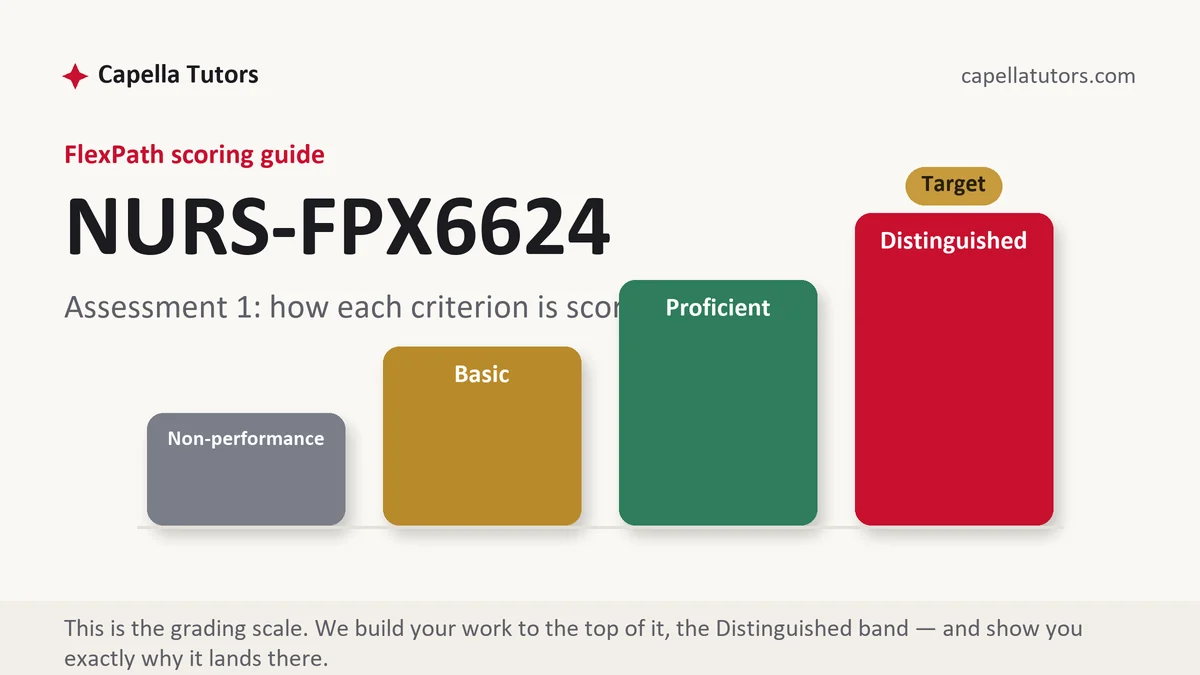
How NURS-FPX6624 Assessment 1 is scored
FlexPath grades each criterion at one of four levels, and on a case analysis the levels come apart like this:
| Level | What it means on an ethical and legal case analysis |
|---|---|
| Distinguished | The governing law is cited by section, the obligations that conflict are named with the parties who hold them, a decision is made and reasoned, and the residual harm the decision leaves behind is stated. |
| Proficient | A correct analysis with law and ethics both handled, reaching a defensible position, without the adjudication between competing obligations written out where the reader can audit it. |
| Basic | Principles defined, a regulation summarized, and a conclusion that follows from neither. The case turns out not to have been difficult after all. |
| Non-performance | A required element is absent, most commonly the legal analysis, the counterposition, or any decision at all. |
Two moves raise the whole guide here. Cite the regulation or the code provision you are relying on rather than an article about it, and separate the question of what is permitted from the question of what is right. Papers that keep those two questions apart read as graduate work even before the argument begins.
The NURS-FPX6624 Assessment 1 method, step by step
-
Reduce the case to the decision someone has to make
Write the decision in one sentence with a deadline attached: whether the discharging hospital may send a patient's behavioral health treatment history to the receiving agency this afternoon, and on whose authority. A case without a decision produces commentary, and commentary cannot be scored against criteria that ask you to apply law and ethics to a choice.
-
Draw the legal boundary before you argue any ethics
Establish what the law permits, requires, and forbids first, cited to the regulation itself. For information moving between organizations that means the privacy rule provisions on treatment, payment, and health care operations, the minimum necessary standard, and the business associate obligations that follow the data downstream. Quote sparingly, cite by section, and never let a secondary article stand in for the text you are relying on.
-
Check whether a stricter rule sits on top of the general one
General privacy law is the floor, not the ceiling. Federal protections for substance use disorder treatment records impose their own consent regime, and recent rulemaking has moved that regime closer to the privacy rule, which is a reason to cite the current text rather than an older summary of it. State law adds further protection in many jurisdictions for behavioral health records, minors, and reproductive care. Name the state layer as a variable and say how you resolved it.
-
Name the obligations and the parties who hold them
Set the conflict out as a table before you write prose. The patient holds an interest in confidentiality and in a receiving team that can treat him safely. The nurse coordinator holds obligations under the code of ethics to both self-determination and protection from avoidable harm. The receiving agency holds a duty of competent care it cannot discharge without information. Conflicts written as parties and interests do not collapse into vagueness the way principle lists do.
-
Rule between the obligations, and show the reasoning
Make the decision and give the grounds: the severity and likelihood of the harm from silence, whether a narrower disclosure would serve the clinical need, and whether consent can be obtained in the time available. Cite the code of ethics by provision and apply the provision to the actual choice. A decision reached without visible grounds reads as a preference, which is the most common reason a strong paper stalls at Proficient.
-
Answer the strongest objection, then score your own draft
State the best version of the opposing position, including who would hold it, and answer it on its own terms rather than dismissing it. Then name what your decision costs and who bears the cost. Read each criterion, mark your own level, and rewrite anything below the top before submitting early enough to use the evaluator's comments.
A structure that maps to the criteria
These are our tutors' planning targets for a master's case analysis, not Capella requirements; your scoring guide decides which section carries the weight.
| Section | What it must do | Guide |
|---|---|---|
| Case and decision | The de-identified facts, the decision in front of the coordinator, and the timeframe that makes it urgent. | ~200 words |
| Legal analysis | The statutes and regulations that govern the choice, cited by section, with the stricter and state layers identified. | ~350 words |
| Obligations in conflict | Every party, what each one holds, and where the obligations pull against each other rather than merely coexist. | ~300 words |
| Decision and reasoning | The position taken, the grounds for it, and the narrower alternatives considered and rejected. | ~350 words |
| Residual harm and safeguards | What the decision costs, who absorbs it, and the safeguards that limit the damage. | ~250 words |
| References | APA 7, peer-reviewed ethics and health law scholarship plus primary legal and professional sources. | as needed |
Annotated sample excerpt
A short original passage from our team, showing what adjudication looks like once it reaches the page. Take the reasoning pattern and run your own case through it.
Permitted and warranted are separate findings here, and the analysis has to reach both.1 The privacy rule would allow a treatment disclosure to the receiving agency without additional authorization, yet the record in question originated with a federally protected program, and the coordinator's obligation to the patient's own decision making is not discharged by the existence of a permission.2 The defensible course is the narrower one: seek written consent for a limited disclosure naming current medications and the next appointment, exclude the treatment narrative, and document the request and the patient's answer before transport, accepting that this leaves the receiving nurse with less context than she would want and that the residual risk falls on her assessment rather than on the record.3
- 1The paragraph opens by separating the legal question from the ethical one in a single sentence. That distinction is the analytic spine of the course, and stating it plainly signals the reader is about to get reasoning rather than a summary.
- 2The stricter regime is identified as the operative one, and the professional obligation is described as unfinished business rather than as a competing preference. In the finished paper both claims carry citations to primary sources.
- 3The ruling is specific enough to execute, the narrower option is chosen deliberately, and the residual risk is placed with the person who will carry it. Naming who absorbs the cost is what keeps a resolution from reading as tidy.
The full premium sample for your exact assessment, written fresh to your scoring guide and issue, is free to request. Study it, revise it into your own voice, and submit work you understand.
The five mistakes that cost Distinguished
- Principles explained, never applied. Four ethical principles set out at length, with none of them attached to the decision the case demands.
- Law collapsed into ethics. A permitted disclosure treated as automatically the right one, which skips the analysis the criterion exists to reward.
- One legal category for everything. All clinical information handled under general privacy law, with no attention to the categories that carry stricter federal or state rules.
- Secondary sources for primary claims. A regulation or a code provision described through a blog post or a review article rather than cited from the text.
- A resolution with no residue. A decision that costs nothing, excludes nobody, and answers no objection, which tells the evaluator the case was never a dilemma.
Pre-submission checklist
- The decision stated in one sentence, with the timeframe that makes it urgent
- Every legal claim cited to the regulation or statute itself, by section
- Stricter federal protections and the state law layer both addressed explicitly
- Code of ethics used by provision and applied to a specific choice
- The strongest objection stated fairly and answered on its own terms
- Residual harm named with the party who bears it, APA 7 verified, draft self-scored
Case analysis due and the law is the hard part?
Send the scoring guide and the scenario you have been given. A premium original sample comes back inside 24 to 48 hours with the legal boundary cited to primary sources and the ethical reasoning written out, then revised free until your target column is met.