This manual is for NURS-FPX6622 Assessment 3, start to submission. Send the guide and a premium original sample lands inside 24 to 48 hours, revised free until it meets the criteria. Assessment 3 in this course usually asks how you would know whether the coordination work succeeded: a measurement and evaluation plan, or an equivalent deliverable that pairs measures with data sources and a reporting rhythm. Your scoring guide decides the exact form and audience. Below is the method our tutors use to build a measurement plan that a quality department would accept, the section map the criteria imply, and an annotated excerpt. Your courseroom may print this as NURS FPX 6622 Assessment 3 or NURS6622 Assessment 3; it is the same deliverable, and NURS-FPX6622 Assessment 3 is what this manual walks through.
One honesty note before the manual: Capella revises courses and scoring guides over time, so always write to the exact scoring guide attached to your assessment in the courseroom. The course identity above is verified on capella.edu; the method and structure below are our tutors' approach to it, not Capella's official rubric text.
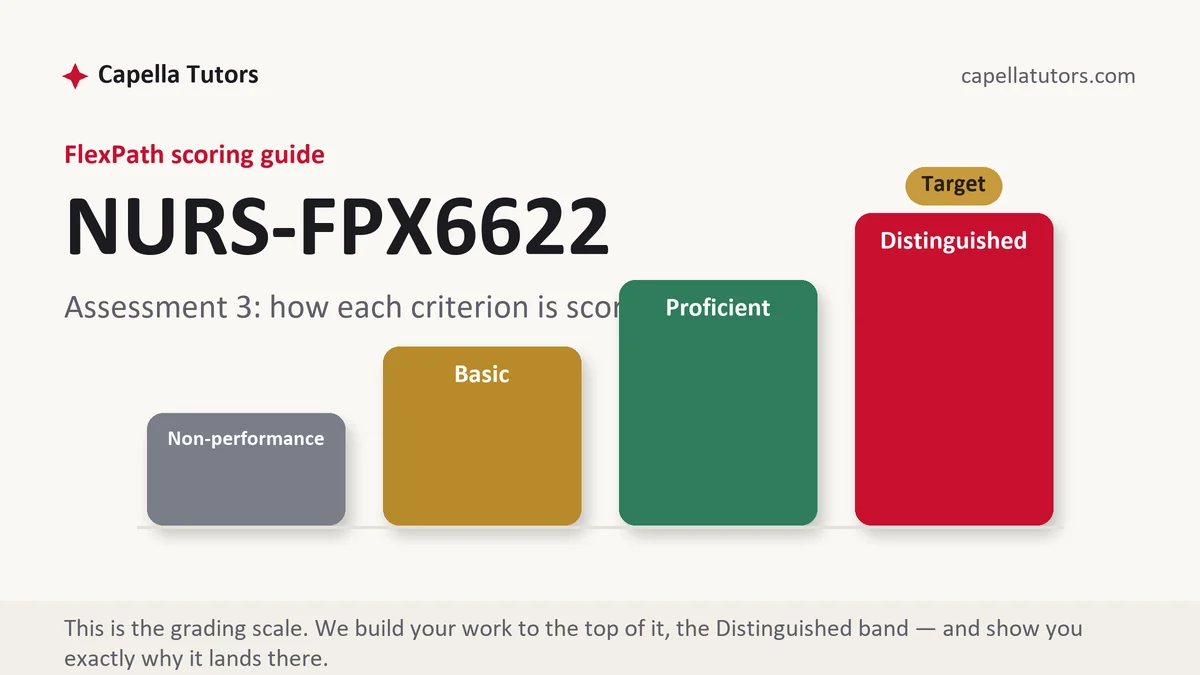
How NURS-FPX6622 Assessment 3 is scored
Levels are assigned criterion by criterion, and a measurement plan separates across them like this:
| Level | What it means on a measurement plan |
|---|---|
| Distinguished | Measures are specified rather than named, each with numerator, denominator, source, cadence, and owner, balanced across outcome and process, with a stated threshold for continuing or stopping the program. |
| Proficient | A sound set of measures with data sources identified, but specified loosely enough that two analysts would count them differently. |
| Basic | A list of outcomes the program hopes to improve, with no denominators, no sources, and no way to compute anything. |
| Non-performance | A required element is missing, most often the data source, the evaluation timeline, or the process measures the criterion asks for by name. |
A measure is only real once someone could compute it without calling you. Write each one so an analyst who has never read your proposal could produce the number, and the specification criterion takes care of itself.
The NURS-FPX6622 Assessment 3 method, step by step
-
Say what a working program would look like in numbers
Write two or three sentences describing success as figures rather than adjectives: more patients reached in their own language, fewer interpretation-dependent visits without a navigator, higher completion of the visit the navigator scheduled. Those sentences become your outcome measures, and anything you cannot state this way is a value rather than a measure.
-
Specify each measure as a numerator over a denominator
A measure without a denominator is a count, and counts move when volume moves. Percentage of Spanish-preferred patients with a documented language preference in the record, denominator all patients registered in the period. Percentage of navigator-scheduled follow-up visits completed within thirty days, denominator all such visits scheduled. Add the source, the collection interval, and the person who owns the number.
-
Borrow published specifications instead of inventing your own
Where a national measure already exists, use it and cite it, because a published specification arrives with a definition and a benchmark attached. CMS measure specifications, quality measures maintained through federal programs, and the language and communication expectations in national standards for culturally and linguistically appropriate services all give you defensible definitions that faculty can check.
-
Attach one process measure to every step that can fail quietly
Outcome measures tell you whether something changed; process measures explain why. If the navigator's value depends on reaching patients within two days of referral, measure that contact rate. If it depends on interpreters being booked in advance, measure advance booking. Distinguishing implementation from effect is standard practice in implementation research, and naming that distinction in the paper reads as graduate-level work.
-
Add a balancing measure and a stopping rule
Every coordination program consumes something. Watch for the harm: front desk wait times, clinician visit length, or the time a nurse now spends on documentation that used to go to patients. Then state in advance what result would justify stopping or redesigning the program. A plan that cannot fail was never an evaluation.
-
Fix cadence, ownership, and review, then self-score the plan
Give every measure a reporting interval, a named owner, and a forum where the numbers get discussed and acted on. Write the review date and who has authority to change the program. Then read each criterion, mark your own level, and rewrite anything below the top before submitting early in the week.
A structure that maps to the criteria
Section proportions our tutors plan around for a master's evaluation plan, not Capella requirements; the criteria in your guide decide what expands.
| Section | What it must do | Guide |
|---|---|---|
| Purpose and program summary | What is being evaluated, in two paragraphs, so the measures that follow have something to attach to. | ~200 words |
| Outcome measures | Two or three results the program is accountable for, fully specified with sources and comparison points. | ~300 words |
| Process measures | One measure per fragile step, each specified the same way, with the failure it is designed to detect named. | ~350 words |
| Balancing measures and risks | What the program might degrade elsewhere, how that will be watched, and the threshold for acting. | ~250 words |
| Data, cadence, and governance | Sources, collection intervals, owners, the reporting forum, the review date, and who may change the program. | ~300 words |
| References and measure table | APA 7 with measure specifications credited to the issuing body, plus a table a reader can compute from. | as needed |
Annotated sample excerpt
An original excerpt from our team, showing a measure written to the standard a quality department would accept. Learn the specification habit and apply it to yours.
Measure 3, timely navigator contact. Numerator: patients contacted by a bilingual navigator within two business days of referral, contact documented in the navigator note. Denominator: all patients referred to the navigator program in the reporting month, excluding those who declined at the point of referral.1 Source: referral queue timestamps joined to navigator note timestamps, pulled monthly by the clinic analyst, with the program manager accountable for the number.2 This is a process measure, not a result: it exists because the retention effect claimed for navigation depends on early contact, so a flat outcome with a contact rate of 54 percent is an implementation finding rather than evidence that navigation does not work.3
- 1Numerator, denominator, and exclusion are written out. An analyst could compute this without asking a single question, which is exactly what the specification criterion is testing.
- 2The data source names the two systems and the join between them, plus the owner of the number. Plans that skip the source are the ones that cannot be implemented, and evaluators know it.
- 3The measure's job is stated explicitly, which is the sentence that separates a measurement plan from a wish list. It also protects the program from being judged on an outcome it never had the chance to produce.
The full premium sample for your exact assessment, written fresh to your scoring guide and issue, is free to request. Study it, revise it into your own voice, and submit work you understand.
The five mistakes that cost Distinguished
- Counts posing as measures. Numbers with no denominator, which rise and fall with volume and prove nothing either way.
- Outcomes only. A plan that can report a flat result but cannot explain it, because nothing was measured about implementation.
- Invented definitions. A homemade measure used where a published national specification exists, discarding both the definition and the benchmark.
- No source. Measures with no system, no report, and no owner, which means nobody will ever produce them.
- No stopping rule. An evaluation with no threshold for redesign, which quietly turns the plan into a promotion.
Pre-submission checklist
- Every criterion answered in its own labeled section
- Each measure written with numerator, denominator, exclusions, and reporting interval
- National specifications used and cited wherever one exists for your measure
- At least one process measure for each step the program depends on
- A balancing measure and a stated threshold for redesigning or stopping
- Owner and forum named for every number, APA 7 verified, draft self-scored at the top level
Measurement plan due this week?
Send the scoring guide and the program you are evaluating. A premium original sample comes back inside 24 to 48 hours with every measure fully specified, sourced, and owned, then revised free until it clears your guide.