This manual is for NURS-FPX6622 Assessment 2, start to submission. Hand this one over and a premium original sample arrives inside 24 to 48 hours, built to your scoring guide and revised free until it reaches the target column. Assessment 2 in this course usually turns analysis into a build: the structure a coordination program needs, the process it will actually run, and the accountability that holds the two together. Your scoring guide decides whether that arrives as a proposal, a design document, or a protocol. What follows is how our tutors write a design that a stranger could execute, the section map the criteria imply, and an annotated excerpt. Your courseroom may print this as NURS FPX 6622 Assessment 2 or NURS6622 Assessment 2; it is the same deliverable, and NURS-FPX6622 Assessment 2 is what this manual walks through.
One honesty note before the manual: Capella revises courses and scoring guides over time, so always write to the exact scoring guide attached to your assessment in the courseroom. The course identity above is verified on capella.edu; the method and structure below are our tutors' approach to it, not Capella's official rubric text.
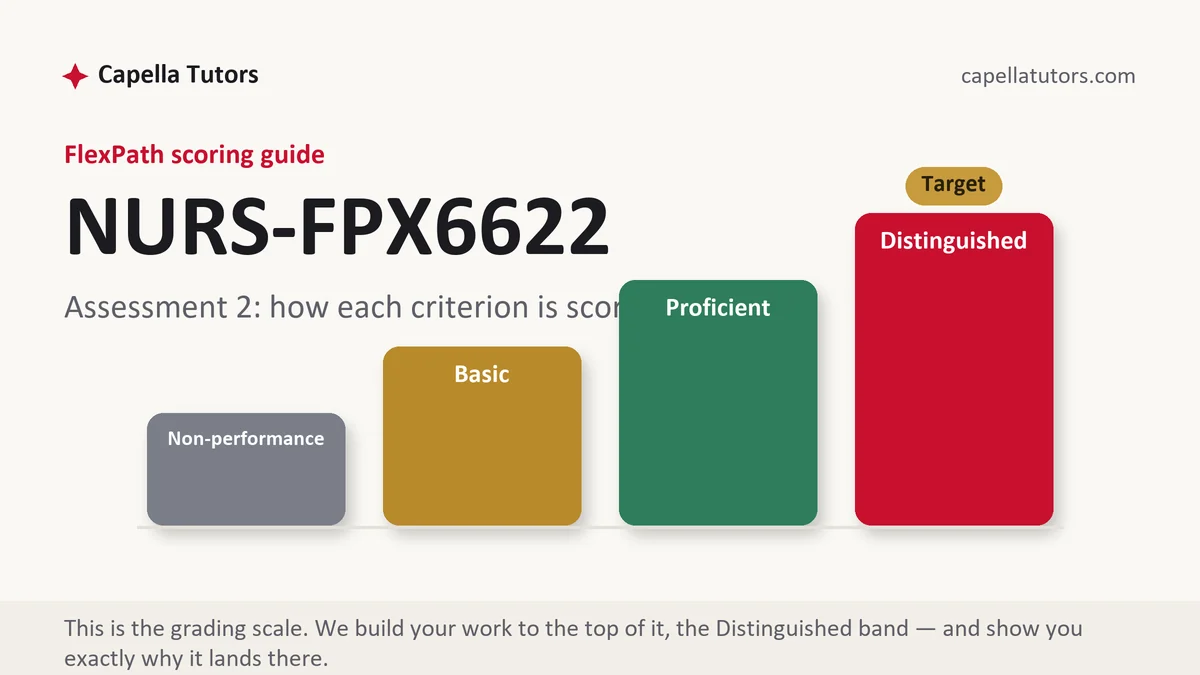
How NURS-FPX6622 Assessment 2 is scored
The four FlexPath levels apply per criterion, and on a design deliverable they separate roughly like this:
| Level | What it means on a process design |
|---|---|
| Distinguished | Steps carry actors, triggers, artifacts, and time windows, each step has one owner, exception paths exist for the steps that fail, and every structural element is justified by the step depending on it. |
| Proficient | A workable design, clearly written and evidence-based, that assumes cooperation and describes only the path where each step succeeds. |
| Basic | A proposal in principle: a new role, better communication, closer follow-up, with no sequence a reader could run on Monday. |
| Non-performance | A required component is absent, commonly the role accountability, the process detail, or the evidence base for the design choices. |
Design criteria are graded for executability. Read your own draft as the person who has to work the process on a Tuesday with two staff out, and the vague steps identify themselves.
The NURS-FPX6622 Assessment 2 method, step by step
-
Design against named gaps, not against a general aspiration
Open the design file by listing the specific breaks it exists to close, in the order you intend to close them. A referral pathway built because palliative care is underused will drift; a pathway built because oncology and heart failure clinics have no shared eligibility trigger and no way to see whether a referral was accepted will not.
-
Write the process as numbered steps before writing any prose
Draft the sequence as a bare list: who acts, on what signal, producing what, within how long, recorded where. For a referral pathway that means a screening trigger inside the clinic visit, a referral order with a required reason field, an acceptance decision returned inside two business days, and a first contact window the patient is told about before leaving. Prose written over a list that already holds up rarely loses the process criterion.
-
Give every step one owner and a named backup
Ownership is what the criteria test hardest. Write each step with a single accountable role, then write who covers it during vacation, night shift, and the week the position sits vacant. Shared accountability for the same step is the most reliable way to produce a step nobody performs, and evaluators who have run a service recognize it on sight.
-
Justify each structural element by the step that depends on it
Structure has to earn its place. A navigator position exists because someone must hold the acceptance decision inside two days. A shared field in the record exists because the referring clinician needs to see the outcome without a phone call. Protected time exists because the huddle is where cases without an obvious owner get one. Admit the cost of each element in the same sentence that justifies it.
-
Write exception paths, and cite the design evidence for them
Every fragile step needs its failure branch: referral not accepted, patient unreachable after three attempts, hospice eligibility discovered mid-pathway. Ground the design choices in published work rather than instinct, using peer-reviewed trials of outpatient palliative care for the referral criteria, AHRQ toolkit material for handoff structure, and Joint Commission standards where they set expectations for communication during transitions.
-
Pressure-test the design, then score it against the guide
Run the sequence mentally through three bad days: a volume spike, a vacancy, and a partner who declines to participate. Fix what breaks, then read every criterion and mark your own level. Anything below the top gets another pass before you submit, and submitting early in the week keeps the evaluator's comments useful inside the same session.
A structure that maps to the criteria
Planning proportions our tutors use for a master's design document, not Capella rules; your scoring guide decides which section carries the weight.
| Section | What it must do | Guide |
|---|---|---|
| Design purpose and scope | The gaps being closed, the patients in scope, and what the design deliberately leaves out of scope. | ~200 words |
| Structure | Roles, caseload assumptions, record fields, meeting cadence, and protected time, each tied to the step that requires it. | ~350 words |
| Process | The numbered sequence with actor, trigger, artifact, time window, and documentation location for every step. | ~450 words |
| Accountability and exceptions | One owner per step, coverage arrangements, and the failure branch for each step that can break. | ~300 words |
| Evidence and rationale | The peer-reviewed and agency sources behind the design decisions, each attached to the decision it supports. | ~250 words |
| References and figure | APA 7 with agency material credited to the issuing body, plus a workflow figure the text refers to. | as needed |
Annotated sample excerpt
An original passage from our team showing the grain a process criterion is written for. Copy the shape, not the wording.
Step 4. The oncology or heart failure clinician places the palliative referral inside the same visit the trigger fires, using an order that requires a reason code and a symptom or goals-of-care field; the order is visible to the referring clinician in the shared plan view.1 Step 5. The palliative nurse coordinator reviews every new referral each weekday by 11:00 and returns an acceptance, a decline with a reason, or a request for information within two business days, and the coordinator on the weekly rotation covers this step during absence.2 If no response is recorded by day three, the pathway escalates automatically to the palliative medical director, who owns the decision and documents it in the same field, so an unanswered referral becomes visible rather than silent.3
- 1The step names an actor, a trigger, an artifact with required fields, and where the result becomes visible. That is the level of specificity the process criterion is written to reward.
- 2A time window and a named backup appear in the same step. Coverage written into the step itself is what separates a design from a description of good intentions.
- 3The exception path is a step rather than a sentence about monitoring. Making failure visible to a named role is the design habit that most reliably reaches the top column.
The full premium sample for your exact assessment, written fresh to your scoring guide and issue, is free to request. Study it, revise it into your own voice, and submit work you understand.
The five mistakes that cost Distinguished
- Verbs with no actor. Steps built on coordinate, ensure, or monitor, which describe a wish rather than an action anyone performs.
- Unjustified structure. New roles and new technology listed as requirements with no step that depends on them and no cost admitted.
- Two owners. Accountability split across roles for the same step, which in practice means the step is skipped and blamed later.
- Sunny-day design. No failure branch anywhere, so the process only describes the days when every step succeeds.
- Design by instinct. Time windows and eligibility criteria chosen without a citation, when published trials and agency toolkits supply defensible numbers.
Pre-submission checklist
- Each criterion answered in its own section, in the order the guide lists
- Every step written with actor, trigger, artifact, time window, and documentation location
- One accountable owner per step, with coverage named for absence and vacancy
- Each structural element justified by a dependent step and costed honestly
- Exception path written for every step that can plausibly fail
- Design choices cited to peer-reviewed or agency sources, APA 7 verified, draft self-scored
Need a design that survives a skeptical reader?
Send the scoring guide and the pathway you are building. We return a premium original sample inside 24 to 48 hours with the sequence written to the step, ownership assigned, and exception paths in place, then revise free until it meets your guide.