This manual is for NURS-FPX6622 Assessment 1, start to submission. Send the scoring guide and we return a premium original sample for this assessment inside 24 to 48 hours, revised free until it satisfies the guide. Assessment 1 in this course usually asks you to examine coordination as it currently runs before you propose anything: a pathway traced end to end, the points where information or accountability drops, and the evidence that those breaks matter. Your scoring guide decides the deliverable and any diagram it wants. Below is the method our tutors use for a current-state analysis, a section map built from the criteria, and an annotated excerpt. Your courseroom may print this as NURS FPX 6622 Assessment 1 or NURS6622 Assessment 1; it is the same deliverable, and NURS-FPX6622 Assessment 1 is what this manual walks through.
One honesty note before the manual: Capella revises courses and scoring guides over time, so always write to the exact scoring guide attached to your assessment in the courseroom. The course identity above is verified on capella.edu; the method and structure below are our tutors' approach to it, not Capella's official rubric text.
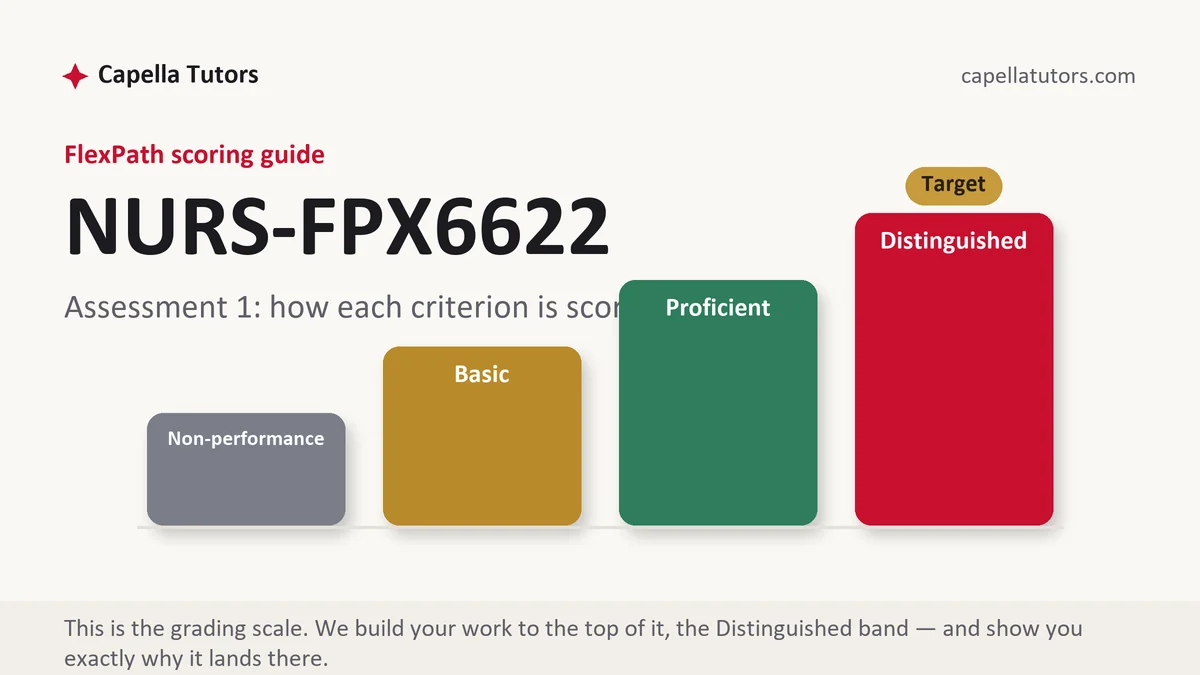
How NURS-FPX6622 Assessment 1 is scored
Each criterion in FlexPath is placed at one of four levels, and for an analysis of an existing process the levels come out like this:
| Level | What it means on a current-state analysis |
|---|---|
| Distinguished | The pathway is traced with actors, artifacts, and time windows, the breakdown points are located and quantified, and the analysis explains why each break happens rather than only that it does. |
| Proficient | An accurate account of the pathway with the problems identified, complete and readable, stopping short of the causal explanation the top level describes. |
| Basic | A general description of how discharge or follow-up works in principle, with problems named as themes rather than located at a step. |
| Non-performance | A required element never arrives, usually the process detail itself or the data that shows the gap is real. |
Analysis criteria reward specificity you can defend. A break located at a named step, with a plausible cause and a number beside it, satisfies several criteria at once, while a paragraph about communication barriers in health care satisfies none of them.
The NURS-FPX6622 Assessment 1 method, step by step
-
Turn the criteria into a data-collection list
Before looking at any pathway, read the scoring guide and write down what each criterion will require you to have found: a described process, a set of located gaps, evidence of impact, and a stakeholder account. That list is your fieldwork plan, and it stops you from writing three pages of context that no criterion asked for.
-
Trace the pathway the way the patient moves through it
Follow one cohort from the event that starts the process to the point coordination is supposed to end. For stroke survivors going home, that runs from the acute stay through rehabilitation decisions, prescriptions, therapy referrals, the first primary care visit, and the first month of caregiver work. Write each step as an actor, a trigger, an artifact, and a time window, since steps written as intentions hide the gaps you are looking for.
-
Time each handoff and record what stops moving
At every transfer, note what information travels, in what form, and whether anyone confirms receipt. Standard failure points in stroke follow-up include therapy orders that never reach the outpatient provider, discharge medication changes that never reach the community pharmacy, and a caregiver who leaves without a named contact. Confirmation is the detail most drafts omit, and it is where accountability actually breaks.
-
Sort what you found into structure, process, and outcome
Attribute that framework to Donabedian's own published work rather than to a nursing textbook that restates it, then use it as a filing system. Resources and arrangements are structure, activities are process, results are outcome. Sorting your findings this way exposes the papers that were about to claim a staffing decision improved a readmission rate with nothing in between.
-
Put a number next to every gap, from a source you can name
Each break needs a magnitude. National data will carry you where local data cannot: federal readmission and post-acute utilization reporting, AHRQ statistical briefs, and peer-reviewed cohort studies on follow-up completion after stroke. Where you estimate, label the estimate and say what it is based on, because a labeled estimate is defensible and an unlabeled one is not.
-
Draw the current-state map, then score the analysis yourself
Build the map after the prose, not before, so it reflects what you found rather than what you assumed. Keep it readable, one lane per role, gaps marked. Then read the draft against each criterion, mark your own level honestly, and rewrite anything short of the top before you submit early enough to use the evaluator's comments.
A structure that maps to the criteria
Word targets our tutors plan around for a master's current-state analysis, not Capella requirements; expand whichever criterion your guide weights most heavily.
| Section | What it must do | Guide |
|---|---|---|
| Purpose and setting | The population, the de-identified setting, and the coordination question the analysis answers. | ~150 words |
| The pathway as it runs | Every step with its actor, trigger, artifact, and time window, including the workarounds staff rely on. | ~400 words |
| Breakdown points | Three or four located failures, each with a plausible cause and a stated consequence for the patient. | ~350 words |
| Evidence of impact | The data showing these breaks matter, drawn from national reporting and peer-reviewed studies of comparable cohorts. | ~300 words |
| Stakeholders and implications | Who is affected at each break, what each of them currently absorbs, and what the analysis implies for redesign. | ~250 words |
| References and figure | APA 7 throughout, with the process map labeled and referenced from the text by number. | as needed |
Annotated sample excerpt
An original excerpt from our team at the level of detail an analysis criterion is written for. Take the structure and rebuild it around your own pathway.
The first break sits between the inpatient therapy team and the outpatient rehabilitation provider, where recommended therapy intensity travels as a free-text line inside the discharge summary and is never confirmed as received.1 Nobody owns that transfer: the therapist documents the recommendation, the discharging nurse assumes the summary carries it, and the outpatient scheduler works from a referral order that contains no intensity at all.2 The consequence is measurable in the schedule rather than the chart, since patients arrive for evaluation two to three weeks after discharge and start at whatever frequency the outpatient site has open, which is the point at which the plan built in the hospital stops being the plan.3
- 1The break is located between two named roles rather than described as a communication problem. Analysis criteria pay for a coordinate, and a coordinate is two roles and an artifact.
- 2The cause is written as a chain of reasonable assumptions instead of blame. Explaining why competent people produce a failure is the difference between the top level and the one below it.
- 3The consequence is stated where it can be observed, which sets up a process measure later and gives the evidence criterion something concrete to attach a citation to.
The full premium sample for your exact assessment, written fresh to your scoring guide and issue, is free to request. Study it, revise it into your own voice, and submit work you understand.
The five mistakes that cost Distinguished
- Process as intention. Steps written as coordinate, communicate, or follow up, with no actor, artifact, or time window anywhere in them.
- Themes instead of coordinates. Problems named as fragmentation or poor communication rather than located between two specific roles.
- An unsourced gap. A break asserted to be harmful with no data, no citation, and no labeled estimate of its size.
- The framework as decoration. Structure, process, and outcome named once, credited to a secondary summary, and never used to organize a finding.
- The tidy pathway. A description of the process on days when nothing goes wrong, with none of the workarounds staff actually use.
Pre-submission checklist
- Each criterion answered in its own labeled section, in the guide's order
- Every step written with an actor, a trigger, an artifact, and a time window
- Three or four breaks located between named roles, each with a plausible cause
- A number attached to every gap, sourced or labeled as an estimate
- The process map referenced from the text and readable without the prose
- Setting fully de-identified, APA 7 verified, draft self-scored at the top level
Analysis due before you can design anything?
Send the scoring guide and the pathway you are examining. A premium original sample comes back inside 24 to 48 hours with the process traced step by step and the gaps quantified, then revised free until your target column is met.