This manual is for NURS-FPX6620 Assessment 3, start to submission. We can build this one with you or for you, first premium sample free and back inside 24 to 48 hours. Assessment 3 in this course usually asks you to carry your model work to an audience: a presentation, or a similar audience-facing deliverable, with speaker notes doing the scholarly work the slides cannot. Your scoring guide decides the format and the audience, so confirm both before you design a slide. What follows is how our tutors storyboard an audience deliverable, the slide map that satisfies the criteria, and an annotated excerpt of speaker notes. Your courseroom may print this as NURS FPX 6620 Assessment 3 or NURS6620 Assessment 3; it is the same deliverable, and NURS-FPX6620 Assessment 3 is what this manual walks through.
One honesty note before the manual: Capella revises courses and scoring guides over time, so always write to the exact scoring guide attached to your assessment in the courseroom. The course identity above is verified on capella.edu; the method and structure below are our tutors' approach to it, not Capella's official rubric text.
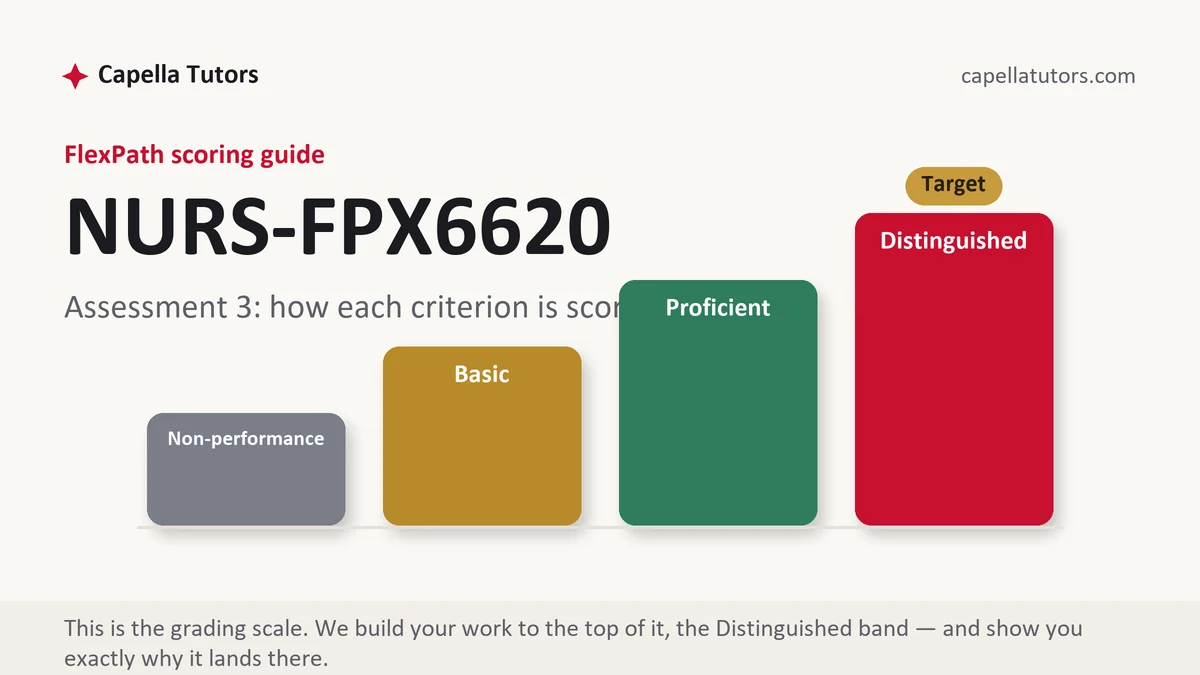
How NURS-FPX6620 Assessment 3 is scored
Presentation criteria in FlexPath are graded as strictly as paper criteria, and the four levels translate like this:
| Level | What it means on a presentation with notes |
|---|---|
| Distinguished | Slides carry one claim each, notes carry the evidence and the citations, the audience's own objections are answered on the slide where they arise, and the close asks for a specific decision. |
| Proficient | Accurate content, properly cited in the notes, delivered to the right audience, but written at the audience rather than around what the audience has to do next. |
| Basic | Slides used as a document: dense paragraphs read aloud, notes that repeat the slide text, and evidence that never appears in either place. |
| Non-performance | A required component is missing altogether, most often the speaker notes, the references, or the audience-specific framing the criterion names. |
The division of labor is what evaluators check first. A slide is a claim and an image of the data; the notes are where the peer-reviewed source, the agency report, and the caveat live. Collapse the two and both criteria suffer, since the slide becomes unreadable and the notes stop adding anything.
The NURS-FPX6620 Assessment 3 method, step by step
-
Name what the audience must be able to do afterward
Write the outcome first: the county health department and the clinic's leadership group leave able to choose between two linkage models for patients experiencing homelessness. That sentence decides which slides survive. Content that does not move an audience toward a decision is content the audience criterion will read as filler.
-
Storyboard the whole deck before writing any notes
One line per slide on paper, in order, until the sequence argues by itself. A workable spine for a model deck runs problem, population, two candidate models, evidence, recommendation, measures, ask. Storyboarding first prevents the classic failure where slides eleven through fifteen repeat slides four through eight in a different font.
-
Put the claim on the slide and the scholarship in the notes
Each slide gets a headline that states a claim, plus the minimum evidence needed to see it. The notes then carry the full argument in complete sentences, with citations in APA form: the peer-reviewed studies behind street medicine and clinic-based linkage, HRSA and AHRQ material on health center services for people experiencing homelessness, and the source of every number on the slide.
-
Translate the model into the audience's daily work
An audience of clinicians and outreach staff hears a model as a change to their week. Say who screens, who holds the panel, where the patient is seen when there is no fixed address, how a missed appointment is handled, and who does the pharmacy call. Concrete workflow is what separates a presentation that persuades from one that informs.
-
Rehearse against the clock and cut on evidence
Read the notes aloud and time them. If the deliverable has a length limit, cut the slide whose claim is least load-bearing rather than trimming words from every slide evenly. If the assessment asks for recorded audio, record a full pass, then listen once for pace and once for whether every number you say appears in the notes with a source.
-
Score the deck against the guide, including the citation criterion
Check each criterion separately: audience fit, content accuracy, evidence and citation, and communication quality. Presentations lose most often on citation, since slide decks tempt writers into uncited claims, so verify that every figure spoken has a reference in the notes and a matching entry on the reference slide.
A structure that maps to the criteria
A slide count our tutors plan around for a master's audience deliverable, not a Capella rule; your scoring guide and any stated time limit decide the real shape.
| Section | What it must do | Guide |
|---|---|---|
| Title and purpose | The decision on the table and the audience it belongs to, so the first thirty seconds orient rather than introduce. | 1 to 2 slides |
| Population and problem | Who the patients are, how many, and the coordination failure being fixed, with sourced figures. | 2 to 3 slides |
| Candidate models | Two or three models, one slide each, with structure and accountability shown rather than described. | 3 to 4 slides |
| Evidence | What is known about each model's results, with study design and setting acknowledged in the notes. | 2 slides |
| Recommendation and workflow | The chosen model rendered as who does what, plus the measures that will show whether it worked. | 3 slides |
| Ask and references | The specific decision or approval requested, then a reference slide in APA 7 covering every cited source. | 2 slides |
Annotated sample excerpt
An original excerpt from our team, showing what a speaker note looks like when it is doing scholarly work rather than restating a bullet.
Street medicine and clinic-based linkage have both been evaluated, and they do not perform the same job, which is why the slide shows their results side by side rather than stacked.1 Outreach delivered where people already are consistently improves initial engagement, while the studies reporting durable primary care attachment describe a named clinician and a held appointment slot, which is a linkage feature rather than an outreach feature.2 Most of this evidence comes from single-city programs with short follow-up, so the honest reading is that engagement gains are well supported and retention gains are promising rather than established.3
- 1The note explains the design choice on the slide, which is what a strong notes section does. An evaluator reading only the notes can reconstruct the whole argument, and the audience criterion rewards notes that a colleague could deliver from.
- 2The claim is attributed to a specific program feature rather than to a model label. Naming the active component is the analytic move the evidence criterion looks for, and it is what makes the later workflow slide defensible.
- 3The limitation is stated in the writer's own voice and graded, promising against established. Calibrated confidence is easier to defend than either enthusiasm or hedging, and it usually satisfies the limitations language in the guide.
The full premium sample for your exact assessment, written fresh to your scoring guide and issue, is free to request. Study it, revise it into your own voice, and submit work you understand.
The five mistakes that cost Distinguished
- Paragraph slides. A paper pasted onto slides, with notes that repeat what is already visible.
- Uncited numbers. Figures spoken aloud with no reference anywhere in the notes or on the reference slide.
- A generic audience. Content aimed at nobody in particular, when the criterion names the audience and expects the framing to change accordingly.
- No ask. A deck that ends on a summary slide instead of the approval, resource, or decision it was built to obtain.
- Workflow left abstract. A model recommended without saying who does what on which day, which leaves the audience nothing to agree to.
Pre-submission checklist
- Every criterion in the guide mapped to at least one slide before designing
- One claim per slide, with the supporting argument in complete sentences in the notes
- Every number on a slide traceable to a cited source in the notes
- Reference slide in APA 7, agency reports credited to the issuing body
- Workflow stated as roles and timing the audience would recognize
- Timed rehearsal completed and the deck self-scored at the top level on every criterion
Presentation due and no time to build it?
Send the scoring guide, the audience, and any time limit. You get a premium original deck with full speaker notes and an APA reference slide inside 24 to 48 hours, revised free until it meets the guide, and a walkthrough so you can deliver it in your own voice.