This manual is for NURS-FPX6424 Assessment 1, start to submission. Send us the scoring guide and this deliverable comes back as a premium original sample inside 24 to 48 hours, revised free until it satisfies the guide. Assessment 1 of NURS-FPX6424 is the course's opening working document. Your scoring guide decides the fields, and the assessment usually asks you to arrange and document a scheduled conversation that turns a vague interest in data into a feasible analytic question: what you want to know, which tables actually hold it, how far back the data is trustworthy, and who signs the extract. Your courseroom may print this as NURS FPX 6424 Assessment 1 or NURS6424 Assessment 1; it is the same deliverable, and NURS-FPX6424 Assessment 1 is what this manual walks through.
One honesty note before the manual: Capella revises courses and scoring guides over time, so always write to the exact scoring guide attached to your assessment in the courseroom. The course identity above is verified on capella.edu; the method and structure below are our tutors' approach to it, not Capella's official rubric text.
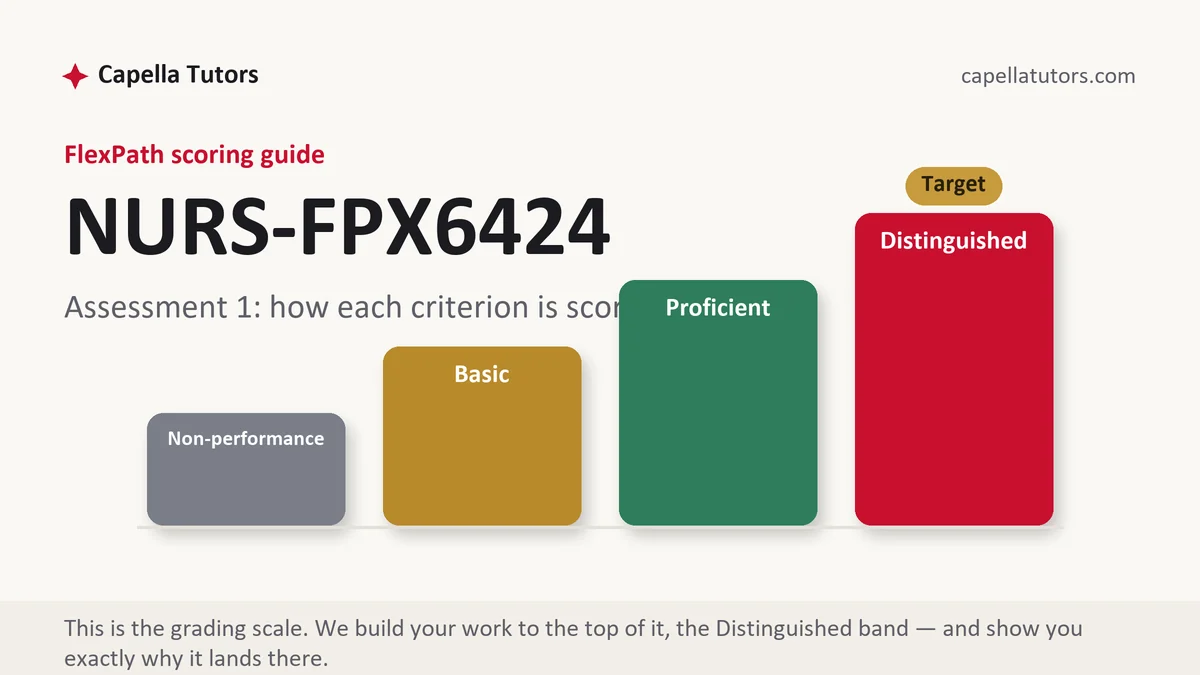
How NURS-FPX6424 Assessment 1 is scored
Nothing in FlexPath resolves to a letter. Each criterion lands on one of four levels, and on a scoping record for an analytic project the levels sort by feasibility:
| Level | What it means on a dataset scoping and feasibility record |
|---|---|
| Distinguished | One answerable question, the specific fields that answer it, the date the data became trustworthy, a named extract approver, and the honest note about what the available data will not support. |
| Proficient | The question is clear and the data source identified. Thorough, and still short of the top, because feasibility is assumed rather than tested. |
| Basic | An interesting question and a general plan to obtain data about it. The most common first version, and it caps the criterion, since nothing has been verified. |
| Non-performance | A required element is absent, usually the confirmed attendees or the data source. An analytic plan with no verified source is not a plan. |
Data mining courses fail in week one far more often than in week eight, and always the same way: a question the available data cannot answer. Spending this deliverable on feasibility rather than ambition is what buys you a working project, and the criteria are built to reward exactly that trade.
The NURS-FPX6424 Assessment 1 method, step by step
-
Write the question so a table could answer it
Turn the interest into a sentence with a population, an outcome, a time frame, and a comparison. Rather than asking whether downtime hurts documentation, ask what proportion of medication administrations recorded on paper during unplanned downtime were reconciled into the record within 24 hours, across the last six events. The second question names a table, a denominator, and a window, so a data analyst can tell you in five minutes whether it is answerable.
-
Ask what exists before you ask what you want
Bring the data dictionary, or ask for it in the meeting. Confirm which fields are discrete, which are free text, which are optional at save, and which are calculated rather than entered. A field that looks perfect in a report specification and turns out to be optional at entry is the classic wasted month, and the conversation is where you catch it.
-
Find the date the data became trustworthy
Every dataset has a boundary before which it means something different: a build change, a policy change, a merger, a new module. Ask the analyst directly when the fields you need last changed definition, and set your window to start after it. Record that date and the reason in the notes, because it is the first thing a reader will question when your window looks short.
-
Size the sample before you promise a finding
Ask how many rows the window will produce and how many of them will contain your outcome. A rare outcome in a small window supports description and nothing more, and knowing that in advance changes what you commit to. Write the expected counts into the record and note what the group agreed to do if the real extract comes back thinner than expected.
-
Specify the extract like a contract
Fields, filters, aggregation level, date range, output format, identifiers included or removed, who approves, where it will be stored, and how long you keep it. Specifying the aggregation level matters more than students expect: a file of one row per encounter and a file of one row per department per month answer different questions and cannot be converted into each other.
-
Record the honest limitation and set the gates
Name in the record what the available data will not be able to establish, then attach dated gates with named deciders to every open item, distribute the notes, and log the date. Ground the informatics role in the ANA scope and standards material rather than describing yourself as a data enthusiast, and cite it as a report in APA 7.
A structure that maps to the criteria
The word targets below are our tutors' planning proportions for a record of this kind, not Capella rules; where your scoring guide names a template, use the template.
| Section | What it must do | Guide |
|---|---|---|
| Purpose and the question | The setting and the analytic question written with a population, an outcome, a window, and a comparison. | ~200 words |
| Attendees and authority | Who was present, and what each of them can approve: the extract, the definitions, or the staff time. | ~120 words |
| Data inventory | The tables and fields that hold the answer, whether each is discrete or free text, and whether it is optional at entry. | ~250 words |
| Trust boundary and window | When the fields last changed meaning, and the window the group agreed to work in as a result. | ~200 words |
| Extract specification | Fields, filters, aggregation level, identifiers, approver, storage, retention, and expected row counts. | ~250 words |
| Limits, gates, sources | What this data cannot answer, the dated gates with deciders, distribution log, and current APA sources. | ~200 words |
Annotated sample excerpt
An original model excerpt from our team, written the way an analyst reads a request. Study the moves in it, then write your own record around your own question.
The question is what proportion of medication administrations documented on paper during the six unplanned downtime events since January were reconciled into the electronic record within 24 hours, and whether the proportion differs between the units that hold a printed recovery packet and those that do not.1 Three fields carry the answer, and only two of them are dependable: the administration timestamp and the entered-by user are required at save, while the downtime-entry flag is optional and was added to the build on March 18, so events in January and February cannot be identified from the flag and have to be bounded by the incident log times instead.2 The analyst estimates 4,100 administrations inside the six event windows, which is enough for a proportion by unit and not enough for anything by shift, and the group agreed to report unit-level figures only.3
- 1States the question with a population, an outcome, a window, and a comparison, so its answerability can be judged in a single reading.
- 2Separates the reliable fields from the unreliable one, gives the build date that created the boundary, and names the substitute source. This paragraph is the difference between a feasible project and a stalled one.
- 3Sizes the sample before promising a finding and lets the row count decide the level of reporting. Deciding granularity from the data rather than from ambition is a graduate habit.
The full premium sample for your exact assessment, written fresh to your scoring guide and issue, is free to request. Study it, revise it into your own voice, and submit work you understand.
The five mistakes that cost Distinguished
- A question no table can answer. Broad curiosity about a topic cannot be extracted, and the criterion for the analytic plan is measuring exactly that specificity.
- Fields assumed to be complete. Optional-at-save fields look identical to required ones in a report specification, and the difference only appears once the extract arrives.
- No trust boundary. A window that reaches back across a build or policy change mixes two different measurements and invalidates the comparison you wanted most.
- Aggregation left unspecified. One row per encounter and one row per unit per month are not interchangeable, and requesting the wrong one costs a full cycle.
- Silence about limits. A record that promises what the data cannot deliver is the version faculty remember when they read your later assessments.
Pre-submission checklist
- The analytic question written with a population, an outcome, a window, and a comparison
- Fields inventoried as discrete or free text, and required or optional at entry
- The date the fields last changed meaning recorded, with the window set after it
- Expected row and outcome counts estimated before any finding is promised
- Extract specified to field, filter, aggregation level, approver, storage, and retention
- One honest limitation stated, dated gates with named deciders, sources in current APA
Want the scoping record built with you?
Send the scoring guide and the question you are chasing. Our writers hold graduate nursing credentials and have specified extracts for real analytics teams, so the record comes back with the feasibility already tested on paper. Delivery in 24 to 48 hours, two rounds of quality review, and free revisions until the guide is met.