This manual is for NURS-FPX6400 Assessment 3, start to submission. Hand this one off and a premium original sample lands inside 24 to 48 hours, written to your scoring guide and revised free until it meets it. Assessment 3 of NURS-FPX6400 turns your analysis outward. Your scoring guide decides the format, and the assessment usually asks for a short, decision-forcing document addressed to administrative leaders: the informatics problem, the evidence, the options with their costs, a recommendation, and the measure that will tell everyone whether it worked. Length is not the difficulty here. Deciding is. Your courseroom may print this as NURS FPX 6400 Assessment 3 or NURS6400 Assessment 3; it is the same deliverable, and NURS-FPX6400 Assessment 3 is what this manual walks through.
One honesty note before the manual: Capella revises courses and scoring guides over time, so always write to the exact scoring guide attached to your assessment in the courseroom. The course identity above is verified on capella.edu; the method and structure below are our tutors' approach to it, not Capella's official rubric text.
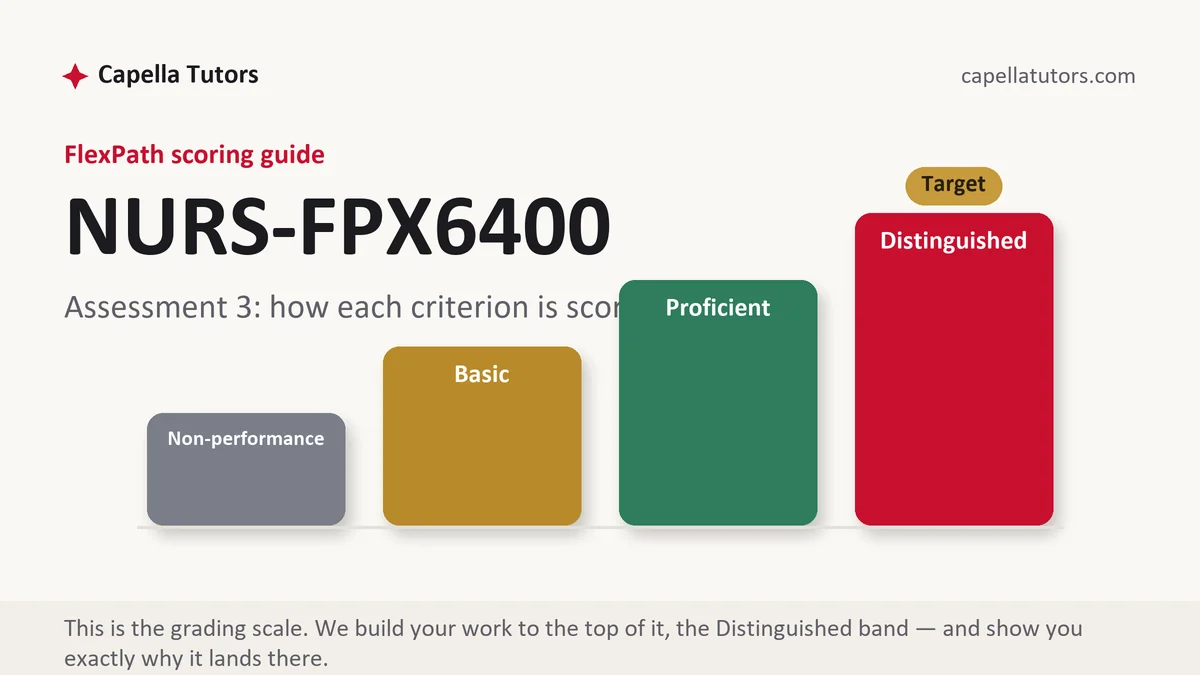
How NURS-FPX6400 Assessment 3 is scored
FlexPath criteria each resolve to one of four levels, and for a document written to executives the level language reads unusually plainly:
| Level | What it means on a summary written for administration |
|---|---|
| Distinguished | A named recommendation with its cost stated, the rejected option explained rather than ignored, and a measure with a denominator and a review date that would show the recommendation failing. |
| Proficient | A clear recommendation supported by evidence. Complete and readable, and still short of the top, because nothing in it can be falsified later. |
| Basic | A well-written account of a problem that leaves the decision to the reader. The most frequent outcome, and it caps the criterion regardless of prose quality. |
| Non-performance | A required element is missing, most often the alternatives or the evaluation measure. Executives notice the same absence the scoring guide does. |
The audience assumption drives every choice in this document. Leaders read for what changes, what it costs, and what happens if the recommendation is wrong, and they read the first hundred words with the most attention they will give the whole page. Write the recommendation into those hundred words.
The NURS-FPX6400 Assessment 3 method, step by step
-
Open with the decision you want made
The first sentence names the action, the owner, and the date. Everything after it is support. Documents that build to a recommendation in a final paragraph get skimmed to that paragraph anyway, and skimming is where nuance is lost. Lead, then justify.
-
Quantify the gap with a rate, not an anecdote
Give the reader a rate with its denominator and its window in the same sentence, then one sentence of context so the number means something: how it compares to the prior period, the peer unit, or a published benchmark. A single well-built rate carries more executive weight than a paragraph of description.
-
Show the options you rejected
Put two or three real options side by side, including doing nothing, and state what each costs in dollars, clinician time, and risk. A recommendation presented without alternatives reads as advocacy. A recommendation that survives a visible comparison reads as analysis, and that contrast is where the criterion pays.
-
Price the recommendation honestly
Name the build hours, the training time, the licensing or interface cost if there is one, and the workflow the change makes slower. Every real informatics change makes something slower. Naming that cost yourself is more persuasive than hoping no one asks, and leaders who find an unstated cost stop trusting the rest of the page.
-
Attach a measure that could fail
Write the evaluation as a specific metric with a denominator, a baseline, a target, and a review date, plus the person who reports it. Then say how you would distinguish a genuine improvement from an artifact of changed documentation, because a metric that only ever moves in the right direction is measuring the process rather than the outcome.
-
Cite the sources leaders find credible
Two layers hold up a document like this. Peer-reviewed informatics literature carries the claims about outcomes and clinician behavior, and standards and federal material carry the rules: the ONC resources on healthit.gov, including the SAFER guides for electronic record safety, AMIA and HIMSS publications on governance and competency, and the ANA informatics standards. A vendor page evidences what a product claims and never what it achieves.
A structure that maps to the criteria
The targets below are the proportions our tutors use for an executive-facing document, not Capella rules; if your scoring guide specifies a length or a template, that wins.
| Section | What it must do | Guide |
|---|---|---|
| Recommendation up front | The action, the owner, the date, and the single number that justifies it, inside the opening paragraph. | ~150 words |
| The gap, quantified | The rate with denominator, window, and comparison, plus the data-quality caveat that qualifies it. | ~250 words |
| Options and costs | Two or three alternatives including no action, each with dollars, hours, and risk stated side by side. | ~300 words |
| What the change requires | Build, training, governance approvals, and the workflow that becomes slower or harder as a result. | ~250 words |
| Evaluation plan | Metric, denominator, baseline, target, review date, reporting owner, and how a real gain is told from an artifact. | ~250 words |
| Risks, limits, references | What could make this fail, what the evidence cannot promise, and current APA sources. | ~200 words |
Annotated sample excerpt
An original model paragraph from our team, pitched at the altitude leaders actually read. Learn the sequence, then write your own document around your own recommendation.
Recommendation: fund 120 build hours and one analyst day per month so that referral status can be written back into the ambulatory record automatically, with the ambulatory operations director accountable and the change live by October 1.1 In the quarter ending June 30, 2,884 specialty referrals were placed from our twelve primary care sites, and 1,046 of them, 36 percent, had no consultation note or status of any kind in the record 60 days later; the comparable figure in the medical group's own 2023 review was 22 percent, and the gap widened after the referral queue moved to the shared work list in February.2 Doing nothing is a defensible option only if the 1,046 are being closed outside the record, and the 40-chart audit we ran in July found closure documented elsewhere for 7 of them.3
- 1Puts the action, the money, the owner, and the date in one sentence. A leader who reads nothing else knows what is being asked and who will answer for it.
- 2Reports the rate with its numerator, denominator, and window, then anchors it against a prior internal figure. The comparison does the persuading; the adjective would not have.
- 3Takes the null option seriously and tests it with a small audit instead of dismissing it. Killing the do-nothing case with evidence is what separates a recommendation from advocacy.
The full premium sample for your exact assessment, written fresh to your scoring guide and issue, is free to request. Study it, revise it into your own voice, and submit work you understand.
The five mistakes that cost Distinguished
- Burying the recommendation. A decision that appears in the last paragraph is a decision the reader made without you, and the criterion measures whether you drove it.
- Rates with no denominator. Thirty-six percent means nothing until the reader knows thirty-six percent of what, measured across which window, from which sites.
- The costless proposal. A change that slows nothing and burdens no one has not been thought through, and experienced leaders read the omission as inexperience.
- An unfalsifiable measure. If no plausible result would count as failure, the evaluation plan is decoration and the criterion treats it that way.
- Consumer sourcing at executive altitude. Vendor collateral and general health websites undercut a decision document that peer-reviewed informatics literature and ONC material would have carried.
Pre-submission checklist
- The recommendation, its owner, and its date appear in the first paragraph
- Every rate carries a numerator, a denominator, and a measurement window
- At least two alternatives priced beside the recommendation, including no action
- The cost of the change stated, including the workflow it makes slower
- A measure with baseline, target, review date, reporting owner, and a stated failure signal
- Peer-reviewed and federal or standards sources only, cited in current APA form
Need the executive document written?
Send the scoring guide, the setting, and any numbers you already hold. Our writers hold graduate nursing credentials and have built these recommendations for real committees, so the draft arrives speaking in program terms already. Delivery inside 24 to 48 hours, two quality passes before you see it, free revisions until it meets the guide.