This manual is for NURS-FPX6400 Assessment 2, start to submission. This one can come off our desk as a premium original sample with a walkthrough, back inside 24 to 48 hours. Assessment 2 of NURS-FPX6400 moves from arrangements to analysis. Your scoring guide decides the format, and the assessment usually asks you to take one informatics problem in a named setting and analyze it as a nurse accountable for the data: the chain from raw entry to a decision, the terminology governing each field, and the role boundaries around who fixes what. The register shift is the whole test. You stop writing as the nurse who uses the system. Your courseroom may print this as NURS FPX 6400 Assessment 2 or NURS6400 Assessment 2; it is the same deliverable, and NURS-FPX6400 Assessment 2 is what this manual walks through.
One honesty note before the manual: Capella revises courses and scoring guides over time, so always write to the exact scoring guide attached to your assessment in the courseroom. The course identity above is verified on capella.edu; the method and structure below are our tutors' approach to it, not Capella's official rubric text.
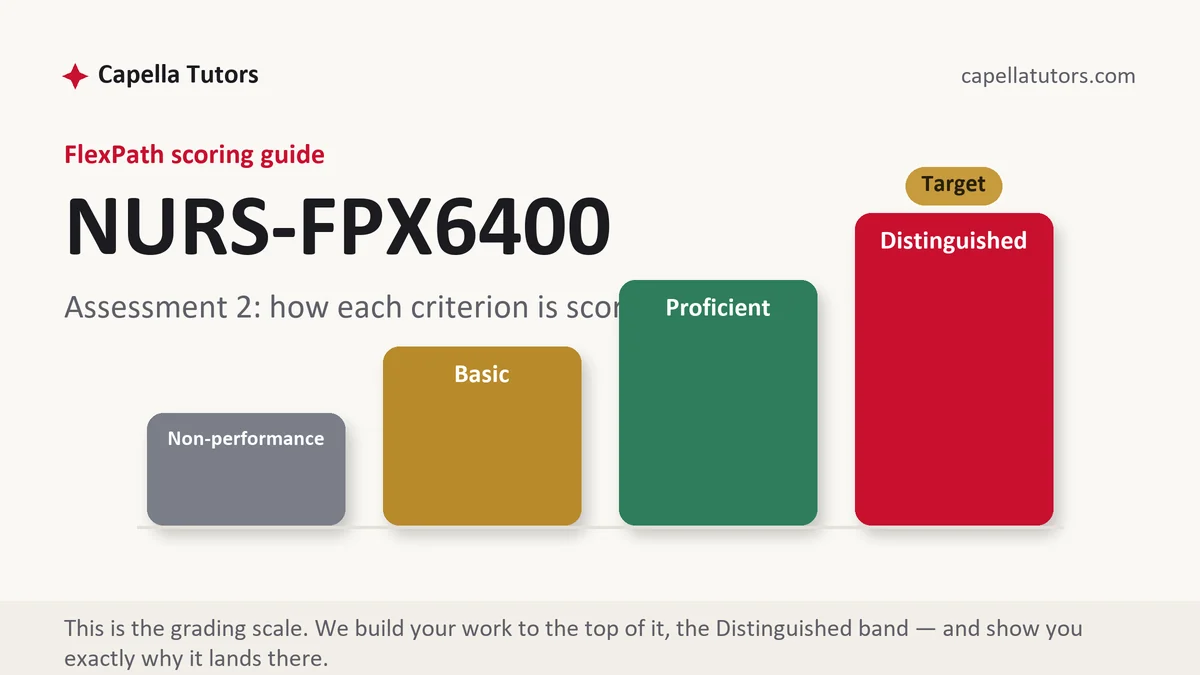
How NURS-FPX6400 Assessment 2 is scored
There are no letter grades in FlexPath. Every criterion lands on one of four levels, and those descriptions read as instructions for an analysis like this one:
| Level | What it means on an informatics practice analysis |
|---|---|
| Distinguished | One data element is traced from capture to decision with the mechanism named at each step, the governing terminology matched to the field, and the limits of the analysis stated in the writer's own words. |
| Proficient | The chain is described accurately and the standards are correct. Sound work that stops before it says what the analysis cannot establish. |
| Basic | The four levels of the data model are defined, correctly, in the abstract, with no element ever carried through them. The default outcome for a first submission at this level. |
| Non-performance | A required criterion has no corresponding section, most often the analysis of the informatics role itself. Nothing there scores nothing. |
Faculty reading this course have seen the data-to-wisdom model defined several hundred times. What they rarely see is one field followed the whole distance through a real system, which is why application is where the available credit actually sits.
The NURS-FPX6400 Assessment 2 method, step by step
-
Choose a field, not a topic
Pick one element you can point at in a live system: a discrete image-capture field, a coded problem entry, a timestamp. A topic such as wound documentation spreads a paper thin across everything; a single field forces every claim you make to have a location. Keep the same element from the first paragraph to the last.
-
Check the data before you interpret it
Pull a small extract and screen it before you build any argument on it. Count missing values, look for impossible entries, look for duplicates created by device or session behavior, and check whether the field changed definition inside your window. Report what the screen found. An analysis that never mentions data quality tells the evaluator the writer did not look.
-
Trace one element from capture to decision
Write the chain as a sequence with mechanisms attached. Who or what creates the value, what validates it, where it is stored, which report or view surfaces it, who reads that view, and what decision changes because of it. Every transition needs a named mechanism, because a transition with no mechanism is a diagram rather than an analysis.
-
Match the terminology to the field
Name standards against the specific data you chose rather than in a list. Clinical findings and problems belong in SNOMED CT, laboratory and observation names in LOINC, coded diagnoses in ICD-10-CM, nursing plan content in an ANA-recognized nursing terminology, and the messages moving between systems in HL7 formats. Then state what your organization actually uses in that field, and what a local pick list costs when the data leaves the unit.
-
Draw the role boundary in the open
Say which parts of the problem the informatics nurse decides, which parts the role recommends on, and which parts belong to security architecture, vendor code, or clinical governance. A boundary drawn explicitly reads as competence; bridge and champion language with no deliverable behind it reads as filler at graduate level.
-
Separate what you found from what you suspect
Use associative language for associative evidence. Units with the new capture workflow recorded fewer amended entries is a finding; the workflow reduced amendments is a causal claim your design cannot support. Then name one thing the analysis cannot settle. That sentence is cheap to write and it is often exactly what the top of the guide is paying for.
A structure that maps to the criteria
These are the planning targets our tutors work to for an analysis of this length, not Capella requirements; follow your scoring guide wherever it asks for more.
| Section | What it must do | Guide |
|---|---|---|
| Setting and problem | The organization, the system or module, and the informatics problem stated as a measurable gap in how data is captured or used. | ~200 words |
| Data quality screen | What you checked in the extract, what you found, and which conclusions you held back as a result. | ~200 words |
| The element traced | One field followed from capture to decision, with the mechanism and the accountable person named at each step. | ~350 words |
| Standards and terminology | The code sets governing that field, the local deviation if there is one, and the cost of the deviation downstream. | ~250 words |
| Role and boundaries | What the informatics nurse owns, recommends, and hands off across this problem, with a deliverable named per stage. | ~250 words |
| Limits, implication, references | What the analysis cannot establish, one action a leader could take this month, and current APA sources. | ~200 words |
Annotated sample excerpt
A model excerpt from our writers, showing how the register reads when application replaces definition. Use it as study material and write your own version around your own field.
A wound photograph enters the record as an image attached to an encounter, with the capture workflow supplying five discrete fields: anatomic site, measurement pair, ruler in frame, wound type, and the assessing clinician.1 In the eight-week extract, site was present on 96 percent of 412 captures and wound type on 61 percent, because wound type sits below the fold on the mobile capture screen and is not required for the image to save.2 The consequence is downstream rather than local: the wound care service's weekly review view filters on wound type, so roughly two in five images never reach the specialist queue, and the images that do reach it are not a random sample of the wounds photographed.3
- 1Names the field, the workflow that fills it, and the artifact it lives on. The evaluator can locate every noun in this sentence inside a real system.
- 2Reports completeness with a denominator attached, then gives the mechanical reason for the gap. A screen-layout cause is more useful to a committee than an appeal to nurse compliance.
- 3Carries the data problem to the decision it distorts, and names the selection bias rather than treating the queue as a sample of the population. This is the sentence that reads as graduate analysis.
The full premium sample for your exact assessment, written fresh to your scoring guide and issue, is free to request. Study it, revise it into your own voice, and submit work you understand.
The five mistakes that cost Distinguished
- Definitions in place of application. Three tidy paragraphs on data, information, knowledge, and wisdom, with no field ever carried through them, is the classic capped submission in this course.
- Terminology listed rather than mapped. SNOMED CT and LOINC named in one breath, neither attached to a field in the system you are writing about, reads as recall rather than practice.
- Numbers without denominators. A count of missing entries means nothing until the reader knows out of how many, over what window, and from which population.
- Causal verbs on associative evidence. Reduced, improved, and caused are earned by design, not by conviction, and evaluators at this level notice the substitution immediately.
- Bedside altitude. One nurse on one shift is the wrong unit of analysis when the criteria are asking about a system, a population, and a governance structure.
Pre-submission checklist
- One data element named in the first section and carried to the last
- A data quality screen reported, with the conclusions it forced you to withhold
- Every transition in the chain has a named mechanism and an accountable person
- Terminology matched field by field, local deviation and its downstream cost stated
- Associative findings written in associative language, with one stated limit
- Peer-reviewed informatics sources from the last five years, standards cited as reports in APA 7
Stuck on the analysis?
Send the scoring guide and the setting you want to write about. A research analyst pulls the evidence and the standards material first, a subject-matched informatics writer drafts to the Distinguished column criterion by criterion, and two quality passes follow before delivery inside 24 to 48 hours. Revisions stay free until the draft meets target.