This manual is for NURS-FPX6226 Assessment 3, start to submission. This is the technical centre of NURS-FPX6226. Your scoring guide sets the format, and the assessment usually asks you to build an operating budget for a defined unit and a capital request alongside it, then explain both in prose an executive could act on. The two documents are graded differently: an operating budget is judged on internal consistency and on whether the labor arithmetic honors how positions actually work, while a capital request is judged on whether it carries a life, a cost, and a return. Below sits the method our tutors use, a structure mapped to the criteria, and an annotated excerpt. Prefer it handed off? A premium original sample is delivered in 24 to 48 hours and revised free until your guide is satisfied. Your courseroom may print this as NURS FPX 6226 Assessment 3 or NURS6226 Assessment 3; it is the same deliverable, and NURS-FPX6226 Assessment 3 is what this manual walks through.
One honesty note before the manual: Capella revises courses and scoring guides over time, so always write to the exact scoring guide attached to your assessment in the courseroom. The course identity above is verified on capella.edu; the method and structure below are our tutors' approach to it, not Capella's official rubric text.
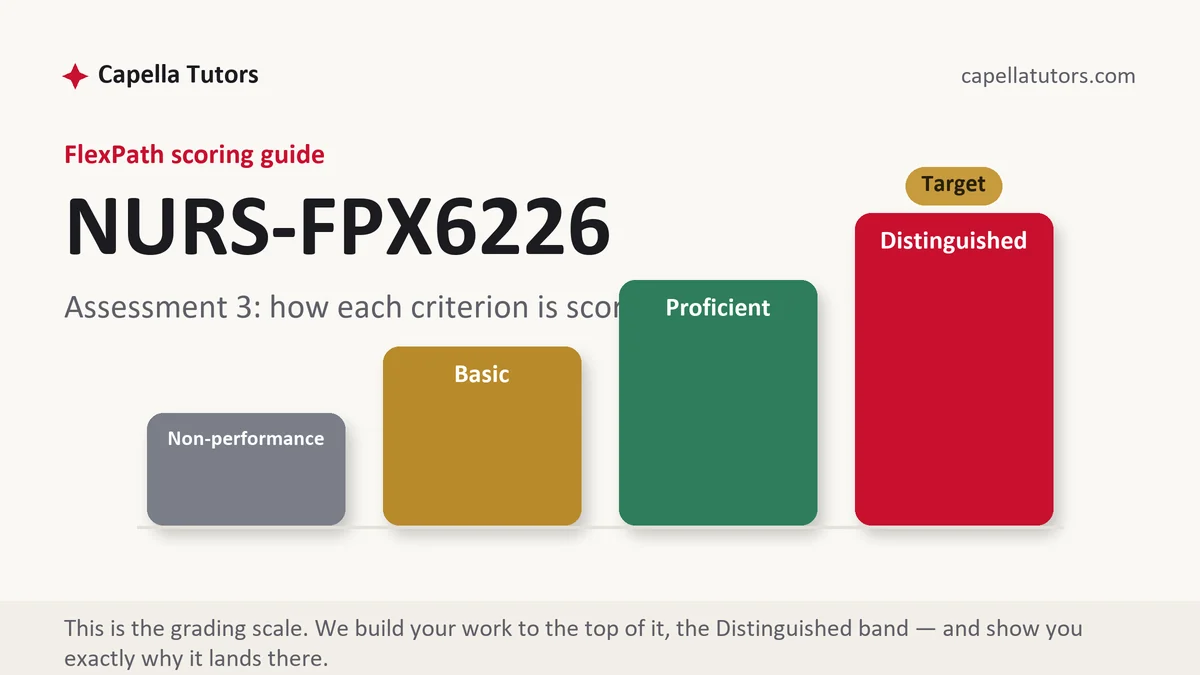
How NURS-FPX6226 Assessment 3 is scored
Criteria are scored one at a time against four levels, and on budget construction the levels are decided by arithmetic before they are decided by prose:
| Level | What it means on an operating and capital budget |
|---|---|
| Distinguished | The lines add up, every rate has a stated basis, paid and productive hours are distinguished, the capital request carries a useful life and a payback, and the narrative interprets the budget rather than repeating it. |
| Proficient | A complete and consistent budget with a properly formed capital request. What holds it below the top is interpretation: the narrative describes the lines instead of saying what the figures oblige a manager to do. |
| Basic | A table of plausible numbers with no visible basis, and a capital request that argues from need alone with no life and no return. |
| Non-performance | A required element is missing, most often the capital component, the assumption set, or the narrative, and its criterion falls to the floor. |
The single most common technical failure in this deliverable is treating paid hours and productive hours as the same thing. Paid time off, orientation, and education hours are paid and are not at the bedside, so a budget built on the assumption that a position delivers every hour it is paid for will under-hire and then spend the year explaining premium pay. State the non-productive percentage you are using, name where it came from, and apply it consistently in both the hours and the dollars.
The NURS-FPX6226 Assessment 3 method, step by step
-
Build the volume line first and derive everything from it
Beds, occupancy, and days give you patient days; patient days times the target hours per patient day give you productive hours; productive hours drive salary, and patient days drive supplies. Establish that chain at the top of your assumption table so a reader can follow any figure in the budget back to the volume line in two steps.
-
Distinguish paid hours from productive hours in writing
Convert productive hours to positions, then gross the positions up for paid non-productive time at a declared percentage, and show both numbers. Naming the productive position count and the paid position count separately signals immediately that you understand what you are budgeting, and it prevents the error that costs the staffing criterion most often.
-
Give every rate a basis in the line that uses it
Blended hourly rate from the payroll report or a published survey, benefit load as a stated percentage, supply cost per patient day from the prior year detail, premium pay assumption from the last three closed months. A rate with no basis is an unsupported claim, and in a finance paper it damages the evidence criterion exactly as an uncited assertion would elsewhere.
-
Separate the capital request from the operating budget properly
Capital items have a threshold, a useful life, and a depreciation consequence that lands in the operating budget afterward. Say which threshold your organization applies, state the life, and show the annual depreciation, because a capital request that never touches the operating statement has not been finished.
-
Make the capital case with a life, a cost, and a return
Name the one-time cost including installation, the recurring cost it removes or the harm cost it avoids, the payback period, and the useful life it has to be compared against. Where the benefit resists pricing, say so and give the operational consequence of refusal instead, including what happens if the request is deferred another year.
-
Write a narrative that interprets rather than repeats
The prose exists to say what the numbers oblige. Which line is most exposed if volume falls, which assumption you are least confident in, what you would stop doing if the organization asked for a three percent reduction, and which report you will monitor each month. Then read the whole document once for arithmetic alone, because one figure that disagrees with another invites a reader to distrust every other figure in it.
A structure that maps to the criteria
Word targets our tutors plan against for a deliverable of this kind, not Capella rules; follow your guide where it specifies exhibits.
| Section | What it must do | Guide |
|---|---|---|
| Unit and volume assumptions | Beds, occupancy, patient days, units of service, target hours per patient day, and skill mix, all stated as assumptions. | ~250 words |
| Labor budget | Productive hours, productive and paid positions, blended rate, benefit load, premium pay assumption. | ~320 words |
| Non-labor budget | Supplies and other variable costs per unit of service, plus fixed lines with their basis. | ~230 words |
| The capital request | Item, one-time cost with installation, useful life, depreciation, recurring cost avoided, payback period. | ~300 words |
| Narrative interpretation | The exposed lines, the weakest assumption, the reduction scenario, and the monitoring report. | ~280 words |
| Assumption table and references | Every assumption in one place with its source, and current APA citations both ways. | ~150 words |
Annotated sample excerpt
An original model excerpt from our team, showing the arithmetic that scores at the top of the guide. Take the method and build your own lines.
Thirty-four beds at eighty-eight percent occupancy give ten thousand nine hundred and twenty-one patient days, and at the division's six and one tenth target hours per patient day the unit needs sixty-six thousand six hundred and eighteen productive hours, which is thirty-two productive positions before any allowance for paid time away.1 Applying the twelve and a half percent non-productive rate the payroll office reports for this division grosses that to seventy-six thousand one hundred and thirty-five paid hours, or about thirty-six and six tenths paid positions, and at a blended forty-nine dollars fifty the salary line totals three million seven hundred and sixty-nine thousand before a twenty-six percent benefit load takes total labor to about four million seven hundred and forty-nine thousand.2 The capital request sits beside it and is deliberately small: twelve replacement lifts at nine thousand four hundred plus sixteen thousand of installation, one hundred and twenty-eight thousand eight hundred against a ten year life, which removes thirty-one thousand two hundred a year of rental and, at the organization's own handling injury cost, avoids about forty-six thousand more, giving a payback near one year and eight months.3
- 1The chain from beds to patient days to productive hours is visible, so any figure can be traced back in two steps. Stating the productive position count before the paid one is the move that shows the writer knows the difference.
- 2The non-productive percentage is named and attributed, and the benefit load is declared rather than folded silently into the rate. Every number here can be recomputed by a reader, which is what internal consistency means in practice.
- 3The capital request carries installation, a useful life, two separate offsets with the organization's own figure named, and a payback. Comparing payback against the life rather than reporting it alone is the part most submissions leave out.
The full premium sample for your exact assessment, written fresh to your scoring guide and issue, is free to request. Study it, revise it into your own voice, and submit work you understand.
The five mistakes that cost Distinguished
- Paid and productive hours treated as one. A position does not work every hour it is paid for. Budgets built that way under-hire and generate the premium pay they failed to forecast.
- Rates with no basis. An hourly rate, a benefit load, or a supply cost per day with no stated origin is an unsupported claim wearing a decimal point.
- A capital item with no life. Without a useful life there is nothing to compare the payback against, and the request becomes an appeal rather than an argument.
- Depreciation left out of the operating statement. Capital lands in operations the following year. A request that ignores it is only half a document.
- A narrative that reads the table aloud. The prose has to say what the figures oblige a manager to do, including what would be stopped if the budget were cut.
Pre-submission checklist
- The volume chain stated so any figure traces back to it in two steps
- Productive positions and paid positions both reported, with the non-productive percentage named
- Every rate carrying a basis in the line where it is used, benefit load declared
- The capital item shown with installation, useful life, depreciation, offsets, and payback
- A narrative that names the exposed line, the weakest assumption, and the reduction scenario
- One read for arithmetic alone, an assumption table, and current APA citations both ways
Budget and capital request due in 6226?
Send the prompt, the criteria, and any figures you have, even partial ones. We build the operating budget from a visible volume chain, keep paid and productive hours apart, source every rate, form the capital request with a life and a payback, and write a narrative that interprets rather than repeats. Back inside 24 to 48 hours, two independent reads with one devoted to arithmetic, revisions free until your guide is satisfied.