This manual is for NURS-FPX6226 Assessment 2, start to submission. The second deliverable in NURS-FPX6226 usually asks you to plan money before you spend it: your scoring guide decides the form, and the assessment typically wants a budget built around a strategic intention rather than a budget rolled forward from last year. That means a volume assumption you can defend, the resources the intention consumes, the contribution or savings it produces, and a sensitivity test on the assumption most likely to be wrong. Evaluators are reading for whether the figures agree with each other and whether each one has a visible origin. The method, a criterion-mapped structure, and an annotated excerpt sit below. Want it built for you? A premium original sample lands in 24 to 48 hours with revisions free until your guide is met. Your courseroom may print this as NURS FPX 6226 Assessment 2 or NURS6226 Assessment 2; it is the same deliverable, and NURS-FPX6226 Assessment 2 is what this manual walks through.
One honesty note before the manual: Capella revises courses and scoring guides over time, so always write to the exact scoring guide attached to your assessment in the courseroom. The course identity above is verified on capella.edu; the method and structure below are our tutors' approach to it, not Capella's official rubric text.
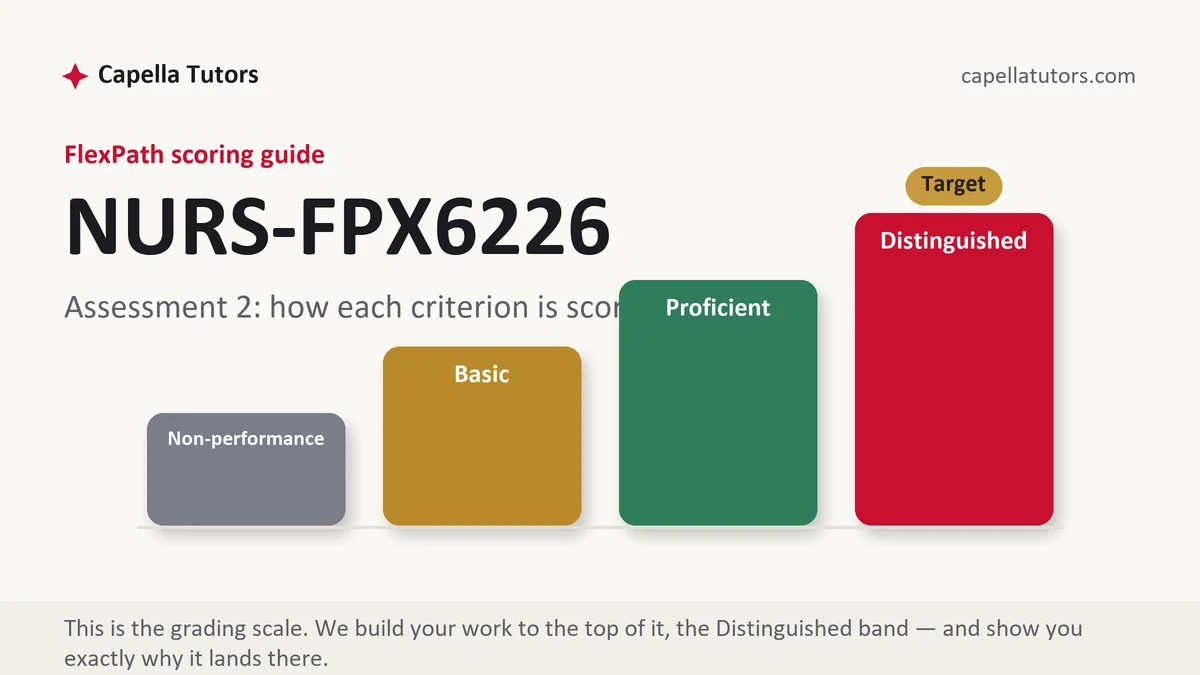
How NURS-FPX6226 Assessment 2 is scored
FlexPath scores criteria independently against four levels, so one weak section cannot be carried by a strong one, and on budget planning the levels turn on traceability:
| Level | What it means on a strategic budget plan |
|---|---|
| Distinguished | Every figure traces to a stated assumption or a named source, the volume projection is argued rather than asserted, fixed and variable costs are handled correctly, and the plan is tested against a worse assumption and still reported honestly. |
| Proficient | A complete, internally consistent budget aligned to a strategic aim. The distance to the top is the absence of a sensitivity test and of an explicit statement of what the plan would look like if volume disappointed. |
| Basic | Last year's numbers with a percentage added. Aligned to strategy in the narrative, unchanged in the arithmetic, and unable to say what the strategy costs. |
| Non-performance | A required element is absent, most often the assumption set or the financial implication of the aim, and its criterion drops to the floor. |
Two habits distinguish graduate work here. State the assumptions under every projection where you use them, and source each rate to a report, a published survey, or a declared estimate. The second habit is rarer and worth more: report the answer when the arithmetic disagrees with the plan. A submission that shows a payback stretching past two years and says so reads as competent, while one that quietly adjusts a rate until the answer improves reads as advocacy, and experienced evaluators check the inputs before the conclusion.
The NURS-FPX6226 Assessment 2 method, step by step
-
Write the strategic aim as a volume and a capability
Serving one thousand eight hundred additional infusion treatments a year at a chair utilization above eighty percent is an aim a budget can be built around. Growing the ambulatory business is not. The aim has to name the unit of service, because the unit of service is what every variable cost in the plan will be driven by.
-
Defend the volume projection before you cost anything
Take the last eight quarters, name the driver behind the trend, referral growth, a payer contract, a service moving out of the inpatient setting, and say what could stop it. A budget is only as good as its volume line, and an unargued volume line is the reason most first submissions cannot survive a single question about the total.
-
Separate fixed from variable, then flex only the variable
Rent, equipment depreciation, and the fixed portion of management time do not move with volume; drugs, supplies, and direct care hours do. Mixing them is the most common technical error in this deliverable, and it produces a plan that either overstates the cost of growth or understates the cost of shrinking.
-
Convert new work into positions honestly
Take the added hours the volume requires, divide by the productive hours a position actually delivers rather than by the hours in a year, then load the salary with benefits at a declared percentage. Positions are the largest number in most plans and the one a finance reviewer will test first, so show the calculation rather than the result.
-
Compute contribution rather than revenue
Revenue is not the measure a service line is judged on. Take the payment expected under the blended payer mix, subtract the variable cost of delivering the unit, and use the contribution figure, with the source of the payer mix named. Where payment rules govern what the setting can bill, work from the primary federal program documentation rather than from a summary of it.
-
Test the plan against a worse assumption and report the result
Reduce the volume projection by twenty percent and recompute. State the new contribution, the new payback, and whether you would still recommend proceeding. Sensitivity analysis costs a paragraph and answers the only question a finance committee reliably asks, which makes it the highest-yield paragraph in the document.
A structure that maps to the criteria
Word targets our tutors plan against for a budget plan, not Capella rules; expand any section your guide weights more heavily.
| Section | What it must do | Guide |
|---|---|---|
| Aim and unit of service | The strategic aim expressed as volume and capability, with the unit of service that will drive the variable costs. | ~200 words |
| Volume assumptions | The projection with its history, its driver, and the conditions that would falsify it. | ~280 words |
| Cost structure | Fixed and variable costs separated, with the basis for each rate stated in the line where it is used. | ~300 words |
| Staffing requirement | Added hours converted into positions using productive hours, salaries loaded at a declared benefit percentage. | ~280 words |
| Contribution and payback | Expected payment under the blended payer mix, variable cost subtracted, one-time investment, payback period. | ~300 words |
| Sensitivity and references | The plan recomputed on a worse assumption, the recommendation restated, current APA both ways. | ~200 words |
Annotated sample excerpt
An original model excerpt from our team, set at the level the top of the guide describes. Take the sequence and run it on your own service.
Expanding the infusion center from eighteen chairs to twenty-six requires eight chairs at four thousand three hundred dollars and one hundred and eighty-six thousand of buildout, two hundred and twenty thousand four hundred in total, and adds three and four tenths registered nurse positions at ninety-six thousand loaded, three hundred and twenty-six thousand four hundred a year.1 The volume line is the part worth arguing over: chair utilization currently runs at sixty-eight percent on four thousand eight hundred and sixty treatments, two oncology practices have moved referrals into the service across the last five quarters, and on that trend the plan projects one thousand eight hundred and twenty incremental treatments, which at the finance office's blended contribution of three hundred and ten dollars a treatment is five hundred and sixty-four thousand two hundred, leaving two hundred and thirty-seven thousand eight hundred after the new positions and a payback of about eleven months.2 Cut the volume assumption by a fifth and the case still holds: one thousand four hundred and fifty-six treatments contribute four hundred and fifty-one thousand three hundred and sixty, net contribution falls to one hundred and twenty-four thousand nine hundred and sixty, and payback stretches to about twenty-one months, which is still inside the three year threshold this organization applies to service line investment.3
- 1One-time capital and recurring staffing are stated separately, with the loaded salary declared as loaded. Keeping the two apart is what makes a payback calculation mean anything.
- 2The volume projection is argued from utilization and a named referral driver before it is used, and the contribution figure is attributed to the finance office rather than invented. Both moves are what the evidence criterion is actually asking for.
- 3The sensitivity test is run and reported with the organization's own threshold named. Recomputing on a worse assumption, and saying the recommendation survives, is the paragraph that separates the top level from a competent plan.
The full premium sample for your exact assessment, written fresh to your scoring guide and issue, is free to request. Study it, revise it into your own voice, and submit work you understand.
The five mistakes that cost Distinguished
- A volume line nobody defends. Every variable cost in the plan is driven by it. An unargued projection makes the whole document a rounding exercise.
- Fixed costs flexed with volume. Rent and depreciation do not move because the census did. Mixing them misprices growth in both directions.
- Positions derived from calendar hours. A position does not deliver every hour it is paid for. Coverage built on paid hours under-hires every schedule it touches.
- Revenue used where contribution belongs. Gross revenue tells a committee nothing about whether the work pays. Contribution does, and it needs the payer mix named.
- No sensitivity test. One paragraph answers the question every finance reviewer asks. Leaving it out invites them to run the worse case without you.
Pre-submission checklist
- The aim written as a volume with a unit of service attached
- The volume projection argued from history and a named driver, with its falsifying condition
- Fixed and variable costs separated, each rate carrying a basis in the line that uses it
- Added hours converted into positions using productive hours and a declared benefit load
- Contribution computed under a named payer mix, with the payback period shown
- The plan recomputed on a twenty percent worse assumption and the result reported, current APA both ways
Budget planning deliverable due?
Send the prompt, the criteria, and whatever volume or cost figures you can share. We build the plan with an assumption table, defend the volume line, keep fixed and variable costs apart, convert hours into positions properly, and run the sensitivity test in the open. Inside 24 to 48 hours, two independent reads with one devoted to checking that every number agrees with every other number, revisions free until your guide is satisfied.