This manual is for NURS-FPX6226 Assessment 1, start to submission. The first deliverable in NURS-FPX6226 looks clerical and decides how much of the course you can actually attempt. Your scoring guide fixes the template, and the assessment usually asks you to bring the learner, the practicum preceptor, and the faculty member together and record the arrangement: the setting, the operational or financial problem the hours will address, the objectives, and what financial information you have been cleared to use. In a finance course that last item is the whole game, because a learner who leaves the call without a reporting source ends up constructing a budget from guesses. The method, the structure, and an annotated excerpt all follow. Prefer it drafted? A premium original record lands inside 24 to 48 hours, with revisions until the guide is met. Your courseroom may print this as NURS FPX 6226 Assessment 1 or NURS6226 Assessment 1; it is the same deliverable, and NURS-FPX6226 Assessment 1 is what this manual walks through.
One honesty note before the manual: Capella revises courses and scoring guides over time, so always write to the exact scoring guide attached to your assessment in the courseroom. The course identity above is verified on capella.edu; the method and structure below are our tutors' approach to it, not Capella's official rubric text.
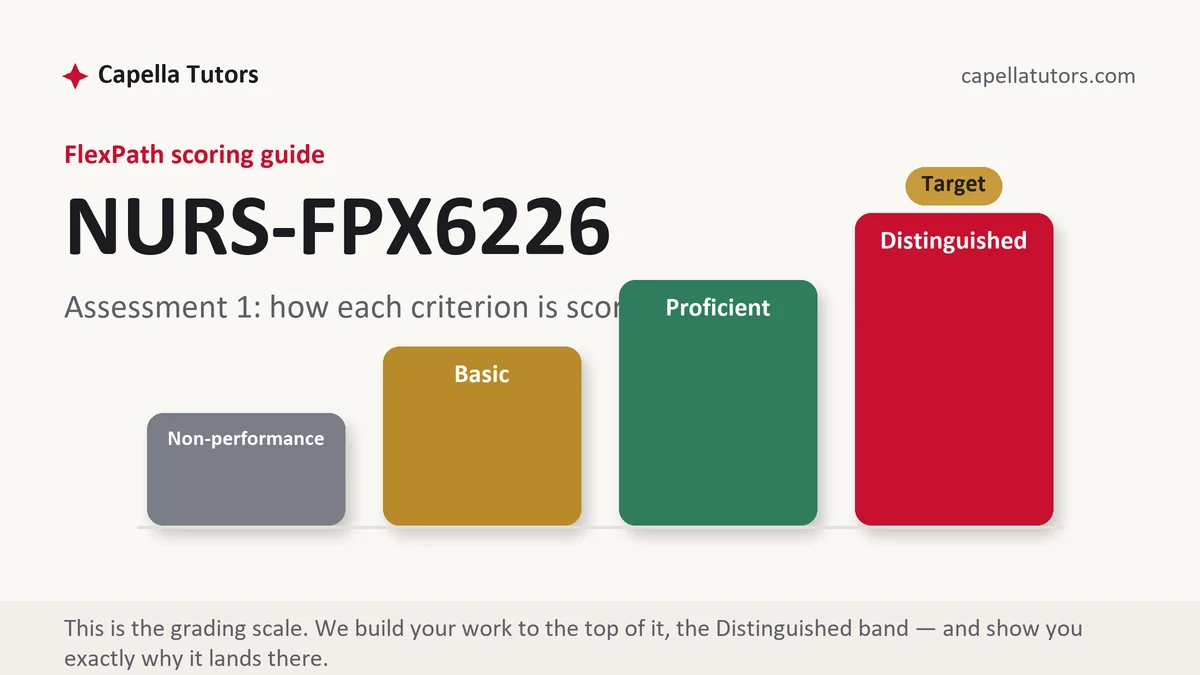
How NURS-FPX6226 Assessment 1 is scored
Each criterion in your guide is placed at one of four levels on its own merits, and on a planning record the levels reward what a reader could later verify:
| Level | What it means on a practicum planning record |
|---|---|
| Distinguished | The problem carries a figure and the report it came from, the objectives end in numbered exhibits, the information you may and may not use is written down, and every commitment names the role that owns it. |
| Proficient | Complete, accurate, and workable. What separates it from the top is that the objectives promise activity rather than the exhibits the activity produces. |
| Basic | Notes from a call. Who attended, what was discussed, and nothing in it a faculty member could hold three people to. |
| Non-performance | A participant, a date, or a required field is absent, which takes the criterion to the floor without regard to the writing around it. |
Choose a problem the general ledger can see. This course grades budget construction, variance interpretation, staffing arithmetic, and a resourced recommendation, so the practicum problem should live in a report somebody already receives every month: premium pay as a share of worked hours, supply cost per unit of service, hours per patient day against target, or a capital request that has been deferred. A problem that never touches a financial report leaves you writing about operations in adjectives, which this course does not reward.
The NURS-FPX6226 Assessment 1 method, step by step
-
Pick a problem that appears in a monthly report
Premium pay, overtime, agency spend, supply cost per case, position vacancies against approved positions, or a deferred capital item. Each of those arrives with history, a target, and an owner, which means your later analysis has a baseline and a trend rather than a snapshot. Write the current figure into the record and name the report it came from.
-
Confirm the preceptor can share reports, not only opinions
Ask directly on the call: may I see the monthly operating statement, the position control report, the productivity report, and the supply spend detail, and in what form. A director who can describe the figures but not release them leaves you constructing everything, which is permitted and much slower. Knowing which it will be changes your objectives, so settle it before the call ends.
-
Write objectives that end in numbered exhibits
A constructed operating budget with its assumption table, a variance analysis split into volume and efficiency, a coverage calculation converted into positions, a capital request with a payback figure. Exhibits can be inspected and graded. Learning about healthcare finance cannot, and it is the phrasing that most often costs the objectives criterion in this course.
-
Separate the figures you will be given from the ones you will construct
Make two lists in the record. Given: census, target hours per patient day, blended rate, supply spend. Constructed: wage rates from a published survey, benefit load at a declared percentage, volume projection from the last eight quarters. Labeling constructed figures as constructed from the first day is what keeps the later deliverables defensible.
-
Agree what may be published about money
Contract rates, vendor pricing, and individual salaries are usually confidential. Record that financial detail will appear de-identified, aggregated, or as a declared range, and that no vendor or payer will be named where a rate is attached. Faculty do not require confidential figures; they require internally consistent ones, and the record is where you commit to producing them that way.
-
Match the hours to the financial calendar
Month end close, budget season, and capital review cycles are fixed and they will not move for a practicum. Lay your hours against them, put the observation of a close or a budget meeting where it actually falls, and reserve the final block for analysis. Then complete every template field and submit early in the week, since evaluation can take two business days.
A structure that maps to the criteria
Planning targets our tutors work to for a record of this kind, not Capella requirements; expand the fields your own template names.
| Section | What it must do | Guide |
|---|---|---|
| Participants and logistics | Learner, preceptor, and faculty member with roles and credentials, plus date, format, and duration. | ~90 words |
| Setting and financial structure | The unit or division described operationally, its units of service, and where it sits in the budget hierarchy. | ~190 words |
| The problem and its figure | The operational or financial problem, its current value, the report it comes from, and the period. | ~220 words |
| Objectives and exhibits | Three to five objectives, each naming the exhibit it produces and who receives it. | ~220 words |
| Information access | Reports you may use, reports you may only view, and the figures you will construct with their bases. | ~180 words |
| Terms, hours, sign-off | Confidentiality of rates, the weekly hours distribution against the financial calendar, and required acknowledgements. | ~150 words |
Annotated sample excerpt
An original model excerpt from our team, at the register the top of the guide describes. Take the moves and write your own record.
Agreed focus: premium pay ran at six and four tenths percent of worked registered nurse hours across the division in the last three closed months against the three percent the operating plan assumes, and the division carries eighteen vacant approved positions with forty-one requisitions in various stages, both figures taken from the position control and productivity reports the preceptor receives monthly.1 Objective one, produce a coverage calculation for two units that converts the current schedule into positions and shows how much of the premium pay is structural rather than incidental.2 Information terms agreed on the call: the operating statement and productivity report may be used with the entity de-identified, individual salaries and the agency contract rate may not appear at all, and any wage figure I need will be constructed from a published survey and labeled as constructed.3
- 1Two figures, a period, a target, and the reports both came from. Naming the report is what allows an evaluator to treat these as data rather than as recollection.
- 2The objective names its exhibit and the distinction the exhibit must draw. Structural and incidental premium pay have different remedies, and committing to separate them here shapes the whole practicum.
- 3The information terms are explicit in both directions, including what will be constructed and labeled. That sentence is the difference between a finance practicum that can be written up and one that cannot.
The full premium sample for your exact assessment, written fresh to your scoring guide and issue, is free to request. Study it, revise it into your own voice, and submit work you understand.
The five mistakes that cost Distinguished
- A problem with no report behind it. If no monthly document contains the figure, there is no baseline and no trend, and the analysis criterion has nothing to grade.
- Access left vague. Viewing a report and being able to use it are different permissions. Settle which one you have while everyone is on the call.
- Objectives written as learning. Understanding the budget process is an outcome nobody can inspect. A constructed budget with an assumption table can be inspected line by line.
- Confidential rates assumed shareable. Contract and vendor rates are usually protected. Agree the de-identified or range form now rather than after the draft is written.
- Hours planned without the close calendar. Month end and budget season do not move. A plan that ignores them schedules its observation hours for weeks when nobody is available.
Pre-submission checklist
- All three participants named with roles and credentials, plus the date of the call
- The problem stated with its current figure, the report it came from, and the period
- Objectives that each name a numbered exhibit and its recipient
- Given figures and constructed figures listed separately, with the basis for each construction
- Confidentiality terms for rates, salaries, and vendor pricing written into the record
- Hours laid against the financial calendar, every template field completed, submitted early in the week
Setting up a 6226 practicum?
Send the template, the scoring guide, and what you can tell us about the setting and the preceptor. We return a premium original record inside 24 to 48 hours: a problem tied to a monthly report, objectives that produce numbered exhibits, information terms written down, and hours laid against the close calendar. Two independent reads, and revisions at no charge until the guide is satisfied.