This manual is for NURS-FPX6224 Assessment 4, start to submission. The closing deliverable in NURS-FPX6224 usually moves from the decision to the delivery: your scoring guide sets the format, and the assessment typically asks for an implementation plan detailed enough that somebody else could run it. Sequence, training capacity, super user coverage, data migration, downtime behavior, and the measures that will tell you whether adoption is real rather than nominal. The graded skill is operational realism. Most implementation plans submitted in this course fail on arithmetic rather than on ideas, because the training hours they require do not fit inside the weeks they allow. Our method, the structure we use, and an annotated excerpt sit below. Prefer it drafted? A premium original sample reaches you in 24 to 48 hours, revised free until the guide is met. Your courseroom may print this as NURS FPX 6224 Assessment 4 or NURS6224 Assessment 4; it is the same deliverable, and NURS-FPX6224 Assessment 4 is what this manual walks through.
One honesty note before the manual: Capella revises courses and scoring guides over time, so always write to the exact scoring guide attached to your assessment in the courseroom. The course identity above is verified on capella.edu; the method and structure below are our tutors' approach to it, not Capella's official rubric text.
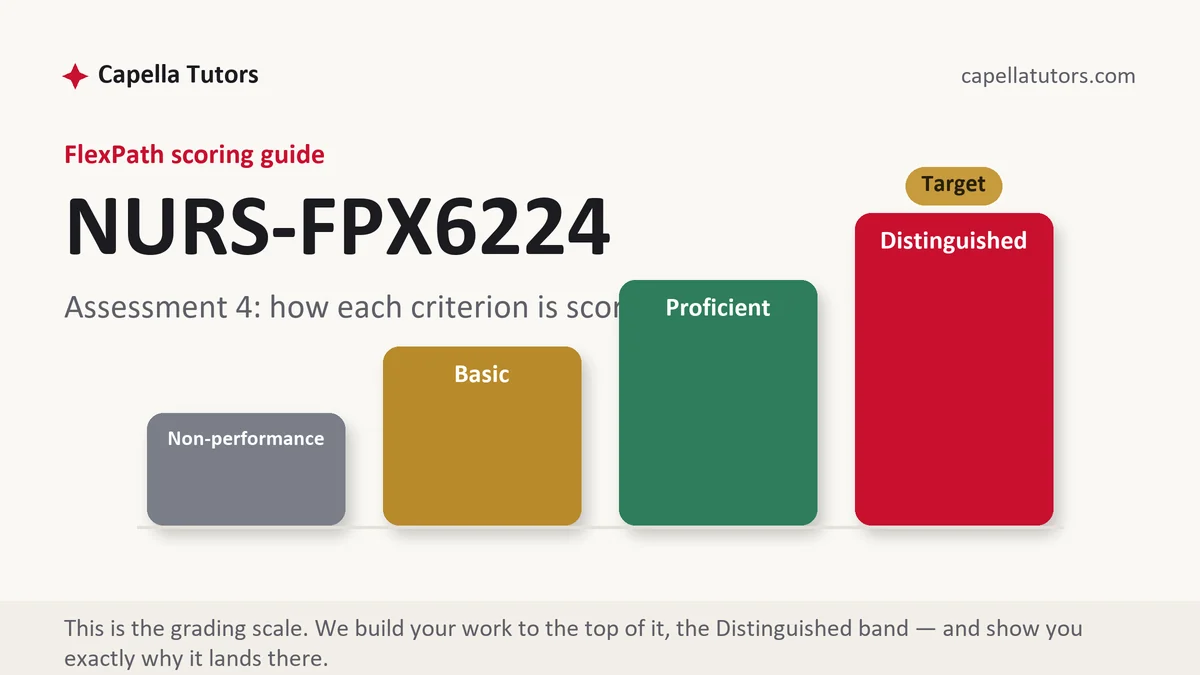
How NURS-FPX6224 Assessment 4 is scored
Criteria are judged one at a time against four levels, and on an implementation plan the levels turn on whether the plan could actually be executed:
| Level | What it means on an implementation plan |
|---|---|
| Distinguished | The sequence is built on real dependencies, the training load is converted into hours and staffed, roles carry names by title, contingency and downtime behavior are specified, and adoption is measured by use rather than by attendance. |
| Proficient | A thorough plan with phases, training, and metrics. What holds it below the top is capacity: the hours the plan needs are never reconciled with the hours available. |
| Basic | A timeline with phases and generic activities. Train staff, go live, evaluate, with no hours, no owners, and no contingency. |
| Non-performance | A required element is absent, commonly the evaluation measures or the contingency plan, and the criterion falls to the floor whatever the presentation quality. |
Convert everything into hours and then check it against the calendar. A plan that trains twelve hundred staff in four weeks is arithmetic waiting to fail, and an evaluator who has run an implementation will see it in a glance. The same discipline applies to adoption metrics: attendance at a session measures compliance with a session, while the proportion of eligible events completed in the new system measures adoption, and only the second one tells you whether the money worked.
The NURS-FPX6224 Assessment 4 method, step by step
-
Sequence on dependencies, not on months
Build and configuration precede validation, validation precedes super user training, super user training precedes end user training, and data migration has to be finished before anyone is trained on migrated content. Draw the chain, then place dates on it. Plans that start from a desired go-live date and work backward usually discover the dependency they broke during the first week of training.
-
Convert the training requirement into hours and staff it
Multiply the population by the session length, add the backfill cost at a loaded rate, then divide by the weeks and the educators you have. If the result exceeds what your educators can deliver, change the wave sizing or add capacity, and show that calculation on the page. This single piece of arithmetic is the most reliable way to move an implementation plan out of the middle of the guide.
-
Name every role by title, including the ones you do not control
Executive sponsor, project manager, clinical lead, analytics build, interface owner, unit super users, and the educator who will still be delivering annual competencies while your rollout runs. State what each one owes the project and how many hours it costs them. A plan that assigns work to the organization has assigned it to nobody.
-
Plan the first two weeks after go-live in more detail than the rest
Command centre hours, at-elbow coverage per shift including nights and weekends, the issue log and who triages it, the escalation path to the vendor, and the criteria for pausing the next wave. Adoption is decided in those two weeks, and the criteria that reward planning are looking for evidence that you know it.
-
Specify contingency and downtime behavior
What staff do when the system is unavailable, how the record is reconciled afterward, who declares a rollback and on what threshold, and what happens to data captured during the outage. Where your guide asks for regulatory grounding, take information management and contingency requirements from the primary accreditation and federal sources rather than from a summary.
-
Measure adoption by use, and set the review dates
Two or three adoption measures with baselines, denominators, owners, and review dates: the proportion of eligible events completed in the new system, the proportion of users active weekly, the rate at which the old workaround persists. Add a benefit measure carried over from your business case so somebody can tell whether the projection held.
A structure that maps to the criteria
Word targets our tutors plan against for a plan of this kind, not Capella rules; expand wherever your guide asks for more detail.
| Section | What it must do | Guide |
|---|---|---|
| Scope and dependencies | What is being implemented, for whom, and the dependency chain the schedule rests on. | ~230 words |
| Phases and waves | The sequence with dates, wave composition, and the criterion that must be met before the next wave starts. | ~280 words |
| Roles and governance | Every role by title with its hours and its decision rights, plus the forum that oversees the rollout. | ~250 words |
| Training and capacity | Population, session length, total hours, backfill cost, educator capacity, and the reconciliation between them. | ~300 words |
| Go-live support and contingency | Command centre and at-elbow coverage by shift, issue triage, downtime behavior, rollback threshold. | ~280 words |
| Adoption measures and references | Adoption and benefit measures with denominators, owners, review dates, and current APA both ways. | ~230 words |
Annotated sample excerpt
An original model excerpt from our team, showing the arithmetic that scores at the top of the guide. Take the method and run your own numbers.
The competency and credentialing platform touches one thousand two hundred and forty nursing staff across thirty-four tracked competencies, and at a forty-five minute session the end user training load is nine hundred and thirty hours, or about forty-two thousand eight hundred dollars of backfill at the division's loaded forty-six dollar rate.1 Three waves of roughly four hundred and thirteen staff over six weeks each means three hundred and ten training hours per wave, about fifty-two hours a week, which is more than one educator can deliver alongside annual competency work, so the plan assigns three educators per wave at seventeen hours a week each and buys eighteen super users sixteen hours of release time apiece for validation and at-elbow support.2 The gate between waves is deliberately not a date: wave two begins only when eighty-five percent of wave one users have completed at least one competency verification inside the platform, because attendance at a session tells us nothing about whether the eleven unit spreadsheets have actually stopped.3
- 1Population, session length, total hours, and backfill cost are all shown, with the rate named. Turning a training plan into hours and dollars is what converts an intention into a schedule.
- 2The capacity check is performed on the page and it fails, so the plan changes. Showing the failed version and the correction is stronger than presenting a plan that happens to fit.
- 3The wave gate is a use measure rather than a date, and the sentence names the thing that would otherwise persist. Measuring the survival of the old workaround is the adoption question, and most plans never ask it.
The full premium sample for your exact assessment, written fresh to your scoring guide and issue, is free to request. Study it, revise it into your own voice, and submit work you understand.
The five mistakes that cost Distinguished
- A schedule built backward from a go-live date. Dependencies decide the sequence. A date chosen first usually breaks validation or migration and the breakage surfaces during training.
- Training described but never costed. Hours, backfill, and educator capacity are the plan. Without them the timeline is a wish with dates on it.
- Work assigned to the organization. Every task needs a title attached to it, including the roles you do not control, or nobody owns it.
- Attendance counted as adoption. Sessions delivered measure the sessions. Eligible events completed in the new system measure whether anything changed.
- No rollback threshold. Somebody has to be able to stop the rollout, and the plan has to say who and at what number.
Pre-submission checklist
- The dependency chain drawn before any date is assigned
- Waves defined, each with an entry criterion that is a measure rather than a date
- Every role named by title with its hours and its decision rights
- Training converted into hours and backfill cost, then reconciled with educator capacity
- Go-live support by shift, downtime behavior, issue triage, and a rollback threshold
- Adoption measured by use with denominators and owners, plus one benefit measure, current APA both ways
Implementation plan due in 6224?
Send the prompt, the criteria, the system, and the population it touches. We build the dependency chain, convert the training load into hours and backfill, staff it against real educator capacity, plan the first two weeks after go-live properly, and measure adoption by use rather than by attendance. Back inside 24 to 48 hours, two independent reads including one on the arithmetic, revisions free until your guide is satisfied.