This manual is for NURS-FPX6224 Assessment 2, start to submission. The second deliverable in NURS-FPX6224 is an evaluation of need rather than a purchase. Your scoring guide sets the exact form, and the assessment usually asks you to establish why a needs assessment is the right instrument, describe the technology the setting already runs, size the gap between that and what the work requires, weigh the evidence including the studies that disagree with you, and say what a solution would have to do for every population the setting serves. The move that separates the top of the guide is restraint: a needs assessment establishes requirements, it does not announce a winner. The rest of this page is the method, the structure, and an annotated excerpt. Want it drafted? A premium original sample is with you inside 24 to 48 hours, revised free until your guide is satisfied. Your courseroom may print this as NURS FPX 6224 Assessment 2 or NURS6224 Assessment 2; it is the same deliverable, and NURS-FPX6224 Assessment 2 is what this manual walks through.
One honesty note before the manual: Capella revises courses and scoring guides over time, so always write to the exact scoring guide attached to your assessment in the courseroom. The course identity above is verified on capella.edu; the method and structure below are our tutors' approach to it, not Capella's official rubric text.
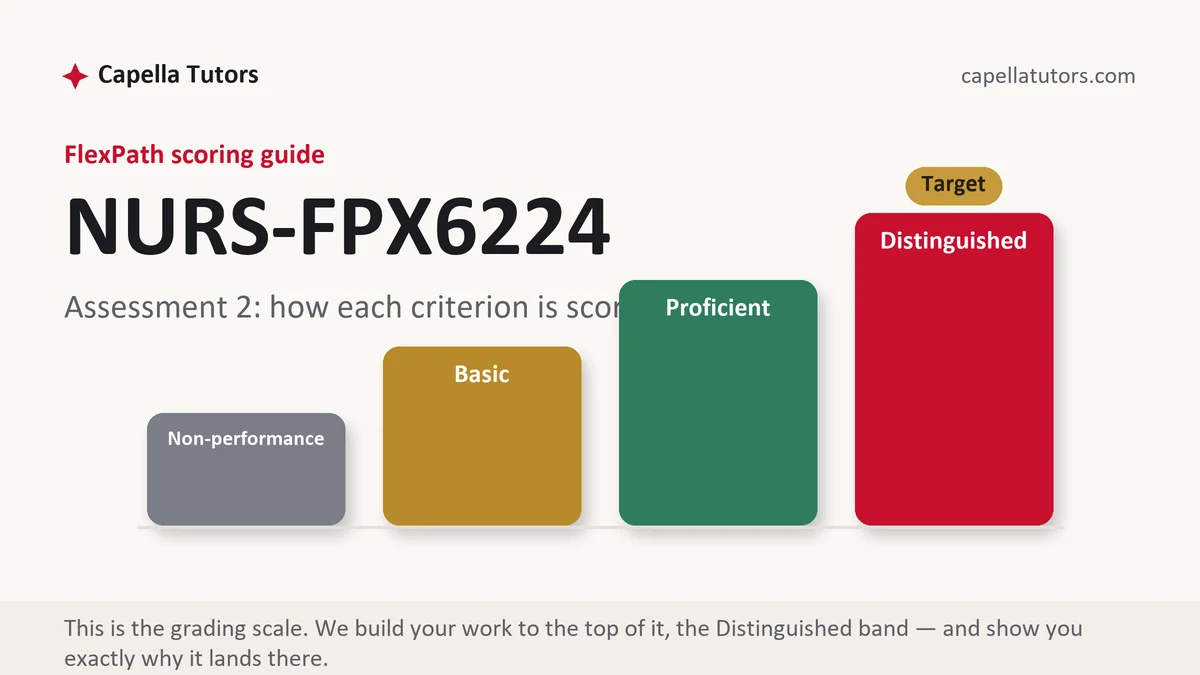
How NURS-FPX6224 Assessment 2 is scored
No criterion is averaged against another. Each one sits at one of four levels, and on a needs assessment the levels turn on whether the need has been measured:
| Level | What it means on a technology needs assessment |
|---|---|
| Distinguished | The current state is counted, the requirements are weighted and each one traced to a measured gap, the disagreeing evidence is engaged rather than avoided, and the access needs of the populations served are treated as requirements rather than as a closing paragraph. |
| Proficient | Accurate and complete, with a real gap and sensible requirements. What holds it below the top is that the requirements are listed without weight, so nothing tells a reader which one would decide the choice. |
| Basic | An appreciation of a technology. The current state is described, the benefits are quoted from the literature or from product material, and no requirement in the document could be tested against a candidate system. |
| Non-performance | A required element is missing, most often the conflicting evidence or the equity analysis, and that criterion falls to the floor whatever surrounds it. |
Two conventions carry the evidence criterion at master's level. Trace every requirement to a measured defect, so a reader can see why it is on the list, and engage the studies that do not support you. Informatics results are conditional almost everywhere: the same intervention that reduces a defect in one implementation creates a workaround in another. Naming the implementation variable that explains the disagreement, and then writing that variable into your requirements, is the analytic move the top column describes.
The NURS-FPX6224 Assessment 2 method, step by step
-
Say why a needs assessment, before saying what is needed
The first criterion in this kind of deliverable usually asks for the rationale, and it is easy points. A needs assessment establishes the requirement set before the market gets to define it, which is what prevents a purchase driven by a demonstration. Two or three sentences of that argument, grounded in your own setting's history with a previous implementation, answers the criterion properly.
-
Document the current state as a count, not an impression
Count the admissions, the tasks, the minutes, the duplicate entries, the incomplete records. State the period and how the count was produced. A needs assessment with no numbers cannot size anything, and every later section, requirements, options, and the financial case in your next deliverable, inherits the denominator you establish here.
-
Describe the existing systems honestly, including what they already do
Setting managers overestimate gaps as often as they underestimate them. Establish what the current record, scheduling, or communication tools genuinely support, whether a needed function exists but is unconfigured, and whether the failure is capability or adoption. A gap that turns out to be a configuration problem is a finding worth more than a purchase recommendation.
-
Weight the requirements and trace each one to the gap
Six to eight requirements, each weighted, each pointing back at a measured defect, and each written so a candidate system could be scored against it. Interoperability with the existing record, discrete fields for the measures you intend to report, role-based access, audit logging, and offline behavior belong on most lists. Convenience features do not, unless a count supports them.
-
Engage the evidence that argues against you
Find the studies where the intervention underperformed and read them for the reason. Adoption depth, staffing model, network reliability, or a workflow the intervention assumed and did not find are the usual explanations. State the disagreement, name the variable that resolves it, then add that variable to your requirement list as a condition of success. That is what distinguishes appraisal from summary.
-
Treat access and equity as requirements
Language, hearing and vision, digital access, and health literacy are design constraints in any patient-facing technology, and staff-facing tools have their own version in shift pattern, device availability, and language. Write them as testable requirements, interpretation available in the top three languages of the service, for example, rather than as a paragraph promising that equity will be considered.
A structure that maps to the criteria
Word targets our tutors plan against for an assessment of this kind, not Capella rules; weight the sections your own guide weights.
| Section | What it must do | Guide |
|---|---|---|
| Rationale for the assessment | Why requirements are established before options, argued from the setting's own history. | ~200 words |
| Current state, counted | The work as it is performed, with volumes, times, and defect counts, and the period they cover. | ~280 words |
| Existing technology | What the current systems support, what is unconfigured, and whether the failure is capability or adoption. | ~250 words |
| Weighted requirements | Six to eight requirements, weighted, each traced to a measured gap and written to be testable. | ~300 words |
| Evidence, including the disagreement | Supporting and contrary studies, the implementation variable that explains the difference, and what that adds to the requirements. | ~300 words |
| Access, equity, references | Population and workforce access constraints as testable requirements, and current APA both ways. | ~220 words |
Annotated sample excerpt
An original model excerpt from our team, showing the discipline that scores at the top of the guide. Take the reasoning, then count your own setting.
The two medical surgical units hold sixty-four beds and admitted two thousand nine hundred and ninety-three patients in the twelve months to April, an average of four and one tenth admissions per unit per day, and a timed sample of thirty admissions found the nursing admission record taking a median of thirty-eight minutes, of which twenty-two were spent on history and screening fields that a virtual nurse could complete from the same record.1 Across the year that is about one thousand and ninety-seven hours of bedside registered nurse time, close to the productive hours of half a position, and the second defect is larger: discharge teaching was documented as complete on seventy-one percent of discharges, with the missing cases concentrated between three and seven in the afternoon.2 A needs assessment sizes those two gaps and turns them into requirements; it does not yet choose a platform, and the financial case for whichever platform scores highest belongs in the next deliverable rather than this one.3
- 1Volume, period, sample size, and the method are all stated, and the writer separates total documentation time from the portion a remote nurse could actually absorb. That distinction is where inflated benefit claims usually hide.
- 2The second defect is reported with its denominator and its clustering. Naming the hours in which failures concentrate turns a completeness rate into something a staffing model can answer.
- 3The paragraph declines to recommend, and says why. Knowing the boundary of the deliverable in front of you is a graduate habit, and evaluators read it as confidence rather than as omission.
The full premium sample for your exact assessment, written fresh to your scoring guide and issue, is free to request. Study it, revise it into your own voice, and submit work you understand.
The five mistakes that cost Distinguished
- A gap with no count. Nothing downstream works without a denominator: not the requirements, not the option comparison, not the return calculation in the deliverable that follows.
- Requirements with no weights. An unweighted list cannot decide anything, and the criterion asking you to evaluate need has nothing to grade.
- Product literature used as evidence. A percentage from a sales sheet has no setting, no denominator, and no method, so it cannot support a claim about outcomes.
- The contrary evidence skipped. Informatics results are conditional. A paper that reports only the favorable studies has not appraised anything.
- Equity as a closing paragraph. Language, connectivity, and literacy are constraints a system must satisfy. Written as requirements they are testable; written as reassurance they are decoration.
Pre-submission checklist
- A stated rationale for assessing need before evaluating options
- Current state counted, with volumes, times, sample size, method, and period
- Existing systems described, including unconfigured capability and adoption failures
- Six to eight weighted requirements, each traced to a measured gap and testable
- At least one contrary study engaged, with the implementation variable it reveals added to the requirements
- Access and equity written as testable requirements, and citations matched both ways in current APA
Needs assessment open in 6224?
Send the prompt, the criteria, and the problem you want a system to solve. We count the current state from whatever you can share, weight the requirements and trace each to a defect, engage the studies that disagree, and write access constraints as requirements rather than as promises. Back inside 24 to 48 hours, two reads by people who did not draft it, revisions free until the guide is met.