This manual is for NURS-FPX6224 Assessment 1, start to submission. The opening deliverable in NURS-FPX6224 sets up everything the course grades afterward. Your scoring guide fixes the template, and the assessment usually asks you to convene the learner, the practicum preceptor, and the faculty member, then document the site, the technology or information problem your hours will address, the objectives, and the terms you are working under. In an informatics course the terms matter unusually: system access, data extracts, and vendor material all come with conditions, and the record is where those get written down. Below is the method, a structure mapped to the criteria, and an annotated excerpt. Prefer it drafted for you? A premium original record is back with you in 24 to 48 hours, revised free until the guide is met. Your courseroom may print this as NURS FPX 6224 Assessment 1 or NURS6224 Assessment 1; it is the same deliverable, and NURS-FPX6224 Assessment 1 is what this manual walks through.
One honesty note before the manual: Capella revises courses and scoring guides over time, so always write to the exact scoring guide attached to your assessment in the courseroom. The course identity above is verified on capella.edu; the method and structure below are our tutors' approach to it, not Capella's official rubric text.
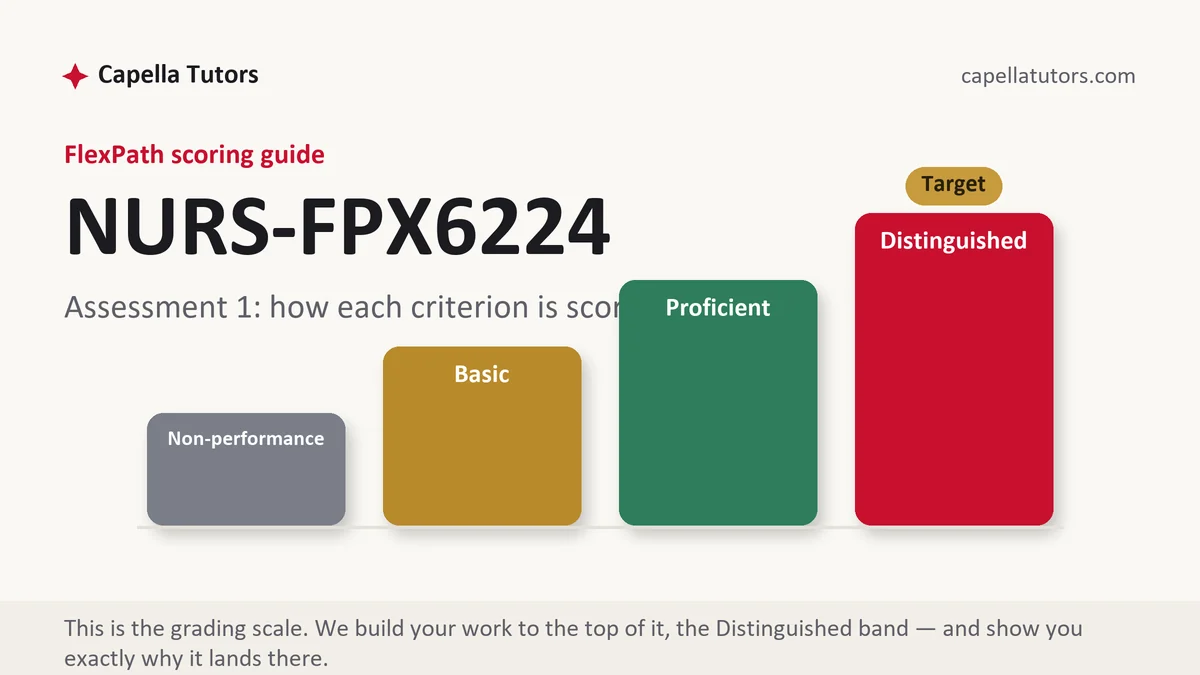
How NURS-FPX6224 Assessment 1 is scored
FlexPath scores each criterion on its own against four levels, with no averaging across them, and on a planning record the levels reward specificity over length:
| Level | What it means on a practicum planning record |
|---|---|
| Distinguished | The problem is counted, the objectives end in documents a reader could inspect, the system access and data terms are explicit, and each commitment carries the role responsible for it. |
| Proficient | Complete and accurate, with a real problem and workable objectives. The remaining distance is that the objectives describe work rather than the artifacts the work produces. |
| Basic | A pleasant account of a conversation. Present were, discussed was, and nothing in it that anyone could be held to in week nine. |
| Non-performance | A participant, a date, or a required field is missing. On this deliverable the floor is reached by omission far more often than by weak prose. |
Pick the problem with the later deliverables in mind. This course grades a purchasing and adoption decision, which means your practicum problem needs a countable current state and a system that plausibly addresses it. A problem stated as a count, so many duplicate entries a shift, so many minutes per handoff, so many cases with an inaccurate scheduled duration, gives you the denominator every later criterion will lean on. A problem stated as a frustration gives you nothing to build a requirement from.
The NURS-FPX6224 Assessment 1 method, step by step
-
Choose a problem that already has a count
Something the setting can quantify without a new data project: duplicate documentation, minutes per task, cases per day with a stated defect, reports that two departments produce differently. Write the count into your objective. If the setting cannot count it, your first three weeks become measurement design and the analysis you were graded on never gets written.
-
Establish who controls the systems and the data
Access decisions in informatics rarely sit with your preceptor. Find out on the call who authorizes a report request, who approves an extract, whether the analytics team has a queue, and how long that queue is. Record the answers with names by role. A practicum that discovers in week six that every extract needs a two week approval has lost the difference.
-
Write objectives that end in a decision document
A requirements matrix with weightings, a current-state and future-state workflow comparison, a governance table naming stewards and access rules, a costed option comparison. Each of those is inspectable. Becoming familiar with the organization's systems is not, and it is the phrasing that costs the objectives criterion most often in this course.
-
Name the systems you will be allowed to look inside
List them: the record, the scheduling module, the reporting environment, the interface engine if you will get near it. State for each one whether you will have read access, a demonstration, or only reports produced by someone else. Being honest about that boundary in week one is what stops your later analysis from claiming knowledge you were never given.
-
Set the vendor boundary in writing
You will be offered product material. Record that vendor documents may be used to describe features and not to evidence outcomes, that you will not sign anything on the organization's behalf, and that pricing shared in confidence stays out of coursework or appears only as a declared range. Writing that down protects you and reads as professional judgment to a faculty reviewer.
-
Reconcile the plan against the courseroom calendar
Lay the hours across the weeks you actually have, put the access-dependent work first, and check that the objectives here use the same words as the categories you will report hours against later. Complete every field the template requires, then submit at the start of a week, since evaluation can take two business days.
A structure that maps to the criteria
Planning targets from our tutors for a record of this kind, not Capella requirements; expand whichever fields your template demands.
| Section | What it must do | Guide |
|---|---|---|
| Participants and logistics | Learner, preceptor, and faculty member with roles and credentials, plus date, format, and duration of the call. | ~90 words |
| Site and system environment | The organization operationally described, and the systems in use with what each one is relied on for. | ~200 words |
| The problem, counted | The technology or information problem with its current count, how the count is produced, and its period. | ~220 words |
| Objectives and artifacts | Three to five objectives, each naming the decision document it produces and who receives it. | ~220 words |
| Access, hours, milestones | System and data access granted, the approval route for extracts, and the weekly distribution of hours. | ~170 words |
| Terms and sign-off | Vendor material boundary, de-identification, supervision arrangements, and the acknowledgements the template asks for. | ~140 words |
Annotated sample excerpt
An original model excerpt from our team, at the register the top of the guide describes. Take the moves and write your own record.
Agreed focus: the perioperative scheduling module produces no utilization or duration reporting, so the office schedules nine service lines from case times entered at booking, and a manual review of one month found a median difference of twenty-seven minutes between scheduled and actual duration, with first case on-time starts at sixty-four percent.1 Objective one, produce a requirements matrix for scheduling analytics with each requirement weighted and traced to one of those two figures.2 Access is bounded and stated here: read access to the scheduling module and to the two standard reports, a demonstration of the analytics environment rather than a login, and any case-level extract routed through the analytics team's request queue, which the preceptor advises runs at about ten working days.3
- 1The problem arrives with two counts and the method that produced them, so a reader knows whether they are holding an audited figure or an impression. Naming the review period is what makes the later requirements traceable.
- 2The objective produces an artifact and ties every requirement back to a measured defect. Requirements that cannot be traced to a count are the ones that get added because a vendor mentioned them.
- 3Access is described precisely, including the part that is only a demonstration and the ten day queue. Recording the constraint in week one is what keeps the later analysis honest about what the writer actually saw.
The full premium sample for your exact assessment, written fresh to your scoring guide and issue, is free to request. Study it, revise it into your own voice, and submit work you understand.
The five mistakes that cost Distinguished
- A problem with no count. Frustration is not a baseline. Without a number there is no denominator for the requirements, the workflow comparison, or the financial case that follows.
- Access assumed rather than agreed. Extracts and reports run through queues and approvals. A plan that assumes same-week data will stall in week six.
- Objectives written as exposure. Shadowing and familiarization are inputs. The criterion wants the decision documents your hours will produce.
- No vendor boundary. Product literature describes features and cannot evidence outcomes. Writing the distinction into the record protects the evidence criterion later.
- An hours total instead of an hours schedule. One number for the term conceals the weeks in which nothing was arranged. A weekly distribution exposes the risk while it can still be managed.
Pre-submission checklist
- All three participants named with roles and credentials, plus the date of the call
- The problem stated with a count, the method that produced it, and the period
- Objectives that each name a decision document and its recipient
- System access described precisely, including approval routes and queue times
- The vendor material boundary and de-identification terms written into the record
- Hours distributed by week, every template field completed, submitted early in the week
Setting up a 6224 practicum?
Send the template, the scoring guide, and what you know about your site, preceptor, and systems. We return a premium original record inside 24 to 48 hours: a counted problem, objectives that end in decision documents, access terms written down, and an hours plan built around approval queues rather than around hope. Two independent reads before delivery, and revisions until the guide is satisfied.