This manual is for NURS-FPX6116 Assessment 4, start to submission. Send the scoring guide and the numbers you were given and we build the evaluation, the item analysis, the interpretation, and the revision decisions, back inside 24 to 48 hours with revisions until the criteria clear. Assessment 4 of NURS-FPX6116 usually asks you to build a course evaluation approach and then use assessment data inside it, which means reading statistics rather than quoting them. The criteria are unusually concrete here: every flagged item has to receive a decision, and every decision has to carry a reason. The method, the structure, and an annotated excerpt from a real analysis follow. Your courseroom may print this as NURS FPX 6116 Assessment 4 or NURS6116 Assessment 4; it is the same deliverable, and NURS-FPX6116 Assessment 4 is what this manual walks through.
One honesty note before the manual: Capella revises courses and scoring guides over time, so always write to the exact scoring guide attached to your assessment in the courseroom. The course identity above is verified on capella.edu; the method and structure below are our tutors' approach to it, not Capella's official rubric text.
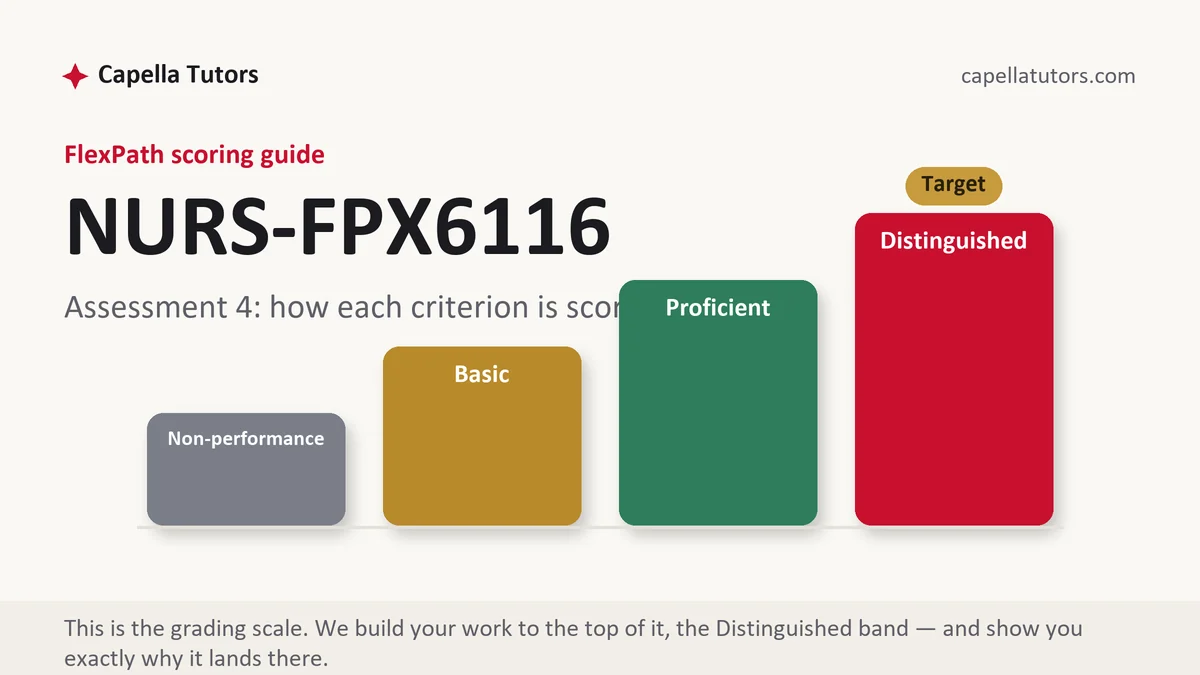
How NURS-FPX6116 Assessment 4 is scored
Each criterion resolves to one of four levels, and the level wording is the brief for the analysis:
| Level | What it means on a course evaluation with item analysis |
|---|---|
| Distinguished | Each statistic is interpreted rather than reported, every flagged item receives a decision with a stated reason, reliability is discussed for what it can and cannot establish, and the evaluation says which teaching decision changes as a result. |
| Proficient | Accurate statistics, correctly interpreted, with sound revision suggestions. The evaluation stops before any teaching decision changes, which is where the top column lives. |
| Basic | A table of numbers restated in prose, with a closing sentence recommending that the exam be reviewed. |
| Non-performance | A required element is absent, most often the revision decisions or the reliability discussion, and absence scores below weakness. |
Keep the two words apart while you write. Assessment is what you do to a learner, deciding whether that person met an objective. Evaluation is the judgment you make about the course using those results in aggregate. A section asked for course evaluation and answered with a testing plan has not answered, and the criteria separate them deliberately.
The NURS-FPX6116 Assessment 4 method, step by step
-
Build the sections from the criteria, then find the data
Copy the criteria out with their verbs and let them structure the document. Then locate what you actually have: item statistics, score distribution, rubric scores by criterion, pass rates, and whatever the courseroom supplied. These criteria are graded against the specific numbers in front of you, so send them to your tutor and work from them rather than from a general account of item analysis.
-
Read difficulty as information about the item, not the class
The difficulty index is simply the proportion answering correctly. A value near 0.95 tells you the item separated nobody, and a value near 0.15 tells you either the content never arrived or the item is broken. Most classroom items are useful somewhere in the middle band, and a small number of very easy items on non negotiable safety content are defensible if you say so. Report each value with its interpretation attached, never as a bare column.
-
Read discrimination, and treat a negative value as an alarm
Discrimination asks whether an item sorted learners the way the whole test did. Compare the top and bottom scoring groups, conventionally the upper and lower 27 percent, or read the point biserial correlation. Modest positive values are workable and higher is better. A negative value means the stronger learners chose a distractor, which almost always signals a keying error or two defensible answers, and the honest remedies are to accept both keys or void the item and record why.
-
Diagnose the flawed stem before you blame the learners
When an item performs badly, read it as an item writer. Look for the echo, where a distinctive phrase from the stem reappears only in the key. Look for convergence, where the correct option shares an element with three distractors and can be assembled without knowledge. Look for the qualified sentence that is longer and more carefully hedged than its neighbors because you wrote it first. Look for absolute terms in distractors, which test wise learners discard on sight. Look for negatively phrased stems, which measure reading under time pressure. Any of these means the item measured something other than the objective.
-
Interpret reliability for what it does and does not say
Report internal consistency with the coefficient appropriate to the data, a Kuder Richardson formula for dichotomously scored items and Cronbach's alpha where scoring is polytomous, and say what the value means for this test and this cohort. Then say what it cannot do: internal consistency is not evidence that the test measured the right content. That argument comes from the blueprint, and pointing at the blueprint here is the move faculty evaluators are waiting for.
-
Give every flagged item a decision, then change one teaching decision
For each flagged item write revise, retire, rewrite at application level, or credit both responses, with the reason in the same sentence. Add distractor counts, because an option nobody selected is dead weight and replacing it is cheaper than rebuilding the stem. Then close the loop at course level: which module gets more time, which objective gets an added formative check, and when the same measure will be read again.
A structure that maps to the criteria
Word figures are our tutors' planning targets for a deliverable of this shape rather than Capella rules; your scoring guide decides the weighting.
| Section | What it must do | Guide |
|---|---|---|
| Course, cohort, and the result | The course, the examination, the cohort size, and the outcome that triggered the review. | ~200 words |
| Blueprint and validity argument | The content to item mapping, and what it shows about whether the test measured the course. | ~250 words |
| Difficulty findings | Values grouped and interpreted, with the defensible easy items distinguished from the broken ones. | ~250 words |
| Discrimination and distractor findings | Sorting evidence per item, negative values flagged, and unselected options identified. | ~250 words |
| Reliability | The coefficient, its interpretation, and the limits of what it establishes. | ~200 words |
| Decisions and course level actions | A decision for every flagged item, plus the teaching change and the re measurement date. | ~300 words |
| References | Current APA, testing standards cited as organizational reports, measurement texts as books. | as needed |
Annotated sample excerpt
A model paragraph from our team, written the way an item analysis should read. Notice that every number arrives with a decision attached.
On the unit examination where 22 of 61 students scored below the 75 percent benchmark, two items account for a disproportionate share of the damage and they fail for different reasons.1 Item 14 shows a difficulty of 0.31 with a point biserial of negative 0.18, which means stronger students preferred option C; reading it as an item writer, both C and the keyed option D are defensible for a client with acute kidney injury, so the decision is to credit both responses for this administration and rewrite the stem to specify the timeframe before it is used again.2 Item 22 shows a difficulty of 0.28 with acceptable discrimination and a distractor pattern in which no student chose option B, and the stem repeats the phrase third spacing that appears in the key alone, so the decision is to replace option B with the volume overload error the clinical faculty report most often and to remove the phrase echo, since the item currently rewards recognition of my own wording rather than the objective.3
- 1Frames the analysis around the cohort result and the benchmark, so the item work is evaluation of a course rather than a statistics exercise.
- 2Interprets a negative discrimination correctly, names the likely cause, and issues a defensible remedy for the administration already scored. A decision with a reason is what the criterion buys.
- 3Diagnoses a different flaw, the phrase echo, and repairs both the dead distractor and the leak, with the replacement drawn from real learner error rather than invention.
The full premium sample for your exact assessment, written fresh to your scoring guide and issue, is free to request. Study it, revise it into your own voice, and submit work you understand.
The five mistakes that cost Distinguished
- Numbers restated as prose. Item 14 had a difficulty of 0.31 is a column read aloud, and the interpretation criterion is unanswered by it.
- Flagged items with no decision. An analysis that identifies problems and recommends further review leaves the revision criterion empty.
- Reliability as a verdict. A coefficient quoted as proof the test was good ignores what internal consistency cannot establish, and the blueprint is what covers the gap.
- Blaming the cohort. Concluding that students did not study explains nothing, and it is the conclusion the item writing diagnosis exists to test.
- Assessment answering an evaluation question. A revised testing plan is not a course evaluation, and the criteria separate the two on purpose.
Pre-submission checklist
- Course, examination, cohort size, and the triggering result stated in the opening
- Blueprint presented and used as the validity argument, not as decoration
- Every statistic interpreted in the sentence that reports it
- Negative discrimination handled with a defensible remedy for the administration already scored
- Item writing flaws diagnosed by name, with distractor counts included
- A decision for every flagged item, plus one teaching change and a re measurement date
Item statistics in front of you and no idea what they mean?
Send the scoring guide and the data table exactly as your courseroom supplied it. We interpret every value, diagnose the flawed items as item writers, attach a decision to each one, and close the loop with a teaching change and a re measurement date. Back inside 24 to 48 hours, revised until you hit your target, and the first sample is on us.