This manual is for NURS-FPX6116 Assessment 3, start to submission. Send the scoring guide and we build the rubric, the criteria, the level descriptors, the weighting, and the reliability plan, back in 24 to 48 hours with revisions until every criterion clears. Assessment 3 of NURS-FPX6116 usually asks you to develop evaluation criteria and a scoring rubric for a specified learning task, then defend them. A rubric is defended on one question: would a second rater, given the same work, produce the same score. Everything in this manual serves that question. The method, the structure, and an annotated rubric excerpt follow. Your courseroom may print this as NURS FPX 6116 Assessment 3 or NURS6116 Assessment 3; it is the same deliverable, and NURS-FPX6116 Assessment 3 is what this manual walks through.
One honesty note before the manual: Capella revises courses and scoring guides over time, so always write to the exact scoring guide attached to your assessment in the courseroom. The course identity above is verified on capella.edu; the method and structure below are our tutors' approach to it, not Capella's official rubric text.
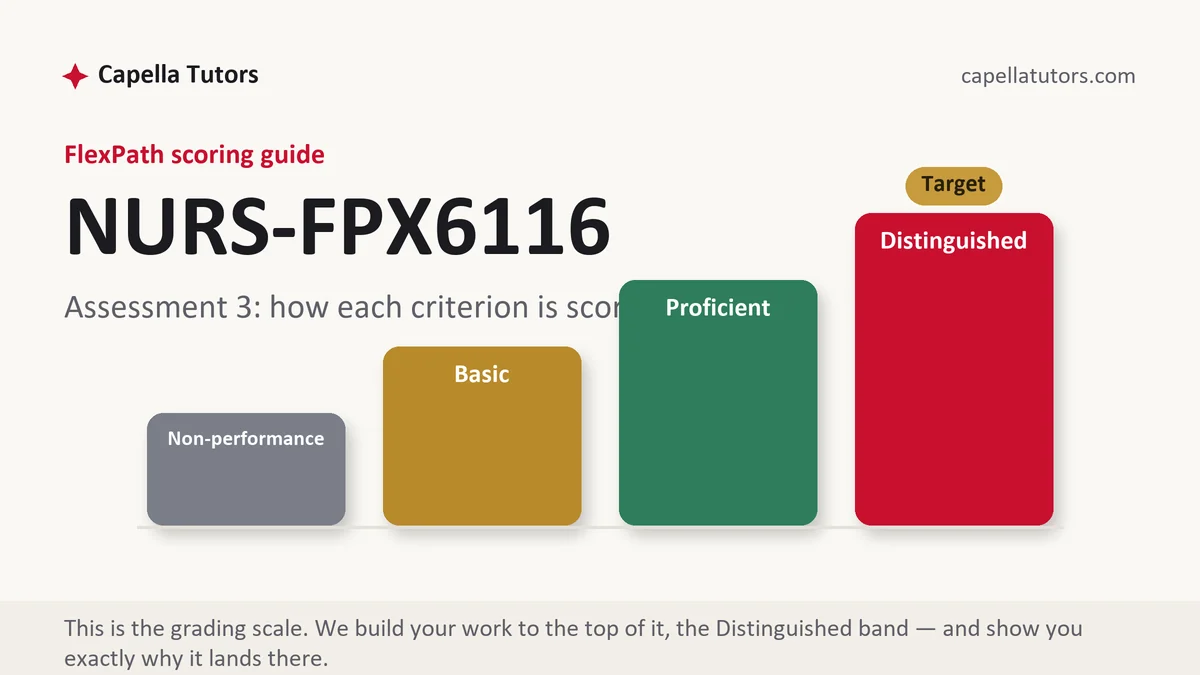
How NURS-FPX6116 Assessment 3 is scored
Each criterion resolves to one of four levels, and the level text describes what a defensible rubric contains:
| Level | What it means on a rubric deliverable |
|---|---|
| Distinguished | Criteria derive from the objectives rather than from convention, every descriptor states observable behavior, exactly one attribute changes between adjacent levels, weighting is justified, and the reliability plan names a coefficient and a pilot. |
| Proficient | A usable, well organized rubric with defensible criteria and clear levels. Reliability is asserted rather than planned for, which is the step to the top column. |
| Basic | Levels labeled excellent through poor with descriptors made of adjectives, which no second rater can apply the same way. |
| Non-performance | A required element is absent, most often the justification of the criteria or any treatment of reliability, and absence scores below weakness. |
Choose the rubric type on purpose and say why. An analytic rubric with a row per criterion gives learners a diagnosis and gives you data at the criterion level, which is what feeds course evaluation later. A holistic rubric delivers a single judgment quickly and tells a learner almost nothing about what to fix. Where the task is complex and the feedback matters, analytic wins, and the criteria in this course usually assume it.
The NURS-FPX6116 Assessment 3 method, step by step
-
Derive the criteria from the objectives, not from memory
Start in the scoring guide, then go to the objectives the task is meant to measure and write one criterion per thing you actually claim to be judging. Four to six criteria is usually right. Anything you cannot trace back to an objective is a habit, and habits are how organization and mechanics end up outweighing clinical reasoning on a rubric nobody intended to build that way.
-
Write descriptors as behavior an observer could record
Excellent and poor are labels. A descriptor states what the work does: cites three sources published within five years and names the design of each; identifies the deteriorating trend and escalates before the second set of vital signs; explains the inhaler technique in lay terms and confirms understanding with a teach back. If two raters could disagree about whether a descriptor is present, it is not a descriptor yet.
-
Change one attribute at a time between levels
The commonest rubric fault is levels that move on three variables at once, so a submission strong on one and weak on another cannot be placed. Pick the attribute that defines each criterion, accuracy, completeness, depth of reasoning, or independence, and vary only that as you step down. Then read the column vertically to check that the progression is a single line rather than a cloud.
-
Weight the criteria and defend the weights
Weighting is a validity statement. If clinical reasoning carries 40 percent and formatting carries 5, you have said what the task is about. Tie the weights to the cognitive level of the objectives and to instructional time, and write the sentence that justifies them, because an unweighted rubric silently treats every criterion as equally important and evaluators notice when that is obviously false.
-
Plan reliability, then pilot it
Name the coefficient you will report and the design that produces it. Two raters scoring the same submissions independently gives you percentage agreement and a chance corrected statistic such as Cohen's kappa; for ordinal scores across more than two raters, an intraclass correlation is the usual choice. Say how many submissions the pilot uses, what value you will treat as acceptable, and what you will revise if agreement fails. Where a published instrument already exists for this kind of task, cite its reported reliability and say whether you are adopting or adapting it.
-
Test the rubric on real work before you defend it
Score two genuine submissions with a colleague, independently, then compare. Disagreements point at the descriptor, not at the colleague. Rewrite the descriptor that caused each disagreement and record what changed. A rubric that has survived a pilot is defensible; one that has only been proofread is a draft, and the reliability criterion is where the difference appears.
A structure that maps to the criteria
Planning figures our tutors use for a rubric deliverable of this shape rather than Capella rules; your scoring guide sets the real weighting.
| Section | What it must do | Guide |
|---|---|---|
| Task and objectives measured | The learning task, the learners, and the objectives the rubric is built to judge. | ~200 words |
| Rubric type and rationale | Analytic or holistic, with the reason tied to feedback needs and data use. | ~150 words |
| Criteria and their derivation | Each criterion traced to an objective, with anything conventional but unjustified removed. | ~250 words |
| The rubric itself | Levels with descriptors written as observable behavior, one attribute varying per step. | ~300 words |
| Weighting and justification | The weights, and the argument from cognitive level and instructional time. | ~200 words |
| Reliability and pilot plan | Raters, design, coefficient, acceptable value, and the revision rule. | ~250 words |
| References | Current APA, testing standards as organizational reports, published instruments cited with their psychometrics. | as needed |
Annotated sample excerpt
Our writers wrote this model to show one attribute moving cleanly down four levels. Build your own column the same way.
For the residency capstone teaching demonstration, the reasoning criterion carries 35 percent because two of the module's four objectives sit at the level of evaluate, and the attribute that varies across levels is the completeness of the justification rather than the polish of the delivery.1 At the top level the resident states the teaching decision, names the learner assessment data behind it, and identifies one alternative approach rejected with a reason; at the next level the decision and the data appear without an alternative; below that the decision appears with no data; at the lowest level a teaching activity is described with no decision stated at all.2 Two faculty scored four recorded demonstrations independently against this column and agreed on three, with the disagreement falling on the difference between the second and third levels, so the descriptor now specifies that learner assessment data means a named pretest, check off, or documented observation rather than an impression.3
- 1Justifies the weight from the cognitive level of the objectives and declares the single attribute that will vary, which is the discipline that makes a column scorable.
- 2Steps down one attribute at a time in observable terms, so a rater is recording presence rather than forming an impression.
- 3Reports a real pilot, the disagreement it produced, and the descriptor change that followed. Evidence of revision is the strongest thing a reliability section can contain.
The full premium sample for your exact assessment, written fresh to your scoring guide and issue, is free to request. Study it, revise it into your own voice, and submit work you understand.
The five mistakes that cost Distinguished
- Adjective ladders. Excellent, good, fair, and poor with no behavior attached is the rubric fault this assessment exists to catch.
- Criteria from habit. Rows for organization and mechanics that outweigh the reasoning the task was set to measure misstate what the task is about.
- Levels moving on three variables. Work that is accurate but incomplete cannot be placed, and raters will place it differently every time.
- Reliability asserted. Claiming a rubric is reliable without a design, a coefficient, or a pilot leaves the criterion unanswered.
- A rubric never used. Descriptors that have not been tested on real submissions are untested by definition, and the defense of the instrument shows it.
Pre-submission checklist
- Every criterion traced to a stated objective, with conventional but unjustified rows removed
- Descriptors written as observable behavior, not as adjectives
- Exactly one attribute varying between adjacent levels, checked by reading each column down
- Weights assigned and justified from cognitive level and instructional time
- Reliability design named with a coefficient, an acceptable value, and a revision rule
- Pilot on real submissions reported, with the descriptor changes it produced
Rubric due and the levels will not separate?
Send the scoring guide, the task, and the objectives it measures. We derive the criteria, write descriptors as observable behavior, keep one attribute moving per level, justify the weights, and build the reliability plan with a pilot in it. Delivery in 24 to 48 hours, revisions until the criteria clear, and your first premium sample is free.