This manual is for NURS-FPX6108 Assessment 2, start to submission. Hand this one off and you get outcomes with defensible verbs, an alignment table that reaches graded evidence, and an evaluation plan with numbers in it, delivered in 24 to 48 hours and revised free until the criteria clear. Assessment 2 of NURS-FPX6108 usually asks for a curriculum proposal: a program or course designed from a documented need, with outcomes, objectives, teaching methods, and assessments shown to hang together. It is a build, not a description, and the criteria are unusually literal about what a build looks like. The method, the structure, and an annotated alignment sample come next. Your courseroom may print this as NURS FPX 6108 Assessment 2 or NURS6108 Assessment 2; it is the same deliverable, and NURS-FPX6108 Assessment 2 is what this manual walks through.
One honesty note before the manual: Capella revises courses and scoring guides over time, so always write to the exact scoring guide attached to your assessment in the courseroom. The course identity above is verified on capella.edu; the method and structure below are our tutors' approach to it, not Capella's official rubric text.
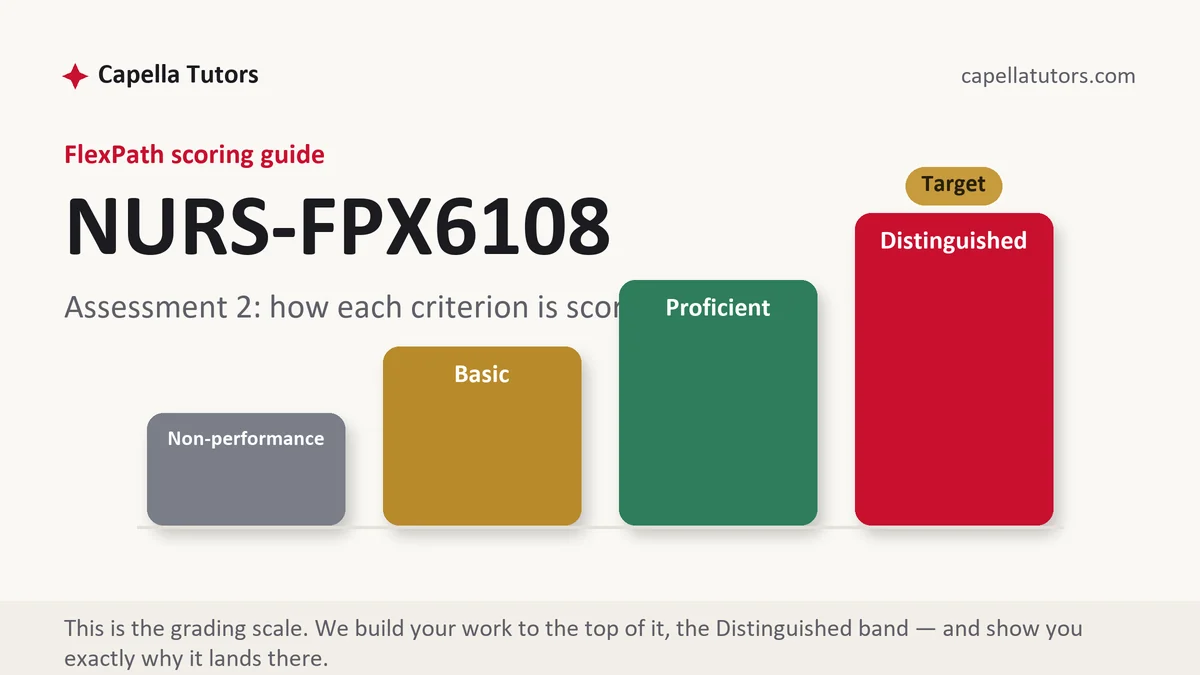
How NURS-FPX6108 Assessment 2 is scored
Each criterion in your scoring guide settles on one of four levels, and the level text is the specification for the build:
| Level | What it means on a curriculum proposal |
|---|---|
| Distinguished | The need is evidenced with the program's own data, every objective sits at a cognitive level that matches the outcome above it, each row of the map reaches an assessment with a numeric threshold, and at least one broken link is named with a repair. |
| Proficient | A complete and internally consistent design with measurable objectives and a full map. No misalignment is identified, so the analysis criterion stays one level short. |
| Basic | A topic outline organized by week with assignments listed, which is a syllabus rather than a curriculum, and no mapping anywhere in the document. |
| Non-performance | A required element is absent, most often the evaluation plan, and absence rather than weakness puts the criterion on the floor. |
The verb ladder is where most proposals quietly fail. Cognitive level has to hold as you descend: if the program outcome says evaluate and the course outcome says synthesize, no module objective underneath may stop at identify. When the ladder breaks in the curriculum you are documenting, write the break down. A named misalignment with a proposed repair is worth more than forty rows that agree with each other.
The NURS-FPX6108 Assessment 2 method, step by step
-
Map criteria to sections before you design anything
Copy the criteria into a blank file and let them become the section headings, with their verbs kept. Design work sprawls, and a proposal organized by your own logic rather than the guide's will hide an answer the evaluator is looking for. If the guide asks you to justify the curriculum design, that section reaches a justification with evidence, not a description of the design.
-
Evidence the need with the program's own numbers
A curriculum change is justified by data, not by the observation that health care is changing. Use what the setting has: a first attempt licensure pass rate that slipped, employer feedback that graduates cannot delegate, a course with a 30 percent withdrawal rate, a revised competency framework the program has not yet mapped to. One number in the opening paragraph changes how the whole proposal reads.
-
Write outcomes at the top, then descend one level at a time
Program outcomes tie to a published competency set. Course outcomes derive from those. Module objectives derive from course outcomes. Write each level before starting the next, and use the revised taxonomy from Anderson and Krathwohl to keep the verbs honest. Given a deteriorating simulated patient, the learner will prioritize interventions in order of urgency is observable. Learners will understand deterioration is not, and the flag is automatic.
-
Build the map with the objective as the unit
The table has a row for each objective and no rows for weeks. Carry seven columns if your guide allows it: competency, program outcome, course outcome, module objective, teaching method, evidence of achievement, and the threshold that counts as success. Then interrogate each row with one question, does the evidence in the last column actually demonstrate the objective in the fourth. A reasoning objective measured by a recall quiz fails that question and the row should be marked, not smoothed over.
-
Choose teaching methods that can reach the stated level
Method has to match cognitive level, and the justification belongs in the proposal. Recall responds to spaced retrieval practice. Application responds to worked cases and deliberate practice with feedback. Clinical judgment responds to unfolding cases and structured debriefing, which is why an experiential cycle in the tradition of Kolb is worth citing where you argue for simulation. A lecture defended as teaching analysis is a misalignment on the teaching side of the map.
-
Design the evaluation as a second problem, with thresholds
Say what will be measured, by which instrument, at what point, by whom, and against what number. Formative review while the course runs, end of course data, and aggregated outcomes across at least two cohorts. Attach the threshold explicitly, for example 85 percent of learners scoring 3 or better on the rubric criterion, and name the committee that reviews the result and the date it meets. Evaluation without a number is an opinion and the criterion reads it that way.
A structure that maps to the criteria
Word figures are our tutors' planning targets for a proposal of this size, not Capella rules; expand any section your scoring guide weights more heavily.
| Section | What it must do | Guide |
|---|---|---|
| Context and documented need | The program, the learners, and the data or standard forcing the design, with a number attached. | ~250 words |
| Program and course outcomes | Outcomes at both levels, mapped to a named competency framework rather than asserted. | ~250 words |
| Module design and objectives | Modules with objectives in observable verbs, each at the level its outcome demands. | ~300 words |
| Teaching methods and justification | The method chosen for each objective and the reason it can reach that cognitive level. | ~250 words |
| Alignment map | One row per objective, running from competency to evidence and threshold, with a break named. | ~200 words |
| Evaluation plan | Instruments, timing, thresholds, reviewers, and the cycle in which findings are acted on. | ~250 words |
| References | Current APA, taxonomy and design theory cited to primary sources, standards as organizational reports. | as needed |
Annotated sample excerpt
A model paragraph from our team, written to the standard the highest level of a criterion sets. It is study material, so take the reasoning and build your own map.
The residency's twelve month didactic sequence carries a program outcome at the level of evaluate, which means the module on recognizing deterioration cannot stop at recall.1 The objective therefore reads: given an unfolding case with worsening vital signs, the resident will evaluate which escalation option meets the patient's need and defend the choice in debriefing, taught through a two part unfolding case with structured debrief and measured by a scored performance checklist with a threshold of 4 of 5 critical actions.2 Two rows below it fail that test: the sepsis objective descends to identify while its outcome says analyze, and its only evidence is a ten item quiz, so I am proposing the quiz be retained as formative and the summative evidence move to the same checklist format.3
- 1States the ladder before writing the objective, so the cognitive level is inherited from above rather than chosen by preference.
- 2Puts objective, method, evidence, and numeric threshold in one sentence. A row that travels all the way to a number is what the alignment criterion is actually asking for.
- 3Names a broken link and repairs it. Finding one real misalignment in your own map earns more credit than a table where every row agrees.
The full premium sample for your exact assessment, written fresh to your scoring guide and issue, is free to request. Study it, revise it into your own voice, and submit work you understand.
The five mistakes that cost Distinguished
- A syllabus in proposal clothing. Weeks, topics, and readings with no mapping is the most common Basic submission in this course.
- Unmeasurable verbs. Understand, appreciate, and be aware of cannot be observed, and they are flagged on sight.
- A ladder that slips. Objectives a level or two below the outcome they serve is a misalignment, and leaving it unremarked costs the analysis criterion.
- A map with no evidence column. A table that stops at the teaching method never reaches graded evidence, so no row proves anything.
- Evaluation without thresholds. Course surveys with no number, no aggregate, and no review date cannot satisfy an evaluation criterion.
Pre-submission checklist
- Need evidenced with a number from the program itself
- Program and course outcomes mapped to a named competency framework
- Every objective observable, and at the cognitive level its outcome requires
- One row per objective, travelling from competency to evidence and threshold
- At least one misalignment identified with a specific repair proposed
- Evaluation plan with instruments, timing, numeric thresholds, reviewers, and a review date
Building a curriculum proposal from nothing?
Send the scoring guide, the program you are designing for, and any syllabus or outcome list you already hold. We write the outcomes, keep the verb ladder intact, build the map row by row, and attach an evaluation plan with real numbers. Back in 24 to 48 hours, revised until you hit your target, first premium sample free.