This manual is for NURS-FPX6108 Assessment 1, start to submission. Send the scoring guide and we assemble the practicum setup document for you, site access, mentor, curriculum artifacts, objectives, and the meeting record, back in 24 to 48 hours with revisions until it clears. Assessment 1 of NURS-FPX6108 opens the curriculum course, and your scoring guide usually asks for the arrangements rather than the analysis: where you will do curriculum work, who will supervise it, which documents you will be permitted to see, and what you agreed with faculty and your mentor on a scheduled call. Curriculum access is the part learners underestimate. Below is the method, the structure, and an annotated sample excerpt. Your courseroom may print this as NURS FPX 6108 Assessment 1 or NURS6108 Assessment 1; it is the same deliverable, and NURS-FPX6108 Assessment 1 is what this manual walks through.
One honesty note before the manual: Capella revises courses and scoring guides over time, so always write to the exact scoring guide attached to your assessment in the courseroom. The course identity above is verified on capella.edu; the method and structure below are our tutors' approach to it, not Capella's official rubric text.
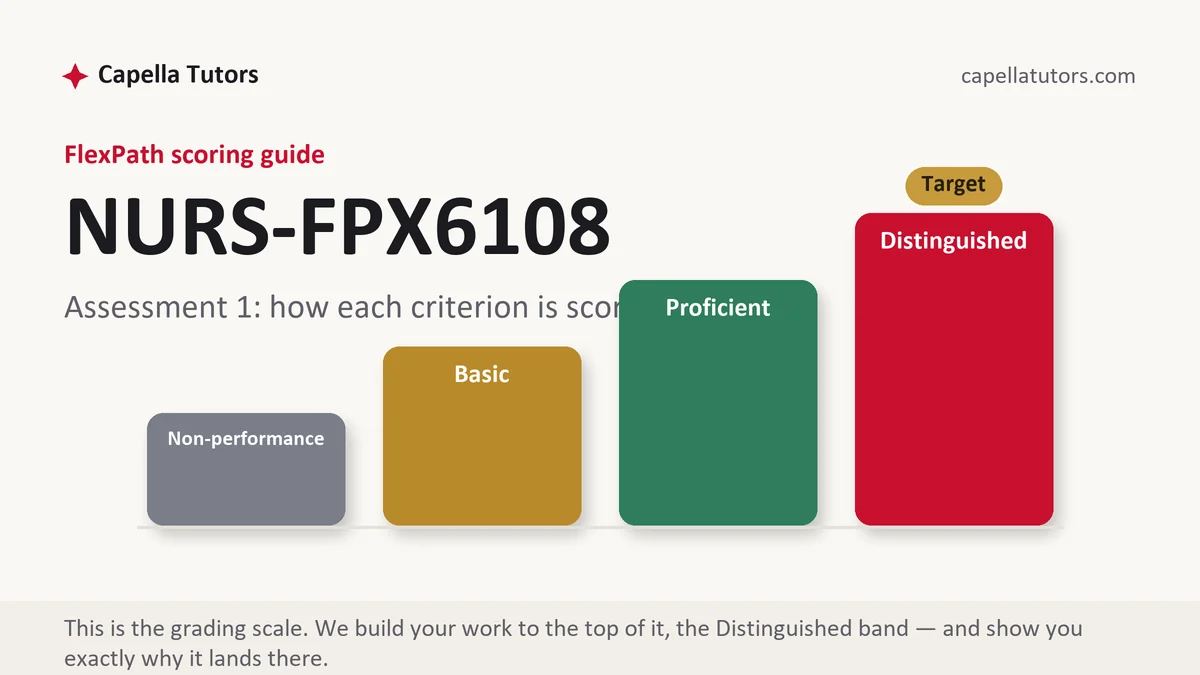
How NURS-FPX6108 Assessment 1 is scored
Nothing here is averaged into a grade. Each criterion resolves to one of four levels, and the level wording tells you what to write:
| Level | What it means on a practicum setup document |
|---|---|
| Distinguished | Access is documented rather than assumed, the curriculum artifacts you need are listed by name with the person who controls each one, the objectives are measurable, and the plan states what you will do if a committee closes a meeting to visitors. |
| Proficient | The arrangements are complete and the plan would work as written. Nothing in it accounts for the documents or meetings you may be refused, which is where the top column is earned. |
| Basic | A site and a mentor named in general terms, objectives written as intentions, and an assumption that syllabi and evaluation data will simply be handed over. |
| Non-performance | A required element is missing outright, commonly the documented meeting or the mentor's qualifications, and a missing element scores below a weak one. |
Curriculum work has a practical constraint the other specialization courses do not. Syllabi, systematic evaluation plans, and accreditation self studies are institutional documents, and some of them are confidential. A setup document that names which artifacts you have permission to use, and from whom, is the difference between a project that runs and one that stalls in week three.
The NURS-FPX6108 Assessment 1 method, step by step
-
Build the section list from the criteria, verbs intact
Read the scoring guide first and let it dictate the headings. Setup deliverables tempt learners into filling in a form, and a form fills space without answering criteria. Where the guide asks you to describe the practicum experience, describe the work you will perform, not the department you will sit in.
-
Choose a curriculum you can actually get inside
The practicum needs a live curriculum under revision, not a program you admire from outside. A school of nursing moving to a concept-based design, a residency rewriting its didactic sequence, an associate degree program responding to a survey finding. Say how many students, how many faculty, and what is being changed, because those three numbers carry every later claim.
-
List the artifacts by name and by owner
Write out what you need: the current curriculum map, the syllabi for the courses in scope, program outcome statements, the systematic plan for evaluation, aggregated course evaluation data, the last accreditation report. Beside each one, name the person who controls it and whether you have permission yet. This list is the single most useful paragraph in the document and almost nobody writes it.
-
Vet the mentor for curriculum authority
Your mentor needs standing in the process, not just a title. A curriculum committee chair, an assistant dean, a program director, a nursing professional development manager who owns the residency curriculum. State the degree, the role, and the specific authority: whether they can seat you in a committee meeting, approve document access, and sign your hours.
-
Write objectives against a competency framework
Anchor the objective set in something published so the evaluator can check the level. The AACN Essentials supply the competency domains that program outcomes map onto, and the accreditation criteria your program answers to, whether commission based or the nursing accrediting commission, supply the evaluation language. Each objective needs an observable verb and the artifact that will prove it: a completed map, a written gap analysis, a drafted evaluation plan.
-
Hold the meeting, then write the record
Take an agenda covering document access, confidentiality, meeting attendance, hours verification, and checkpoints. Afterwards write the record: date, attendees with roles, what was agreed, what was refused, and the next review date. Refusals belong in the record, because a plan that reflects what you were actually granted is stronger than one that assumes everything.
A structure that maps to the criteria
Word figures are our tutors' planning targets for a setup document of this kind, not Capella requirements; your scoring guide decides the weighting.
| Section | What it must do | Guide |
|---|---|---|
| Practicum setting and program | The program or department, student and faculty numbers, and the curriculum change already underway. | ~200 words |
| Mentor and authority | Degree, role, and the specific decisions your mentor can make about access and hours. | ~150 words |
| Curriculum artifacts and permissions | Each document named, its owner identified, and its permission status stated plainly. | ~250 words |
| Project scope | What you will produce, what the program keeps, and the boundary of what you are not attempting. | ~200 words |
| Objectives and evidence | Measurable objectives anchored in a competency set, each with the artifact that proves it. | ~250 words |
| Hours, confidentiality, and the meeting record | Hours by week, how confidential material will be handled, and the minuted call. | ~250 words |
| References | Current APA for the competency framework and the accreditation criteria cited. | as needed |
Annotated sample excerpt
An original model from our writers, set at the standard a top level criterion description implies. Study the moves, then write the version your program needs.
The practicum sits inside a BSN program of 180 students and 14 full time faculty that voted last spring to move from a systems organized curriculum to a concept-based design, with the first revised cohort admitted in fifteen months.1 Five artifacts carry my project, and each has an owner: the current curriculum map and the eight syllabi in scope, held by the curriculum committee chair, who is also my mentor; the program outcome statements and the systematic plan for evaluation, held by the associate dean; and three years of aggregated course evaluation data, held by the assessment office, which releases it only in de-identified summary form.2 Permission for the first four is confirmed in writing; the assessment office has asked for a data request form, so my plan carries a fallback in which the gap analysis runs on syllabi and end of course pass rates alone.3
- 1Establishes the program with three numbers and names the change already in motion, so the project attaches to real work rather than a hypothetical revision.
- 2Lists each artifact with the person who controls it. This is the paragraph that decides whether the practicum runs, and evaluators recognize it as planning rather than optimism.
- 3States what is confirmed, what is pending, and what the project does if the pending item is refused. A documented fallback is the move that earns the top column on a setup deliverable.
The full premium sample for your exact assessment, written fresh to your scoring guide and issue, is free to request. Study it, revise it into your own voice, and submit work you understand.
The five mistakes that cost Distinguished
- Assumed access. A plan that expects syllabi and evaluation data to arrive on request is the reason most curriculum practicums stall, and evaluators have seen it many times.
- A mentor with no standing. A supportive colleague who cannot seat you in a curriculum meeting cannot support a curriculum practicum.
- Objectives with no artifact. Understand the curriculum process cannot be verified. Produce a gap analysis of the eight syllabi in scope can.
- Silence on confidentiality. Self studies and evaluation data carry handling obligations, and a document that ignores them invites a criterion to be marked down for judgment.
- A meeting with no minutes. The documentation criterion is satisfied by a record with attendees, agreements, and refusals, not by the fact that a call took place.
Pre-submission checklist
- Program described with student numbers, faculty numbers, and the change under way
- Mentor's degree, role, and decision authority over access and hours all stated
- Every artifact named with its owner and its permission status
- Objectives measurable, anchored to a competency set, each tied to a deliverable artifact
- Confidentiality handling addressed for any institutional document in scope
- Meeting minuted with date, attendees, agreements, refusals, and next checkpoint
Need practicum access sorted before the clock starts?
Send the scoring guide, the program you have a way into, and your mentor's role. We build the artifact list, the permission status, the objectives, and the fallback plan, then it clears scoring-guide QA and APA review before reaching you inside 24 to 48 hours. Revisions run until faculty approves it, and your first premium sample is free.