This manual is for NURS-FPX6026 Assessment 4, start to submission. Send the criteria and a note on where you practice, and a premium original sample comes back inside 24 to 48 hours, revised free until your guide is satisfied. The final deliverable of NURS-FPX6026 usually turns the lens on your own practice: development goals for the advanced role you are moving into, and an account of how equity, inclusion, and implicit bias will shape the way you work. It is the only deliverable in the course written in the first person, and it is the one most often written too softly. Goals without measures score exactly like intentions. Your courseroom may print this as NURS FPX 6026 Assessment 4 or NURS6026 Assessment 4; it is the same deliverable, and NURS-FPX6026 Assessment 4 is what this manual walks through.
One honesty note before the manual: Capella revises courses and scoring guides over time, so always write to the exact scoring guide attached to your assessment in the courseroom. The course identity above is verified on capella.edu; the method and structure below are our tutors' approach to it, not Capella's official rubric text.
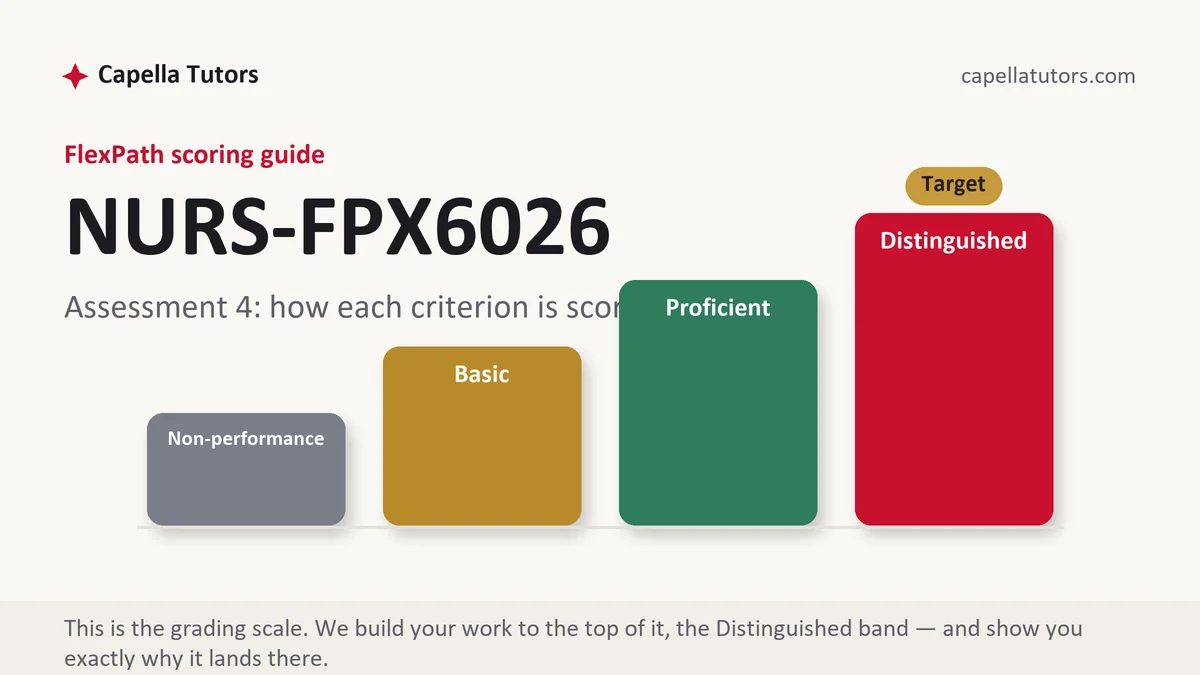
How NURS-FPX6026 Assessment 4 is scored
Four levels per criterion, and the top column is asking for evidence about yourself rather than sentiment about yourself:
| Level | What it means on a professional development and equity deliverable |
|---|---|
| Distinguished | Goals carry a measure, a date, and a verification source; the equity analysis rests on a documented disparity in your own setting; and bias is addressed by a structural change rather than by an intention to be more aware. |
| Proficient | Thoughtful, well-organized goals and a sound discussion of inclusion, supported by literature and short on specifics you could be held to. |
| Basic | Sincere reflection about growth and open-mindedness, with no measure, no date, and no data about the population being served. |
| Non-performance | A required element is missing, most often the implicit bias component, the literature support, or the evaluation of the goals themselves. |
The register that lifts this deliverable is empirical humility applied to your own practice. Implicit bias has a substantial research literature and a contested intervention literature: awareness training has repeatedly failed to change downstream behavior, while structural changes such as standardized triggers, default ordering, and audited access have. Citing that distinction, rather than promising vigilance, is the single clearest signal that a graduate writer is reading the evidence instead of gesturing at it.
The NURS-FPX6026 Assessment 4 method, step by step
-
Read the criteria for what has to be verifiable
Reflective deliverables still have criteria with verbs. Analyze, evaluate, and justify appear here as often as they appear anywhere else in the course, and each one wants something checkable. Build the outline from the guide and mark beside each heading what evidence that section will contain: a number, a source, a policy, or a date.
-
Write each goal as a commitment somebody could audit
A goal needs an action, a measure, a date, and where the measure comes from. Completing a certified interpreter training module and raising documented interpreter use in my own encounters with limited-English-proficiency patients from 40 to 90 percent by the end of the second quarter, verified from the encounter record, is auditable. Becoming more culturally competent is not.
-
Ground the equity section in a disparity you can document
Pull something real from your own setting or from a comparable published population: a difference in appointment completion, in time to a specialty referral, in documented interpreter use, in follow-up after an abnormal result. One quantified gap with a source does more for this criterion than a page about the importance of inclusive care.
-
Name the bias mechanism, then the structure that blunts it
Say where the decision point sits and what pressure distorts it. When an interpreter requires a fifteen-minute wait in a twenty-minute visit, the shortcut is a family member translating, and the mechanism is time pressure rather than prejudice. The counter-structure is a default interpreter booking attached to the language field at scheduling, and an audit of encounters where none was used.
-
Build a development plan with sources and a supervision loop
Name what you will read, what you will complete, who will observe you, and how often you will discuss it with somebody senior. Professional development criteria at this level want a structure rather than a reading list, and a stated feedback loop with a named role and an interval is what turns a plan into a commitment.
-
Evaluate the goals themselves, then self-score
Close by saying how you will know whether each goal was met, what you would do if it was not, and which of them you expect to be hardest and why. That last clause is the honest self-assessment the top column is asking for. Then grade the draft against every criterion and revise anything short of it.
A structure that maps to the criteria
Planning targets our tutors use for a deliverable of this kind rather than Capella rules; expand whatever your own criteria weight.
| Section | What it must do | Guide |
|---|---|---|
| Role and practice context | The advanced role you are entering, the population it serves, and the setting's constraints, stated concretely. | ~200 words |
| Professional and leadership goals | Three or four goals, each with an action, a measure, a date, and a verification source. | ~300 words |
| Documented disparity | One quantified gap in your own or a comparable population, with its source and its likely drivers. | ~250 words |
| Bias mechanisms and structures | The decision points where bias enters, the pressure that produces it, and the structural counter-measure for each. | ~300 words |
| Development plan | Learning activities with sources, the observer or mentor, the interval, and the feedback loop. | ~250 words |
| Evaluation of the goals | How each goal is checked, what changes if it is missed, and which one you expect to be hardest. | ~200 words |
Annotated sample excerpt
An original model paragraph from our team at the register the guide's top column describes. Take the moves and write your own.
In the specialty clinic where I practice, 312 of 2,140 active patients have a preferred language other than English recorded, and a professional interpreter is documented in 38 percent of their encounters against a legal expectation of meaningful access in all of them.1 The mechanism is not hostility toward interpretation; it is a twenty-minute visit template, an interpreter line that averages a nine-minute wait, and an accompanying relative who is standing there and willing.2 My goal is therefore structural rather than attitudinal: a default interpreter booking generated from the language field at scheduling, a lengthened template for those visits, and a monthly audit of encounters completed without one, with the rate reported to the clinic manager and my own encounters counted separately.3
- 1A gap in the writer's own setting with a denominator and a standard beside it. This one sentence converts the equity criterion from an essay into an analysis.
- 2Names the mechanism as workflow pressure rather than as attitude, which is both more accurate and more useful, because workflow can be redesigned.
- 3Turns the analysis into a default, a template change, and an audit with an owner. The goal is now something a manager could verify and the writer could fail at.
The full premium sample for your exact assessment, written fresh to your scoring guide and issue, is free to request. Study it, revise it into your own voice, and submit work you understand.
The five mistakes that cost Distinguished
- Goals written as aspirations. No measure, no date, no source, and therefore nothing for the evaluation criterion to evaluate.
- Equity discussed without data. A page on the value of inclusive care and no number from any population leaves the analysis criterion empty.
- Bias answered with awareness. The intervention literature is unkind to awareness training; defaults, triggers, and audits are what have moved behavior.
- Undergraduate reflective voice. Narrating how your thinking evolved spends the words this deliverable needed for structures and measures.
- No feedback loop. A development plan with no observer, no interval, and no supervision named is a list of intentions with a deadline attached.
Pre-submission checklist
- Every goal carries an action, a measure, a date, and a verification source
- One disparity in your own or a comparable population is quantified and sourced
- Bias is located at a decision point, with the pressure that produces it named
- Each counter-measure is structural, and supported from the literature
- The development plan names an observer, an interval, and a feedback loop
- Each goal has a check, a response for failure, and an honest note on difficulty
Last deliverable of the course?
Send the guide and a few lines about your setting and your role. We return goals written as auditable commitments, one documented disparity with its source, and bias handled through structures the literature actually supports. The premium original sample arrives within two days and is revised at no cost until every criterion is answered.