This manual is for NURS-FPX6026 Assessment 3, start to submission. Tell us who the audience is and a premium original sample lands inside 24 to 48 hours, written to the top of the guide and revised free until it fits. This deliverable usually asks you to advocate rather than to analyze: take a policy position and present it to the people who could adopt it, in the form your prompt specifies, which is often a short presentation with speaker notes. The clinical case is assumed by this point in the course. What is graded is whether the case has been translated into the terms the room decides in. Your courseroom may print this as NURS FPX 6026 Assessment 3 or NURS6026 Assessment 3; it is the same deliverable, and NURS-FPX6026 Assessment 3 is what this manual walks through.
One honesty note before the manual: Capella revises courses and scoring guides over time, so always write to the exact scoring guide attached to your assessment in the courseroom. The course identity above is verified on capella.edu; the method and structure below are our tutors' approach to it, not Capella's official rubric text.
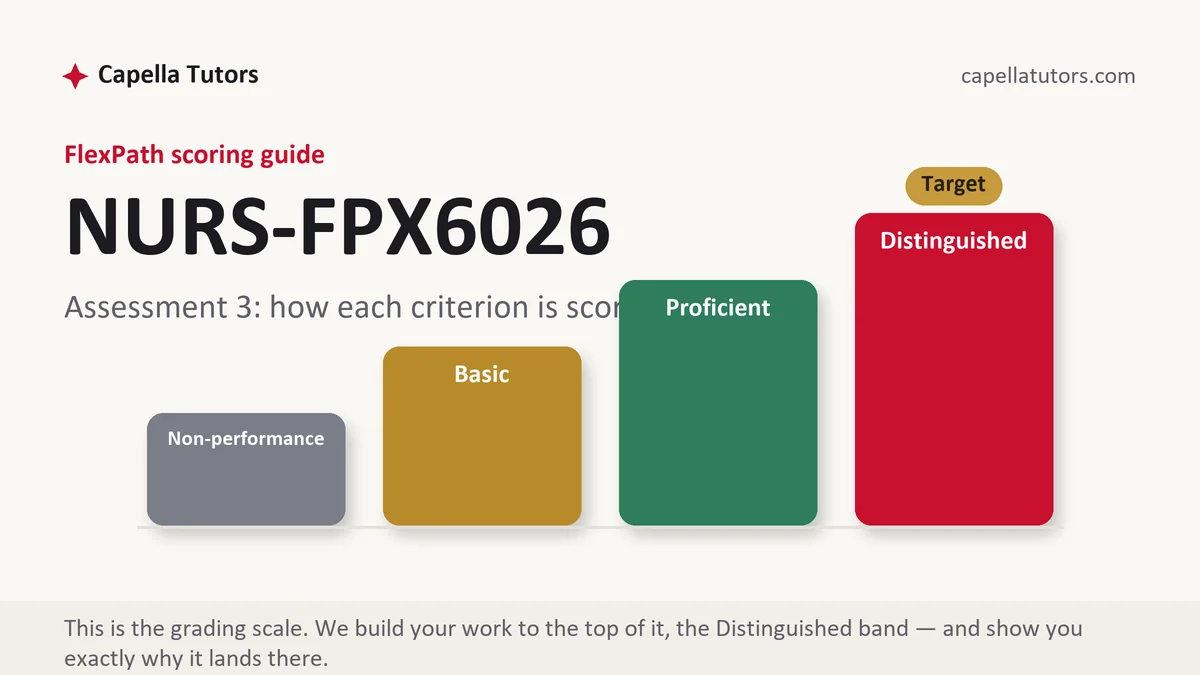
How NURS-FPX6026 Assessment 3 is scored
Four levels per criterion, and the top column is describing persuasion built on evidence rather than on emphasis:
| Level | What it means on an advocacy deliverable |
|---|---|
| Distinguished | The ask is specific and addressed to somebody who can grant it, the evidence is converted into the audience's own currency, and the two objections that would actually be raised are answered in the material rather than left to the question period. |
| Proficient | A clear, well-supported, professionally presented case for the position, with the ask stated in general terms. |
| Basic | A summary of the problem and the evidence delivered to nobody in particular, ending in a call for greater awareness. |
| Non-performance | A required component is missing, most often the speaker notes, the citations behind a claim, or the stakeholder-specific benefit the guide asked for. |
Advocacy at graduate level is still scholarship, and the notes are where that shows. Keep design, sample, and effect size in the notes under every slide that makes a claim, and cite in the notes rather than on the visible material. Where you translate an effect into an operational number, show the arithmetic, because a converted figure with its working shown survives challenge and a converted figure without it invites the wrong kind of question.
The NURS-FPX6026 Assessment 3 method, step by step
-
Name the decision-maker and the decision
Not stakeholders in general: the committee, the executive, the board, or the department that could say yes, and the specific thing they would be saying yes to. Write both at the top of the outline. An advocacy piece with no addressee drifts into general education, which is the reliable route to the middle of the guide.
-
Translate the evidence into the audience's currency
Clinicians decide in outcomes, executives in cost and risk, boards in reputation and regulatory exposure, patients in burden and time. The same trial finding therefore has three or four presentations, and the one you choose should match the room. Say what the change means in avoided admissions, in staff hours, or in documented conversations, not only in relative risk.
-
Open on the single strongest number you own
One figure, sourced, on the first substantive slide, chosen because it is the one nobody in the room can dispute. A statement that a documented advance care planning conversation exists for 18 percent of a dialysis population, against a program requirement that it exist for all, does more work in one line than three slides of context.
-
Answer the two objections that will actually be raised
Not the polite ones. Time in an already full visit, reimbursement for the conversation, whose scope it falls inside, and the fear that the discussion will distress patients or families. Take the two most likely, put them on the record with evidence, and the room's energy moves from resistance to logistics.
-
Make the ask small enough to be granted
A pilot on one shift, a template build, a standing agenda item, a defined trial period with a review date. Large asks get deferred to a subcommittee, and a deferred ask is a refusal with better manners. State who owns the first step and when it starts.
-
Load the notes, then self-score
Every claim on the visible material needs a note carrying the design, the sample, the effect, and the citation, because guides in this course commonly score the notes as the written deliverable. Then read the whole thing against the criteria one at a time and give anything below the top level another pass before submitting.
A structure that maps to the criteria
Our planning targets for an advocacy deliverable rather than Capella requirements. Where the format is a deck, read these as speaker-notes counts.
| Section | What it must do | Guide |
|---|---|---|
| Audience and ask | The decision-maker named, the decision stated in one sentence, and the review date attached. | ~200 words |
| The problem in their terms | The strongest sourced figure first, then the gap expressed in the currency this audience decides in. | ~300 words |
| Evidence for the position | Design, sample, and effect for each supporting study, with any operational conversion shown as arithmetic. | ~350 words |
| Benefit by stakeholder | What each affected role gains or gives up, stated separately rather than merged into shared benefit. | ~250 words |
| Objections answered | The two most likely challenges, each met with evidence or with a design feature. | ~250 words |
| The ask and the first step | Scope, owner, start date, review date, and the measure that would be reported back. | ~200 words |
Annotated sample excerpt
An original model passage from our team, written where the top column sits. Learn the moves and build your own.
The slide carries one number: 18 percent. Of the 412 adults receiving maintenance dialysis across our three units, 74 have a documented advance care planning conversation in the record, and the program's own conditions for coverage expect that discussion to be offered to every patient.1 A cluster randomized trial in 24 dialysis facilities found that a structured conversation delivered by a trained nurse raised documentation from 21 to 63 percent at six months and reduced hospital deaths in the intervention arm, with the effect on documentation far more precisely estimated than the effect on place of death.2 Converted to this population, moving to the trial's documentation rate means roughly 185 additional conversations a year, which at 25 minutes each is 77 hours, or 1.5 hours a week across three units.3
- 1One indisputable figure with its denominator, set against a requirement the audience is already accountable for. Nothing rhetorical is needed after that.
- 2Design and setting before the effect, and the precision of the two outcomes distinguished. Claiming both equally would have been the overreach a committee remembers.
- 3Shows the arithmetic that turns an effect into staff hours. The ask becomes concrete, and the number can be checked in the room rather than doubted.
The full premium sample for your exact assessment, written fresh to your scoring guide and issue, is free to request. Study it, revise it into your own voice, and submit work you understand.
The five mistakes that cost Distinguished
- An audience of nobody. Advocacy addressed to the profession in general has no decision attached, and a criterion about advocating for a policy cannot credit it.
- Evidence left in research units. Relative risk is not a currency any committee spends; hours, admissions, and documented conversations are.
- Objections saved for the question period. The two hardest challenges belong in the material, where you control the answer.
- Shared benefit in place of separate benefits. Roles do not gain equally, and pretending otherwise is what makes an advocacy piece sound promotional.
- An ask with no size. Support for this initiative is not an ask; one shift, one template, one review date is.
Pre-submission checklist
- The decision-maker and the decision are both named in the opening section
- The strongest sourced figure appears on the first substantive slide or page
- Every claim has a note carrying design, sample, effect, and citation
- Any operational conversion shows its arithmetic
- Two likely objections are answered inside the material
- The ask states scope, owner, start date, review date, and the measure reported back
Presenting the advocacy piece?
Tell us the audience and the format and we return the slide text and the speaker notes as one file, with the evidence converted into hours and admissions and the two hardest objections answered on the record. Premium original sample inside 24 to 48 hours, revised at no cost until the criteria are satisfied.