This manual is for NURS-FPX6020 Assessment 3, start to submission. Tell us the format your courseroom wants and a premium original sample comes back inside 24 to 48 hours, revised free until the guide is satisfied. The closing deliverable of NURS-FPX6020 usually turns your clinical work into something an audience receives: a handout, a teaching tool, or a short presentation with speaker notes, built for patients, families, or the interprofessional team. The clinical content is only half the grade. The other half is whether the artifact is usable by the people it names. Your courseroom may print this as NURS FPX 6020 Assessment 3 or NURS6020 Assessment 3; it is the same deliverable, and NURS-FPX6020 Assessment 3 is what this manual walks through.
One honesty note before the manual: Capella revises courses and scoring guides over time, so always write to the exact scoring guide attached to your assessment in the courseroom. The course identity above is verified on capella.edu; the method and structure below are our tutors' approach to it, not Capella's official rubric text.
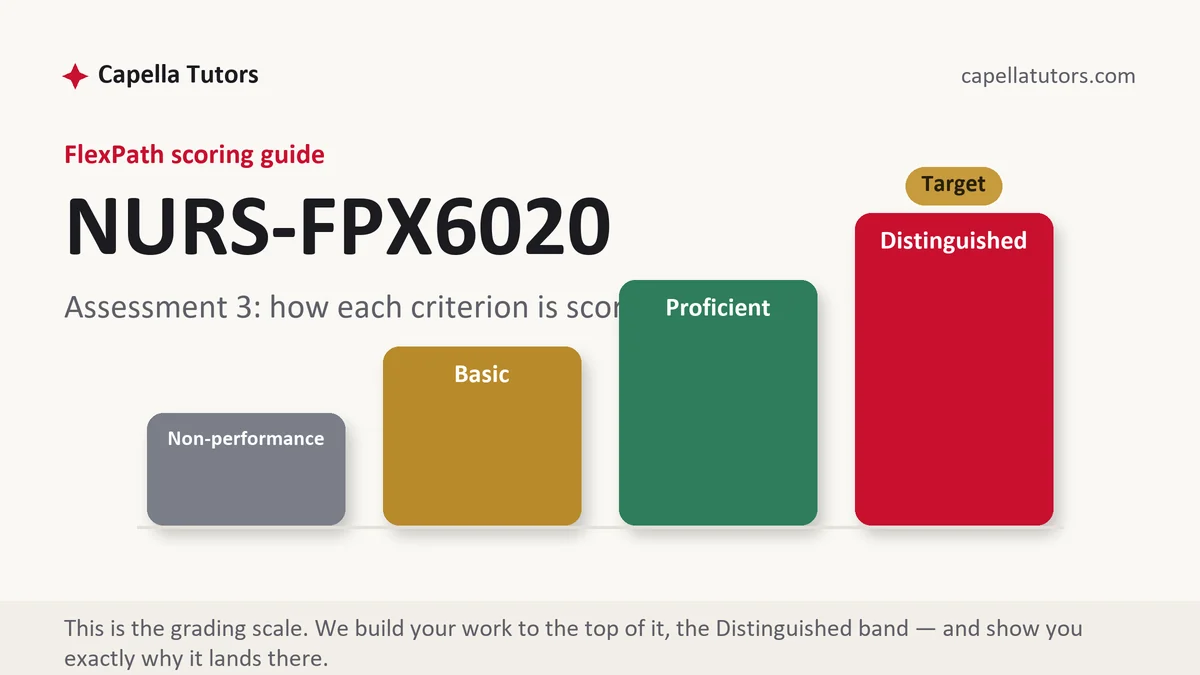
How NURS-FPX6020 Assessment 3 is scored
Four levels per criterion, and this deliverable is unusual because design decisions are graded alongside clinical ones:
| Level | What it means on a communication deliverable |
|---|---|
| Distinguished | The artifact is built to a stated reading level with the audience's language and access needs handled, the clinical claims behind it are cited in the notes, and comprehension is checked by a named method rather than assumed. |
| Proficient | Accurate, complete, professionally presented content aimed at the right audience, with literacy and access treated in general terms. |
| Basic | Clinically correct material written at the level of a nursing textbook and handed to a patient audience. Correct and unusable. |
| Non-performance | A required component is missing, most often the speaker notes, the citations, or the evaluation of understanding the guide asked for. |
Where the format includes notes, the notes carry the scholarly load: design, sample, effect, and citation live there while the visible artifact carries plain language. Two evidence points are worth naming explicitly in the notes because evaluators look for them. Written patient material is widely recommended at a fifth to sixth grade reading level, and teach-back has trial evidence behind it as a comprehension check rather than being merely good manners. Cite both rather than asserting them.
The NURS-FPX6020 Assessment 3 method, step by step
-
Settle the audience and the format in writing before you draft
Patient and family, unit staff, or an interprofessional committee: each takes a different vocabulary, a different length, and a different proof standard. Write the audience at the top of the outline and keep the prompt's format requirements beside it, because length, notes, and citation placement all change the drafting.
-
Reduce the clinical content to the decisions the audience must make
A patient-facing artifact is not a compressed care plan. Ask what this person has to do differently tomorrow, and cut everything that does not serve one of those actions. Three or four actions is the usable maximum for a discharge audience, and the evidence on recall supports keeping the count low rather than the sheet full.
-
Write to a measured reading level, not an intended one
Short sentences, one idea each, common words in place of clinical terms, the action first and the reason second. Then measure it with a readability formula and report the result in your notes. Naming a target and demonstrating that you hit it is the difference between a design claim and a design decision.
-
Handle language and access as design, not as a caveat
Say which languages the artifact exists in and how translation was obtained, whether it works read aloud for a patient who cannot read it, and how a caregiver receives it if they are the operator. Pictures and icons earn their place when they carry the action rather than decorate it, and the notes should say which action each image supports.
-
Keep the evidence in the notes and the plain language in the artifact
The visible sheet says take the water pill in the morning so you are not up at night. The notes carry the guideline, the study, and the citation that justify the timing. Splitting the two is what allows the artifact to be genuinely simple without the deliverable becoming unscholarly, and guides in this course frequently grade both halves.
-
Build in a comprehension check, then self-score
State how you will know the message landed: teach-back with a specified return demonstration, a two-question check at the end of the encounter, a follow-up call at 48 hours with a named caller. Add what happens when the check fails. Then grade the draft against every criterion and give anything short of the top one more pass.
A structure that maps to the criteria
Our planning targets for a deliverable of this kind rather than Capella rules. If the format is a deck or a handout, treat these counts as notes and supporting text rather than as visible copy.
| Section | What it must do | Guide |
|---|---|---|
| Audience and purpose | Who receives this, what they must decide or do, and what the artifact is deliberately leaving out. | ~200 words |
| The artifact itself | Plain-language content organized around actions, at a measured reading level, with images that carry meaning. | ~300 words |
| Clinical rationale in notes | The evidence behind each instruction, with design and citation, kept out of the visible material. | ~350 words |
| Literacy and access decisions | Reading level measured and reported, languages and translation route, read-aloud usability, caregiver handling. | ~250 words |
| Interprofessional handoff | Who delivers it, at what point in the encounter, and which role reinforces it afterward. | ~200 words |
| Comprehension check | The method, the wording of the check, and what happens when the patient cannot return the message. | ~200 words |
Annotated sample excerpt
An original model from our team showing both halves of the deliverable at once. Learn the split, then build yours.
Artifact: Weigh yourself every morning after you use the bathroom, before you eat. Write the number on this card. Call the number on the front if you gain 3 pounds in one day or 5 pounds in a week.1 Notes: the wording targets a fifth grade level and measured at 4.8 on the Flesch-Kincaid grade scale, with the threshold stated as pounds rather than kilograms because that is the unit on the patient's own scale.2 Delivery is by the discharging nurse at the bedside with the card in hand, followed by teach-back in which the patient states the two numbers and the phone number without looking, and a pharmacy technician repeats the weight instruction at the medication review call on day two.3
- 1Four short sentences, action first, one idea each, and a threshold given as a number the patient can recognize on their own scale. No physiology in the visible text at all.
- 2A reading level claimed and then measured, with the unit choice justified. A design decision on the record rather than a design intention.
- 3Names the deliverer, the moment, the comprehension check with its exact success condition, and the role that reinforces it later. Three criteria answered in one sentence.
The full premium sample for your exact assessment, written fresh to your scoring guide and issue, is free to request. Study it, revise it into your own voice, and submit work you understand.
The five mistakes that cost Distinguished
- Clinical prose handed to a lay audience. Accurate, unreadable, and unusable, which is the definitional Basic outcome for this deliverable.
- A reading level intended and never measured. Any readability formula takes a minute, and reporting the number converts a claim into evidence.
- Evidence stripped out entirely. Simplifying the artifact is right; leaving the citations out of the notes as well loses the criterion that asks you to justify the content.
- Images used as decoration. A stock photograph of a smiling clinician supports no action, while an icon showing a scale beside a morning sun does.
- No comprehension check. Material provided is not material understood, and the criterion is asking how you would know the difference.
Pre-submission checklist
- Audience, format, length, and notes expectation confirmed against the prompt
- The artifact is organized around three or four actions, not around a diagnosis
- Reading level measured with a named formula and the score reported
- Citations and clinical reasoning live in the notes, not in the visible material
- Language, translation route, read-aloud usability, and caregiver delivery all stated
- A comprehension check named, worded, and given a response for when it fails
Closing out NURS-FPX6020?
Tell us the format and the audience and we return both halves as one file: the plain-language artifact with its reading level measured, and the notes carrying the evidence and the citations. Premium original sample inside 24 to 48 hours, revised at no cost until your guide is met.