This manual is for NURS-FPX6016 Assessment 2, start to submission. Give us the prompt and the initiative you have been assigned to look at, and a premium original sample comes back within 24 to 48 hours with its criterion walkthrough, revised free until your guide is satisfied. This deliverable usually asks you to evaluate an existing quality improvement initiative rather than invent one: what it set out to change, whether its measures could ever have proved it, what the results actually support, and what should happen next. Evaluation is a verdict with reasons, which is why summarizing the initiative accurately still scores in the middle of the guide. Your courseroom may print this as NURS FPX 6016 Assessment 2 or NURS6016 Assessment 2; it is the same deliverable, and NURS-FPX6016 Assessment 2 is what this manual walks through.
One honesty note before the manual: Capella revises courses and scoring guides over time, so always write to the exact scoring guide attached to your assessment in the courseroom. The course identity above is verified on capella.edu; the method and structure below are our tutors' approach to it, not Capella's official rubric text.
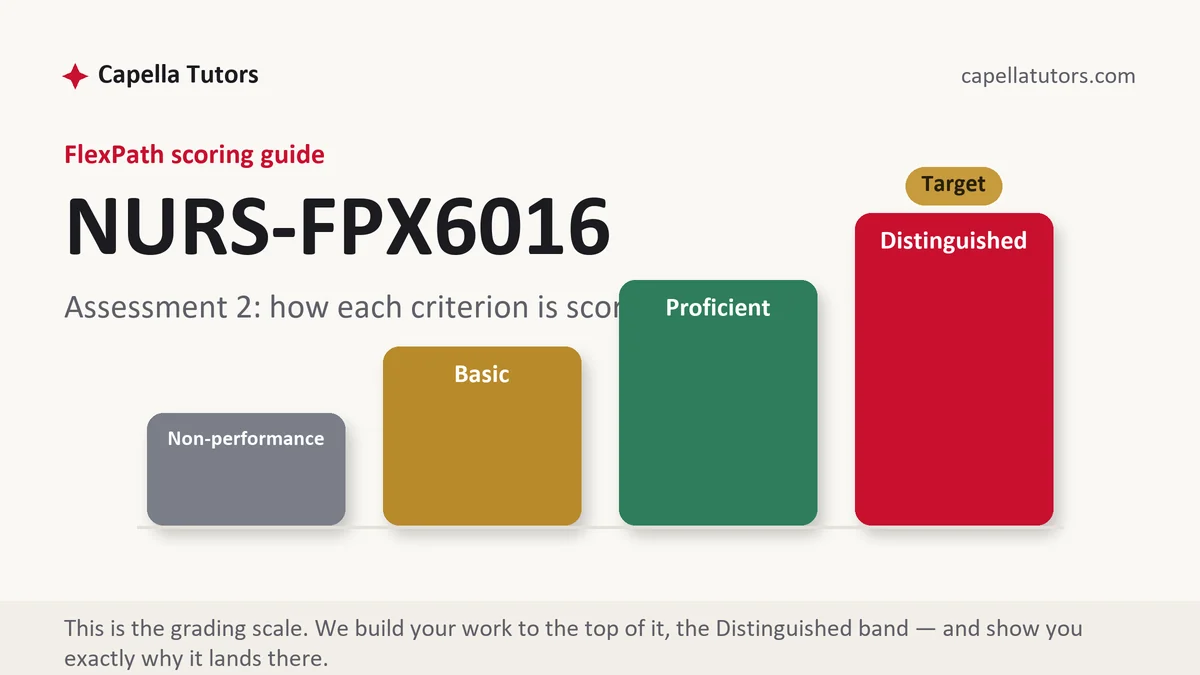
How NURS-FPX6016 Assessment 2 is scored
Four levels per criterion, and the distance between the middle two is almost always the distance between describing and judging:
| Level | What it means on an initiative evaluation |
|---|---|
| Distinguished | The measure set is critiqued before the results are, the interprofessional perspectives are weighed against each other, and the recommendation follows from a stated standard rather than from preference. |
| Proficient | The initiative is accurately described, the outcomes reported, the stakeholders identified. Everything is true and nothing has been decided. |
| Basic | A summary of what the initiative did followed by a general endorsement of it. No critique of the measures, no comparison, no verdict a committee could act on. |
| Non-performance | A required element is absent, commonly the interprofessional perspectives or the recommendation for continued evaluation. |
Two conventions raise this deliverable to master's register. First, judge the instrument before the result: a process measure collected by voluntary reporting cannot support a claim about incidence, and saying so is analysis. Second, distinguish a change that reached statistical detectability from one that changed care. An improvement of four percentage points across 3,000 encounters can be highly significant and still leave the workflow problem intact, and a graduate evaluator wants to see you make that call in writing.
The NURS-FPX6016 Assessment 2 method, step by step
-
Separate the criteria that describe from the criteria that judge
Read the guide and mark each criterion D for describe or J for judge. The description criteria are quick and worth full marks. The judgment criteria are where the paper is won, and they are the ones most drafts answer with a description. Keep the two kinds of paragraph visibly different in your outline so you cannot substitute one for the other.
-
Pick an initiative with a documented record
Choose something published, or something internal you can describe from a report rather than from memory: a pathway rollout, a bundle implementation, a documentation redesign. If your own organization's data is thin, an initiative reported in the peer-reviewed literature gives you a fuller record and the same analytic work, since the criteria grade your evaluation rather than your access.
-
Reconstruct the initiative's logic before judging it
Write out what problem it was aimed at, which mechanism it relied on, and what it expected to change. A wound-care pathway that standardizes assessment intervals is betting on earlier detection; one that centralizes product selection is betting on consistency and cost. Naming the bet is what lets you say later whether the measures could ever have tested it.
-
Critique the measure set on its own terms
Ask four questions of every measure. Is the numerator defined, is the denominator the population actually exposed, is the data source capable of producing the number reliably, and is the interval short enough to act on. Then ask whether the set is balanced, because outcome measures alone cannot tell you whether the change was even carried out, and process measures alone cannot tell you whether it mattered.
-
Test whether the effect transfers, and to whom
Compare the reported result against a benchmark or a comparable published initiative, then ask who inside the population was served worst. Pathways built around a weekly specialist round work differently in a facility where the specialist visits twice a month. Naming the subgroup the initiative underserved, and what would fix that, is frequently the shortest route to the top of the guide.
-
Recommend against a standard, then self-score
Close with a decision: continue, modify, expand, or retire, tied to a named standard or guideline rather than to your own impression, and with the next evaluation interval specified. Then read the draft against the guide one criterion at a time and mark each honestly. Anything short of the top gets one more pass before you submit.
A structure that maps to the criteria
These are our planning targets for an evaluation of this kind rather than requirements from Capella; adjust to whatever your own guide weights.
| Section | What it must do | Guide |
|---|---|---|
| Initiative and context | The problem it addressed, the setting, the mechanism it relied on, and what it predicted would change. | ~250 words |
| Critique of the measures | Numerators, denominators, data sources, intervals, and whether the set is balanced enough to support its claims. | ~300 words |
| Outcome evidence | What the results show, reported with their design and their precision, then compared against a benchmark or a similar initiative. | ~300 words |
| Interprofessional perspectives | How nursing, medicine, pharmacy, therapy, and support roles experienced the change, and where their interests diverged. | ~250 words |
| Recommendation | Continue, modify, expand, or retire, justified against a named standard, with the next evaluation interval stated. | ~250 words |
| References | Current APA, agency and standards documents by publication year, peer-reviewed studies through the Capella library. | as needed |
Annotated sample excerpt
A model passage from our team showing the level of scrutiny the guide's top column is describing. Study it, then write your own.
The pathway reports a single outcome measure, healing rate at twelve weeks, with a denominator of wounds entered into the tracking module rather than wounds present on the unit, which means the measure improves whenever documentation discipline slips.1 No process measure accompanies it, so the record cannot distinguish a pathway that worked from a pathway that was never followed, and the twelve-week interval places the first usable signal well past the point where a mid-course correction was possible.2 The reported improvement of 6.2 percentage points is statistically robust across 480 wounds and still sits inside the range that documentation drift alone could produce, which is the reason the recommendation below asks for a concurrent audit rather than an expansion.3
- 1Attacks the denominator first, and names the perverse incentive it creates. Measure critique of this kind is the single most reliable way to earn a judgment criterion here.
- 2Two structural faults in one sentence, an unbalanced set and an interval too long to act on. Both are faults of design rather than of effort.
- 3Accepts the statistics and still withholds the conclusion, then converts the doubt into a specific next step. Statistical robustness and practical confidence held apart on the page.
The full premium sample for your exact assessment, written fresh to your scoring guide and issue, is free to request. Study it, revise it into your own voice, and submit work you understand.
The five mistakes that cost Distinguished
- Description in place of evaluation. An accurate account of what the initiative did, with no verdict on whether its evidence supports the claims made for it, tops out mid-guide.
- Measures accepted as given. If you never ask what the denominator counts, you have taken the initiative's own word for its success and written a summary of it.
- Interprofessional views merged into one voice. Pharmacy, therapy, and bedside nursing rarely experience a pathway the same way, and the criterion exists because they do not.
- A recommendation with no standard behind it. Preference is not justification; a guideline, a national safety goal, or a published benchmark is.
- No further evaluation interval. An initiative endorsed without a date to look again has been approved rather than evaluated.
Pre-submission checklist
- Each criterion marked describe or judge, and answered in the mode it asks for
- Every measure examined for numerator, denominator, data source, and interval
- Results reported with their design and precision before any verdict is drawn
- At least three professional perspectives given separately, including where they conflict
- The recommendation tied to a named standard, guideline, or benchmark
- A next evaluation interval stated, with the measure that would trigger a change
Evaluating an initiative this week?
Send the criteria and name the initiative, published or internal. We return a premium original sample inside 24 to 48 hours with the measure critique written out in full, the professional perspectives separated, and the recommendation tied to a standard, then revise it free until your guide is met.