This manual is for NURS-FPX6016 Assessment 1, start to submission. Send the criteria and tell us which event you are working from, and a premium original sample arrives inside 24 to 48 hours, aimed at the top of the guide and revised free until it lands there. The opening deliverable of NURS-FPX6016 usually asks for an analysis of an adverse event or a near miss: the sequence set out in neutral order, the conditions that made the failure available, the consequences for each set of stakeholders, and an improvement response grounded in published safety evidence. Analysis carries the weight. The response is what proves the analysis was worth doing. Your courseroom may print this as NURS FPX 6016 Assessment 1 or NURS6016 Assessment 1; it is the same deliverable, and NURS-FPX6016 Assessment 1 is what this manual walks through.
One honesty note before the manual: Capella revises courses and scoring guides over time, so always write to the exact scoring guide attached to your assessment in the courseroom. The course identity above is verified on capella.edu; the method and structure below are our tutors' approach to it, not Capella's official rubric text.
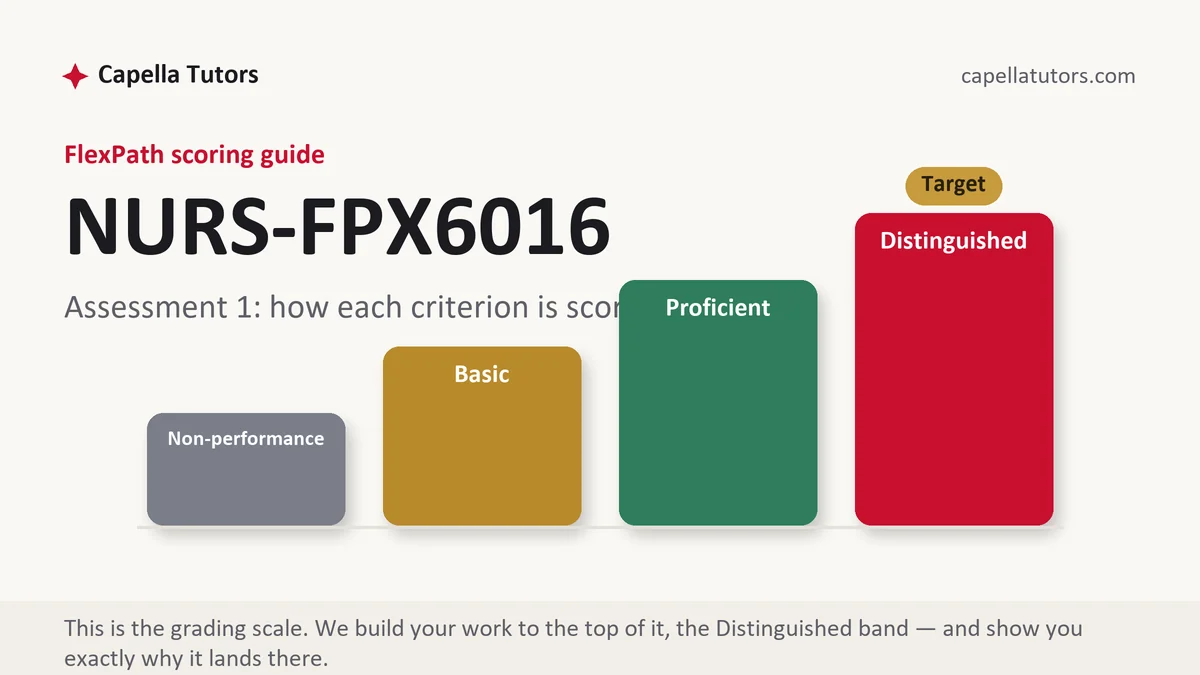
How NURS-FPX6016 Assessment 1 is scored
FlexPath places each criterion at one of four levels, and the language of those levels tells you precisely what kind of thinking is being bought:
| Level | What it means on an event analysis |
|---|---|
| Distinguished | Contributing conditions are sorted into categories, each tied to the failure by a stated mechanism, and the improvement response aims at those conditions rather than at vigilance. Nobody in the account is blamed, and nothing in it is vague. |
| Proficient | The sequence is accurate, the factors are identified, the response is reasonable. Correct work in which nothing has yet been weighed against anything else. |
| Basic | A narrative that ends at human error, usually with more attention paid to who was working than to what the system made easy. The most common landing spot in this course. |
| Non-performance | An element is missing rather than thin, most often the stakeholder implications or the evidence behind the proposed response. |
Graduate safety writing has a house style, and evaluators read for it. Incidence claims arrive with their source and their denominator, so a reader knows whether a rate came from a national surveillance program or from one hospital's chart review. Effect claims about a prevention practice arrive with the study design in front of them. And the difference between a statistically detectable improvement and one a unit would notice gets stated rather than assumed, because safety literature is full of the former.
The NURS-FPX6016 Assessment 1 method, step by step
-
Rebuild the guide as a skeleton and underline every verb
Quality improvement criteria are unusually literal about what they want done. Analyze means factors, plural, sorted, each connected to the outcome. Evaluate means a judgment with a reason attached. Recommend means a change somebody could be held to. Put one heading per criterion in the document, keep the top-level wording underneath, and check the verbs off in a final pass.
-
Choose an event whose failure can be measured
Delayed recognition of sepsis, a missed escalation, an incomplete transfer of information, a treatment that started outside its window: each has published incidence, an accepted prevention practice, and an outcome a quality department already tracks. Then de-identify without mercy. No unit name, no dates precise enough to locate the case, no clinical detail that would let a colleague recognize a patient or a coworker.
-
Write the timeline before you write a word of interpretation
Times, observations, actions, and communications in the order they happened, in language a stranger could follow, with no explanatory adjectives anywhere near them. Interpretation built on a muddled sequence never becomes persuasive, and evaluators can tell the difference between an account assembled forward and one reverse engineered from a conclusion.
-
Sort the contributing conditions into categories
Group them the way a review committee would: staffing and workload, equipment and technology, information flow and documentation, policy and training, physical environment. Then give each condition a mechanism sentence. A vital sign threshold that fires an alert into a screen nobody is watching during a shift change is a condition with a mechanism; understaffing on its own is a complaint.
-
Anchor the analysis in agency material and peer-reviewed work
Agency for Healthcare Research and Quality publications carry national rates and evaluated safety practices. Institute for Healthcare Improvement material supplies improvement method and change concepts. Joint Commission standards and national patient safety goals give you the compliance layer that turns a recommendation into an obligation. Around that spine, put peer-reviewed studies from CINAHL and PubMed, with Cochrane reviews where the intervention has been reviewed.
-
Attach a response to each condition, then grade yourself
Every condition you named needs a change aimed at it, and every change needs something that would move if it worked. Aim at forcing functions and defaults before you aim at education, because a reminder competes for attention and a default does not. Then self-score criterion by criterion with the guide open, and submit early in the week rather than late.
A structure that maps to the criteria
Word targets our tutors plan against for an event analysis, not Capella rules; widen any section your own guide loads more heavily.
| Section | What it must do | Guide |
|---|---|---|
| Event summary | What happened, the harm or the potential harm, and the published incidence of this failure type with its source. | ~250 words |
| Sequence of events | The de-identified timeline in neutral language, with the deviations from expected practice marked but not yet explained. | ~250 words |
| Contributing conditions | Factors grouped by category, each carrying a mechanism sentence that connects it to the outcome. | ~350 words |
| Implications for stakeholders | Consequences for the patient and family, the staff involved, the unit, and the organization, including regulatory exposure. | ~250 words |
| Improvement response | The changes aimed at those conditions, the model that structures them, and what would demonstrate the change happened. | ~300 words |
| References | Current APA, agency documents cited by publication year, peer-reviewed work retrieved through the Capella library. | as needed |
Annotated sample excerpt
An original model paragraph from our team, written at the register the top column describes. Take the moves and build your own version.
Three conditions in the information category made the delay available. The screening tool fired at a lactate threshold into a passive banner on the flowsheet, which is visible only while that flowsheet is open, and it opened twice in the eleven hours before escalation.1 The step-down transfer note carried the admitting diagnosis but not the two prior deteriorations recorded on the sending unit, because the summary template pulls the problem list rather than the event log.2 The unit's escalation policy names the rapid response criteria correctly and lives in a binder at the charge desk with no version in the electronic record, so at two in the morning the policy existed and could not be consulted.3
- 1A category announced, then a condition with its mechanism. The alert design is the finding, not the nurse's attention, and that distinction is what the analysis criterion pays for.
- 2Traces missing information to a template behavior. A fixable object, which means the later recommendation has somewhere concrete to aim.
- 3Names a policy that exists and cannot be reached. Availability rather than absence is the distinction that separates a systems analysis from a compliance complaint.
The full premium sample for your exact assessment, written fresh to your scoring guide and issue, is free to request. Study it, revise it into your own voice, and submit work you understand.
The five mistakes that cost Distinguished
- An analysis that stops at human error. No amount of planning afterward repairs it, because every recommendation built on that base aims at attention rather than at design.
- Factors listed without mechanisms. A bulleted set of conditions with no sentence connecting each to the outcome reads as a checklist rather than as reasoning.
- Interpretation smuggled into the timeline. Adjectives inside the sequence tell the evaluator the conclusion came first and the account was assembled to fit it.
- Incidence claims without a denominator or a source. An event described as common has been characterized, not quantified, and the criterion needs the second.
- Identifiable detail from a real case. A single locating fact converts a scoring problem into a professionalism problem, and it is entirely avoidable.
Pre-submission checklist
- Every incidence figure carries a source and a denominator in the same sentence
- The timeline is neutral, de-identified, and free of explanatory language
- Contributing conditions are grouped by category, each with a mechanism sentence
- Stakeholder implications cover patient, staff, unit, and organization
- Each recommended change points at a condition already named in the analysis
- Agency and standards sources cited by publication year and verified as current
Want the event analysis done with backup?
Send the scoring guide and the event type you plan to analyze, real or composite. Our team of eight, including a research analyst and two QA reviewers, returns a premium original sample written to the Distinguished column in 24 to 48 hours, de-identified properly, with revisions until the guide is satisfied.