This manual is for NHS-FPX5004 Assessment 4, start to submission. You can hand this one off: a premium original sample, written in the reflective register the criteria actually reward, arrives inside 24 to 48 hours with revisions free until the guide is satisfied. Writing it yourself is the better learning, and the method is below. Assessment 4 of NHS-FPX5004 usually closes the course by turning the analytic tools on you. The deliverable is commonly a reflective self-assessment covering three strands at once: how you lead, how you collaborate, and how you behave when the ethical answer costs you something. Your scoring guide decides the length and whether a framework or an instrument has to anchor the reflection. The trap is one every evaluator knows: reflection written as autobiography, warm and unfalsifiable, with no incident specific enough to be wrong about. Your courseroom may print this as NHS FPX 5004 Assessment 4 or NHS5004 Assessment 4; it is the same deliverable, and NHS-FPX5004 Assessment 4 is what this manual walks through.
One honesty note before the manual: Capella revises courses and scoring guides over time, so always write to the exact scoring guide attached to your assessment in the courseroom. The course identity above is verified on capella.edu; the method and structure below are our tutors' approach to it, not Capella's official rubric text.
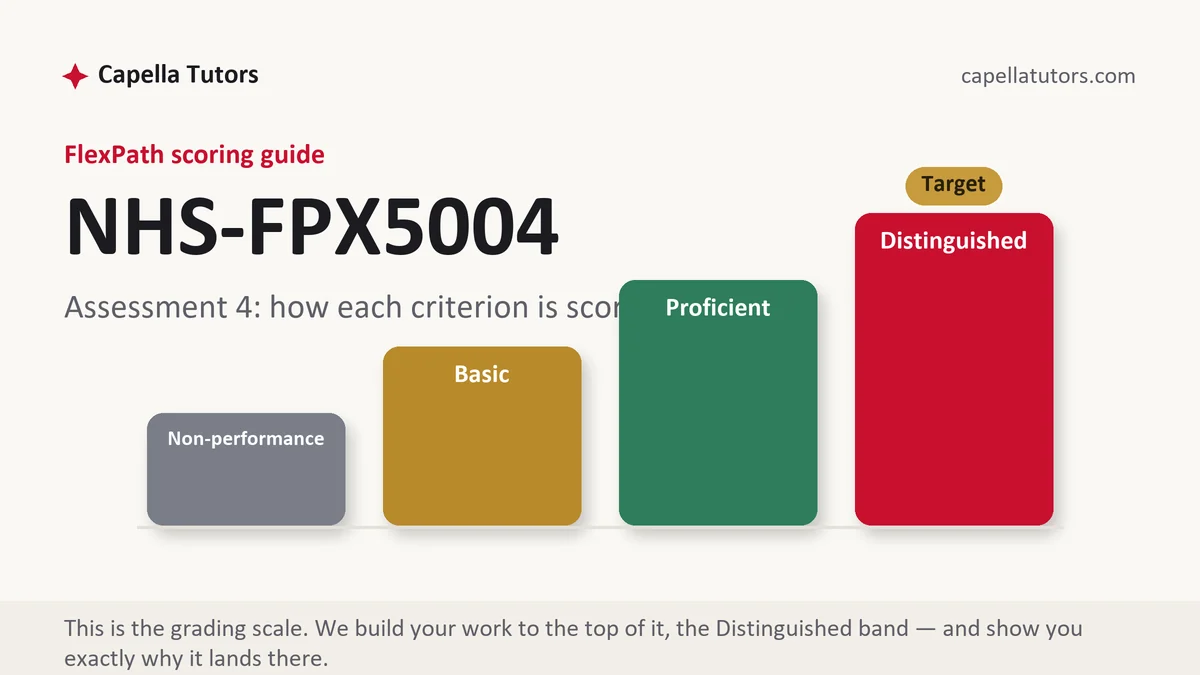
How NHS-FPX5004 Assessment 4 is scored
Reflection is graded here the same way argument is, criterion by criterion against four levels, with no points and no partial credit for sincerity:
| Level | What it means on a reflective self-assessment |
|---|---|
| Distinguished | One incident carried through the whole paper, appraised against named competencies and a professional ethics standard, with a shortfall admitted and a development plan that has dates and measures inside it. Each criterion adds its own requirement, and your scoring guide is the authority on it. |
| Proficient | Honest reflection with sources and a plan, but the incident stays general and the ethical analysis stays at the level of principle. |
| Basic | A career summary with feelings attached. Every strength claimed, no shortfall named, and a plan made of intentions. |
| Non-performance | A required strand is missing, usually the ethics analysis or the development plan. The reflective register does not exempt a criterion from being answered. |
The same rules that govern the analytic assessments govern this one: a claim needs evidence, and in a self-assessment the evidence is a specific thing you did. The strongest papers we see in this course choose an incident the writer is not proud of, name the competency it exposed, and treat the shortfall as a finding rather than as a confession. That register is also what the practicum courses will expect of you later, so it is worth building deliberately now.
The NHS-FPX5004 Assessment 4 method, step by step
-
Choose one incident, and choose it against yourself
Pick a single episode you can describe in four sentences, de-identified, in which your own action or inaction changed the outcome. A recurring problem you decided not to escalate works better than a success, because the analysis has somewhere to go. Then hold that incident for the entire paper; a fresh example in every section is how reflections lose the coherence criterion.
-
Appraise your leadership against a named standard
Measure yourself against something citable rather than against a feeling: the AONL nurse leader competencies, the IPEC domains for interprofessional practice, or a validated instrument if your guide calls for one. Name the domain, paraphrase what it expects, then say plainly where your conduct in that incident met it and where it did not. Cite the instrument properly, version included, and if you used a self-scored inventory state what it measures and what it cannot.
-
Analyze the collaboration you were part of
Ask what the people around you needed from you and did not get: information, a decision, cover, or the willingness to name a problem out loud. Collaboration criteria are scored on your effect on a team rather than on your enthusiasm for teamwork, so write about the effect. One sentence describing how a colleague's shift went because of your choice outperforms a paragraph of principle.
-
Do the ethics with a standard, not a sentiment
Anchor the ethical strand in the ANA Code of Ethics for Nurses and, where it applies, in the obligations your state practice act imposes, then reason from the provision to your conduct. Name the competing goods honestly: loyalty to a colleague set against the duty to patients and to the rest of the team, which is what most workplace ethics questions actually are. Declining to raise a conflict is itself a choice with consequences, and saying so is the analysis the criterion pays for.
-
Write a development plan with dates and measures
Two or three objectives, each traced to a shortfall you named, each carrying an action, a resource, a date, and a way somebody else could tell it happened. Completing a course is an action; stating a difficult expectation to a peer within one shift of noticing it is a measure. Undated intentions are the signature of a Basic plan in every FlexPath course that asks for one.
-
Self-score, then submit early in the week
Walk the paper through the guide criterion by criterion, marking each level yourself, and confirm that each criterion has its own section rather than being spread thinly through a narrative. Rework anything short of the top column, then submit at the start of the week so a two-day evaluation window does not cost you a weekend.
A structure that maps to the criteria
The word targets below are our planning figures for a reflective self-assessment of this kind, not Capella rules. Your scoring guide decides the length and the required components.
| Section | What it must do | Guide |
|---|---|---|
| Introduction and the incident | The situation in four sentences, de-identified, and what this paper sets out to appraise. | ~200 words |
| Leadership self-assessment | Your conduct measured against named competencies, with the domains cited and the gap admitted. | ~350 words |
| Collaboration self-assessment | The effect your choices had on the team, with the specific consequence stated. | ~300 words |
| Ethical analysis | The competing obligations, the code provision that governs, and the reasoning between them. | ~350 words |
| Development plan | Objectives traced to shortfalls, each with an action, a resource, a date, and a measure. | ~250 words |
| Conclusion and APA layer | What the appraisal concluded, plus the mechanics the criteria score. | ~150 words |
Annotated sample excerpt
A model excerpt from our team, in the register the top column describes. Read it for the moves, then appraise your own practice.
For six weeks I knew that a colleague was arriving fifteen to twenty minutes late to relieve the night shift, and for six weeks I covered the gap myself rather than raising it.1 I told myself this was loyalty, and it was partly that. It was also the cheaper choice for me, because escalating would have cost a working relationship I depended on while covering cost only my time.2 The Code of Ethics for Nurses locates the obligation clearly enough that my framing does not survive it: the duty runs to patients and to the profession before it runs to a colleague's comfort, and the night nurse whose handoff was compressed every morning had no idea a choice was being made on her behalf.3
- 1Opens on the writer's own inaction with a duration and a magnitude attached. A self-assessment criterion needs an appraisable fact, and six weeks is one.
- 2Names the self-interested reading alongside the flattering one instead of choosing between them. This is the sentence that moves an ethics criterion off Basic, because it shows a writer who can audit a motive.
- 3Reasons from the governing professional standard to the conduct, then identifies the third party the original framing left out. The code is used as authority here, not as decoration at the end of a paragraph.
The full premium sample for your exact assessment, written fresh to your scoring guide and issue, is free to request. Study it, revise it into your own voice, and submit work you understand.
The five mistakes that cost Distinguished
- The autobiography. A career narrative with adjectives attached gives an evaluator nothing to score. One incident, appraised, outperforms fifteen years summarized.
- Strengths only. A self-assessment that finds no shortfall has answered a different question than the one in the guide, and the omission is visible on the first read.
- Ethics as sentiment. Patient advocacy matters is not an ethical analysis. A named provision, two competing obligations, and reasoning between them is one.
- A plan without dates. Intentions to grow, communicate better, and keep learning are unmeasurable, and a development criterion will hold them at Basic.
- Reflection used to dodge the register. First person is invited here, informality is not. Contractions, unsupported generalizations, and paragraphs with no citation still cost you on the communication criteria.
Pre-submission checklist
- One de-identified incident carried through every section of the paper
- Leadership appraised against named, cited competencies rather than against adjectives
- A collaboration effect stated as a consequence somebody else experienced
- An ethics analysis anchored in a professional code provision, with the competing goods named
- A development plan whose objectives each carry an action, a date, and an external measure
- First person used deliberately, master's register held throughout, APA 7 checked both directions
Want the self-assessment written with you?
Tell us the incident you are willing to appraise and send the scoring guide. A premium original sample comes back in 24 to 48 hours, written in the reflective register the criteria reward, reviewed by two QA readers, and revised free until every criterion clears.